Ephesus Ancient City
NATURAL AND CULTURAL HERITAGE Archaeological Heritage Ancient City COUNTRIES AND TERRITORIES Türkiye
(Ephesus, Selçuk, Izmir, Türkiye)
-
2026

Ephesus is located in the Selçuk district of İzmir Province, on the Aegean coast of Türkiye, approximately 70 km south of İzmir, in the Küçük Menderes (Kaystros) Delta, slightly north of the island of Samos. In ancient Greek times, it was one of the principal centres of the region of Ionia.
Some sources suggest that the name "Ephesus" derives from the name of an Amazon, while more recent studies suggest that the city's name is associated with Apasa, the capital of the country of Arzawa mentioned in Hittite sources, and that this name later became Ephesos.
According to Strabo, the earliest inhabitants of the region consisted of Carians and Leleges. Early information about the city was provided by travellers and researchers such as Chandler, Fellows, Leake, Texier, Rayet, Thomas, and Frothingham. In this region inhabited by the Leleges and Carians, Androklos, one of the sons of the legendary Athenian king Kodros, is said to have founded the city of Ephesus. The city was colonised no later than the tenth century BC. When the Greeks arrived, they encountered the worship of an Anatolian mother goddess, as was common throughout Anatolia. Through a process of religious syncretism, this indigenous goddess came to be identified with Artemis, and the two traditions were worshipped at the same sacred site. The first settlement is thought to have been established at the harbour of Koressos, approximately 1,200 metres west of the Artemision. Ephesus was initially ruled by kings, followed by an aristocratic oligarchy and later by tyrants. Ephesus was attacked by the Cimmerians in the first half of the seventh century BC. Towards the middle of the sixth century BC, the city came under Lydian rule. The columnae caelatae (relief-decorated columns) donated by Croesus to the Temple of Artemis indicate a close relationship between Lydia and Ephesus. The Ephesians were subsequently forced to abandon their settlement at the harbour of Koressos and settle near the Artemision. During the Hellenistic period, Ephesus came under Seleucid rule and, after 190 BC, became part of the Kingdom of Pergamon. In 133 BC, together with the Kingdom of Pergamon, Ephesus came under Roman rule. Beginning in the Augustan period, the city experienced one of its most prosperous periods for approximately two centuries. According to Aelius Aristides, Ephesus was one of the wealthiest commercial centres of its time and an important financial centre for western Anatolia. The Ephesians regarded their city as the metropolis of Asia, or Ionia. Ephesus experienced another period of prosperity extending into the reign of Justinian I (AD 527–565). With the rapid spread of Christianity in the city, numerous important structures were constructed. The fortifications on Ayasuluk Hill and the Basilica of St. John were among the major structures associated with the Byzantine period. The city experienced its final period of prosperity in the fourteenth century under the Aydınoğulları Beylik.
Ephesus is an important settlement that bears evidence of the Neolithic and Chalcolithic periods, the Bronze and Iron Ages, the Archaic and Classical periods, the Hellenistic period, and the Roman, Byzantine, Beylik, Ottoman, and Republican periods.
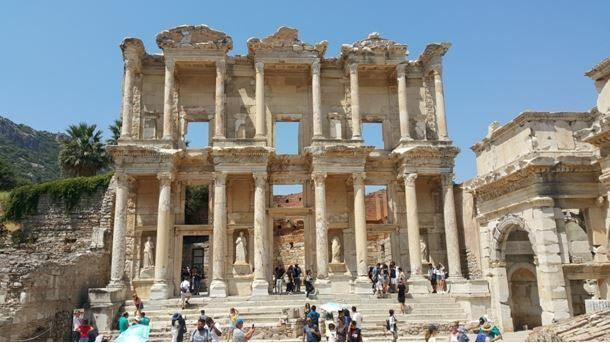
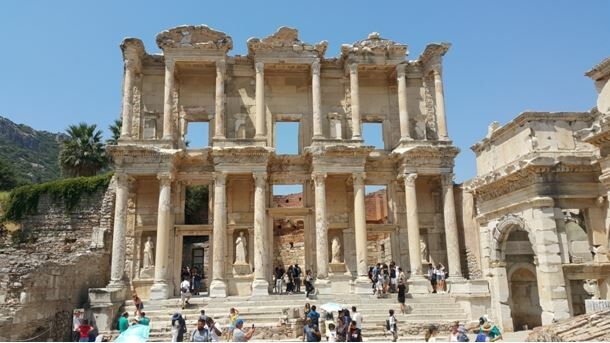
The principal structures and archaeological remains within the ancient city of Ephesus include streets such as Marble Street, Curetes Street, the Arcadiane (Harbour Street), Theatre Street, and the Stoa of Damianus; city walls, including the Hellenistic Walls (Lysimachian Walls) on Bülbül and Panayır Mountains and the Late Antique City Walls (Byzantine Walls); city gates, including the Harbour Gates, Magnesia Gate, and Koressos Gate; and inner-city gate structures, including Hadrian's Gate, the Heracles Gate, and the south, west, and north gates of the Tetragonos Agora. Public buildings include the Tetragonos Agora, Great Theatre, Library of Celsus, Theatre Gymnasium, State Agora, Prytaneion, Bouleuterion (Odeon), Basilica Stoa, Upper Gymnasium (State Agora Baths), Baths of Varius and Latrine, Stadium, Vedius Gymnasium, Harbour Baths and Stoa of Verulanus, Church of Mary and Episcopium, and Byzantine Palace. Temples, monuments, and residential structures include the Olympieion, Temple of Hadrian, Serapeion, Temple and Altar of the Emperors, Terrace of Domitian, Monument of Memmius, Octagon, and Terrace Houses.
The archaeological remains outside the city walls of ancient Ephesus include the Temple of Artemis (Artemision), the ancient harbour and canal of Ephesus, Ayasuluk Hill and its city walls, the Basilica of St. John, the Chapel and Treasury (Skeuophylakion), the Byzantine Aqueduct, Ayasuluk Castle, the İsa Bey Mosque, the İsa Bey Bath, necropolises and sacred areas, the Cemetery of the Seven Sleepers, the rock sanctuary associated with the Mother Goddess, Zeus, and Apollo, and the House of the Virgin Mary.
The remains unearthed in Selçuk, Ephesus, Ayasuluk, and their surroundings demonstrate the city's importance during the Byzantine period. During the Byzantine era, Ephesus gained widespread importance as a Christian pilgrimage centre associated particularly with St. John and the Seven Sleepers. The House of the Virgin Mary became an important Christian pilgrimage site in the nineteenth century.
The first excavations at Ephesus were carried out in 1863 by the British architect and archaeologist John Turtle Wood, whose investigations eventually led to the discovery of the Temple of Artemis in 1869. Austrian archaeological research at Ephesus began in 1895. Following interruptions associated with the two World Wars and other circumstances, excavations and research continued under successive directors and archaeological teams of the Austrian Archaeological Institute, including Josef Keil, Franz Miltner, Fritz Eichler, Hermann Vetters, Gerhard Langmann, Stefan Karwiese, Friedrich Krinzinger, and Sabine Ladstätter. Following the death of Sabine Ladstätter in 2024, Prof. Dr. Bahadır Duman of Pamukkale University was appointed coordinating excavation director.
Some of the artefacts unearthed during the early excavations were taken to Vienna and are now displayed in the Ephesos Museum. Since 1906, however, finds from the excavations have remained in Türkiye. Artefacts from Ephesus are exhibited primarily in the Ephesus Museum in Selçuk, while related collections are also held by other archaeological museums in Türkiye.
Ephesus, inscribed on the UNESCO World Heritage List, is one of Türkiye's most important archaeological and cultural tourism destinations and receives approximately two million visitors annually.
References
Akurgal, E. (2003). Anatolian civilizations. Net Turistik Publications; Ministry of Culture and Tourism, General Directorate of Cultural Heritage and Museums. (2020). Ephesus management plan. http://kulturvarliklari.gov.tr/Eklenti/57319,efes-yonetim-planipdf.pdf?0 (Accessed July 12, 2020); Ladstätter, S., & Daim, F. (2011). Ephesus in the Byzantine period. Ege Publications; Mercangöz, Z. (1997). Christianity in Ephesus and its surroundings: Ephesus and Ayasuluk in the medieval Christian period. In 1st International Selçuk Symposium from Past to Present (pp. 51–62). Selçuk Municipality Cultural Publications; Strabo. (2000). Ancient geography of Anatolia (Geographika: XII–XIII–XIV) (A. Pekman, Trans.). Archaeology and Art Publications.
See Also
Akurgal , E. (2003). Anatolian Civilizations , Istanbul: Net Turistik Publications.
See Also
Map