Hotel Room
ACCOMMODATION AND HOSPITALITY ESTABLISHMENTS Hotels Hotel Industry and Classification
-
2026

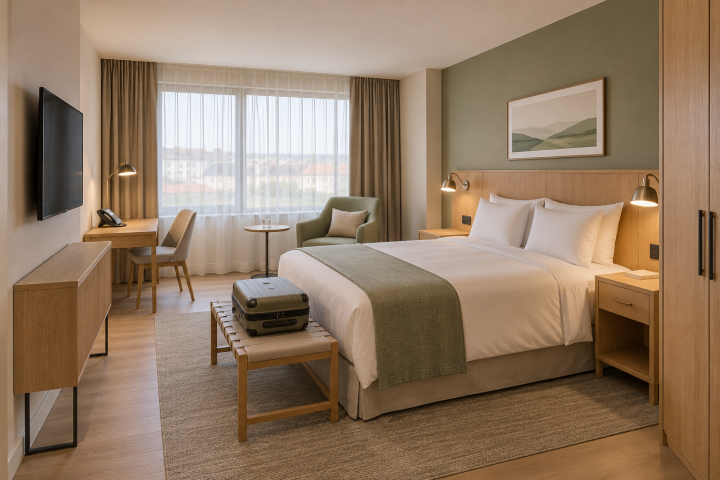
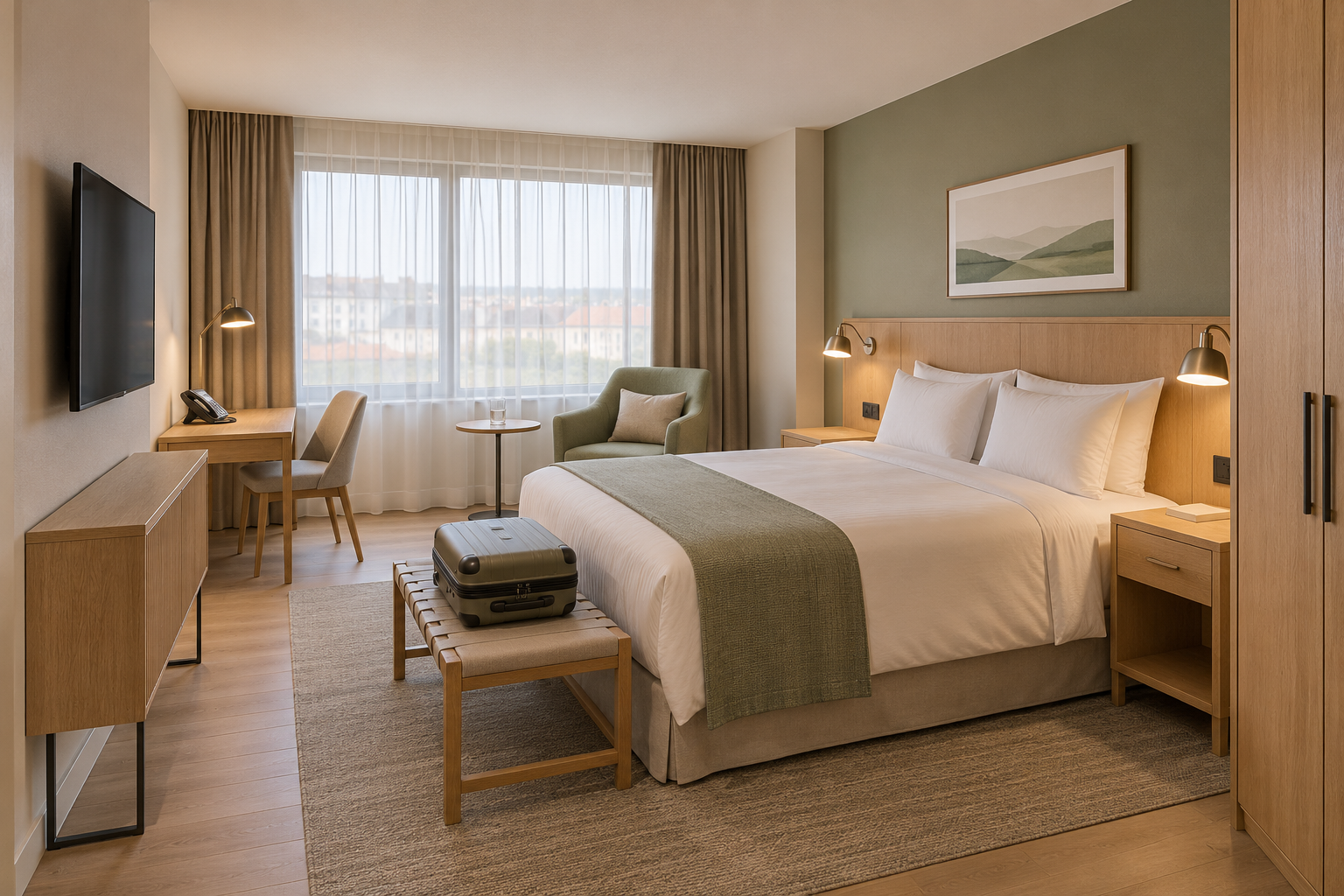
A hotel room is a central component of hotel operations and the guest experience. It usually comprises a bedroom and associated facilities, although a suite may contain several interconnected spaces rented as a single unit. In accommodation statistics, the defining characteristic is that the room or group of rooms constitutes an indivisible rental unit. This statistical understanding is broader than everyday usage and may encompass accommodation units outside conventional hotels.
The room should also be distinguished from the wider accommodation service. Hotels provide furnished guest rooms or suites alongside services such as housekeeping and bed-making. Depending on the establishment, additional facilities may include restaurants, parking, laundry services, swimming pools, fitness centres and meeting spaces. These services contribute to the overall stay but are not necessarily features of the individual room.
The functions of a hotel room extend beyond sleeping. It may serve as a workplace, a setting for relaxation, a temporary retreat or a shared space for families and travelling companions. Rooms differ in size, layout, furnishings, equipment, accessibility and level of comfort. Their contribution to the guest experience depends on both their physical characteristics and how effectively they accommodate individual activities and expectations. Cleanliness, bed comfort, lighting, temperature, sound insulation and ease of use can all influence perceptions of the stay.
From a management perspective, rooms are central to reservations, pricing, allocation and service planning. Their availability and condition affect housekeeping schedules, maintenance requirements and the hotel’s ability to accommodate guests. Room rates may vary according to demand, seasonality, room category, booking conditions and the services included. Revenue management therefore involves more than matching prices to physical attributes: it also requires decisions about availability, market segments and the timing of bookings. Performance is commonly assessed through room occupancy, average daily rate and revenue per available room.
For guests, the room becomes a temporary private environment within a commercially managed establishment. Its meaning depends on the purpose and duration of the trip, previous experiences, personal preferences and travelling companions. A business traveller may prioritise reliable internet access, suitable working furniture, effective lighting and quiet surroundings. A leisure traveller may place greater emphasis on views, interior design or opportunities to relax. These preferences overlap, however, and should not be treated as fixed characteristics of separate traveller categories. Good sleep, comfort and cleanliness can matter across different travel purposes.
Privacy, security and a sense of control are also important dimensions of the experience. Being able to regulate lighting and temperature, organise belongings and manage interruptions can help guests establish a temporary personal space. Expectations may vary with cultural background, familiarity with hotel accommodation and individual circumstances. Consequently, the same room may be experienced as comfortable and convenient by one guest but restrictive or unsuitable by another.
Rooms can also acquire cultural and historical significance through their association with notable guests. Connections with writers such as Ernest Hemingway and Agatha Christie may contribute to literary tourism, commemorative displays and hotel identity. Associations with historical figures, including the Finnish military leader and president Carl Gustaf Emil Mannerheim, belong to a related heritage context. In literature, hotel rooms can function as settings for encounters, solitude, anonymity, conflict or personal transformation, giving them symbolic meanings beyond their practical use.
Hospitality research has examined room attributes, pricing, service quality, satisfaction and guest experiences extensively. A more focused area of inquiry concerns how these elements combine to shape the meaning of the room as a temporary lived space. Studying that relationship can improve understanding of how guests use accommodation and how hotel design and management respond to differing needs. The room can thus be examined simultaneously as a commercial accommodation unit, a personal environment and, in some cases, a cultural resource.
References
Cetin, G., & Walls, A. (2016). Understanding the customer experiences from the perspective of guests and hotel managers: Empirical findings from luxury hotels in Istanbul, Turkey. Journal of Hospitality Marketing & Management, 25(4), 395–424. https://doi.org/10.1080/19368623.2015.1034395; Chattopadhyay, M., & Mitra, S. K. (2019). Determinants of revenue per available room: Influential roles of average daily rate, demand, seasonality and yearly trend. International Journal of Hospitality Management, 77, 573–582. https://doi.org/10.1016/j.ijhm.2018.09.001; Eurostat. (n.d.). Hotels and similar accommodation. In Statistics explained. Retrieved November 5, 2026, from https://ec.europa.eu/eurostat/statistics-explained/index.php?title=Glossary:Hotels_and_similar_accommodation; Ineson, E. M., Čomić, D., & Kalmić, L. (2019). Towards a hierarchy of hotel guests’ in-room needs. International Journal of Contemporary Hospitality Management, 31(12), 4401–4418. https://doi.org/10.1108/IJCHM-01-2019-0061; Kim, D., & Park, B. J. R. (2017). The moderating role of context in the effects of choice attributes on hotel choice: A discrete choice experiment. Tourism Management, 63, 439–451. https://doi.org/10.1016/j.tourman.2017.07.014; Lvov, A. (2025). More than a bed: Exploring the diverse roles of the hotel room. Matkailututkimus, 21(1), 15–22. https://doi.org/10.33351/mt.155443; Lvov, A. (2026). Literary hotel room. In R. Baleiro, G. Capecchi, & J. Arcos-Pumarola (Eds.), E-dictionary of literary tourism. University for Foreigners of Perugia. https://doi.org/10.34623/zdg2-hn59; Lvov, A., & Komppula, R. (2024). The essence of the hotel room in the hotel business – the hotel managers’ perspective. European Journal of Tourism Research, 36, Article 3609. https://doi.org/10.54055/ejtr.v36i.3158; Lvov, A., & Konu, H. (2025). The role of a hotel room within leisure and work-related travel experiences – perspectives of traveller types. European Journal of Tourism Research, 41, Article 4111. https://doi.org/10.54055/ejtr.v41i.4049; Oxford University Press. (n.d.). Room. In Oxford advanced learner’s dictionary. Retrieved November 5, 2026, from https://www.oxfordlearnersdictionaries.com/definition/english/room_1; Rhee, H. T., & Yang, S. B. (2015). Does hotel attribute importance differ by hotel? Focusing on hotel star-classifications and customers’ overall ratings. Computers in Human Behavior, 50, 576–587. https://doi.org/10.1016/j.chb.2015.02.069; Statistics Finland. (n.d.). Hotel room. In Concepts. Retrieved November 5, 2026, from https://stat.fi/meta/kas/hotellihuone_en.html; Unger, O., Uriely, N., & Fuchs, G. (2016). The business travel experience. Annals of Tourism Research, 61, 142–156. https://doi.org/10.1016/j.annals.2016.10.003.