Alhambra and Generalife (Granada, Spain)
UNESCO World Heritage Destination UNESCO World Heritage Site COUNTRIES AND TERRITORIES Spain
Granada, Spain
-
2026

The Alhambra and Generalife occupy an elevated setting overlooking Granada in Andalusia, southern Spain. The Alhambra stands on the Sabika hill, opposite the Albaicín across the Darro valley, while the Generalife lies to its east. Together, they preserve complementary aspects of Nasrid court life: a fortified urban complex accommodating royal, administrative, residential, and military functions, and a country estate combining royal accommodation with gardens and agricultural production.
Although buildings on the Sabika hill are documented from the ninth century, the development of the Nasrid palace-city began under Muhammad I following his establishment in Granada in 1238. Successive rulers enlarged its fortifications, residences, and infrastructure. Particularly important building campaigns took place during the fourteenth century under Yusuf I and Muhammad V. Yusuf I developed the Comares Palace, while Muhammad V commissioned the Palace of the Lions and transformed other sections of the complex.
The principal surviving components include the Alcazaba fortress, the Nasrid Palaces, the Partal area, and later Christian buildings. Walls, towers, and monumental gateways defined the fortified enclosure. Within the palaces, courtyards organize movement between reception halls and residential spaces. The Palace of the Lions is distinguished by its central fountain, supported by twelve marble lions. A poem by the court poet Ibn Zamrak, carved around the fountain’s basin, praises the ruler and the fountain itself.
Architectural decoration includes carved plaster, geometric ceramic mosaics, wooden ceilings, and Arabic inscriptions. The inscriptions combine religious texts, poetry, and expressions of dynastic authority, including the frequently repeated Nasrid motto conventionally translated as “There is no victor but God.” Elaborate muqarnas, formed from tiers of small projecting cells, characterize several interiors, notably the domes of the Hall of the Two Sisters and the Hall of the Abencerrages.
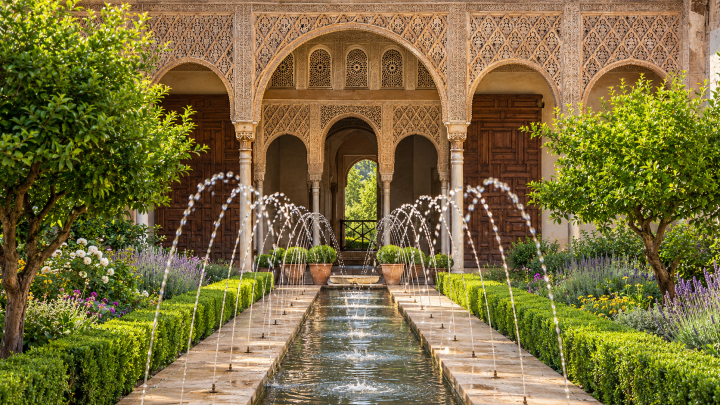
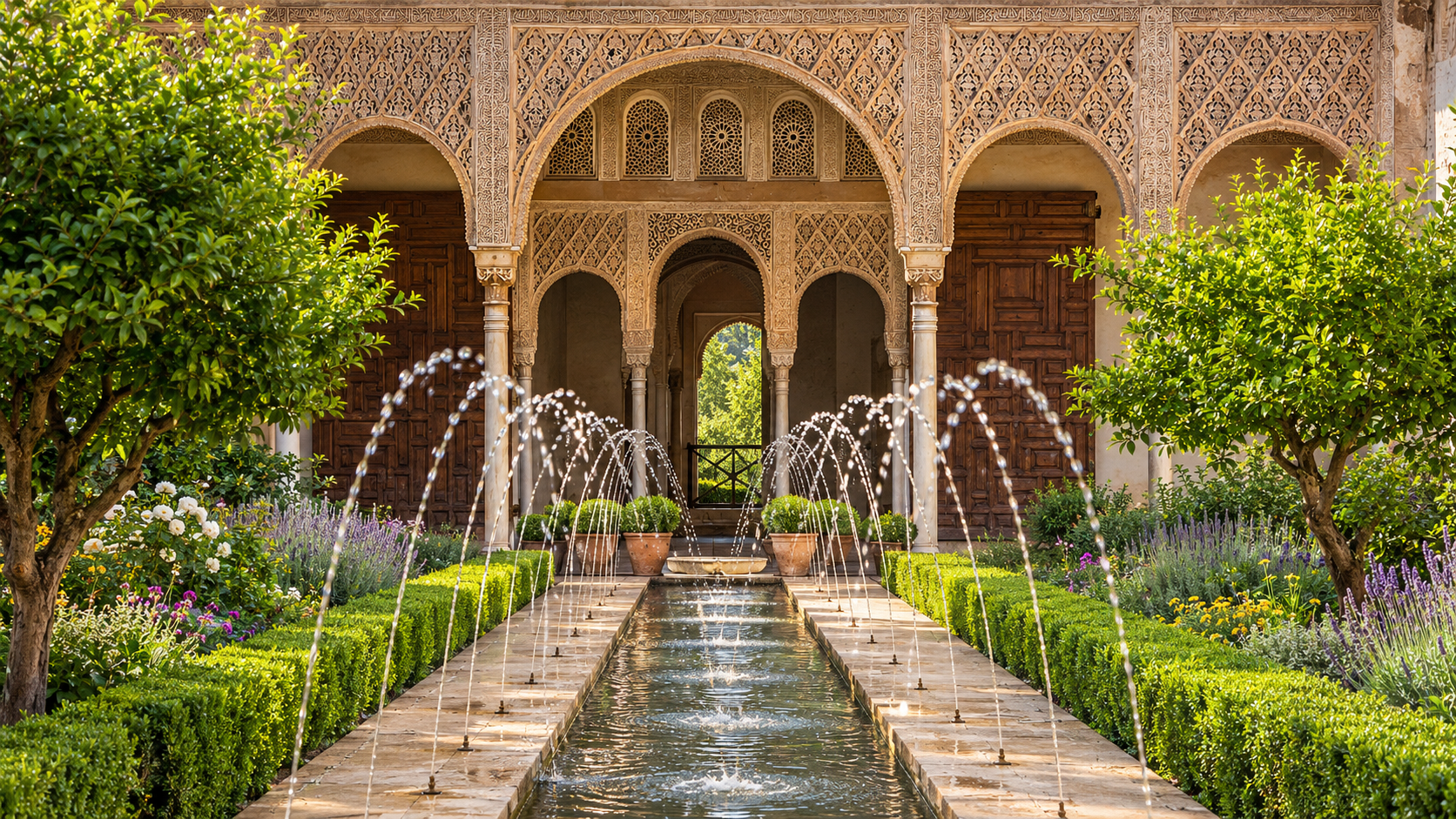
Developed during the thirteenth and fourteenth centuries, the Generalife provided a retreat from court affairs while retaining productive orchards and cultivated land. Its best-known spaces include the Patio de la Acequia and the Water Stairway. The Acequia Real diverted water from the Darro River through a network supplying the estate and the Alhambra. Water supported irrigation and domestic needs while shaping the appearance, sound, and experience of the gardens. Their present arrangement reflects successive alterations and conservation campaigns, including substantial interventions during the twentieth century.
Following Granada’s surrender to the Catholic Monarchs in 1492, the Alhambra became a residence of the Spanish Crown. Existing buildings were repaired and adapted, and new religious and royal structures were introduced. Charles V commissioned a Renaissance palace designed by Pedro Machuca, with construction beginning around 1527. Its square plan encloses a circular courtyard with two levels of colonnades. Completed through later interventions, the building now accommodates the Alhambra Museum and Granada’s Museum of Fine Arts.
Periods of neglect affected the complex during the eighteenth and early nineteenth centuries. Retreating French forces damaged parts of the fortifications with explosives in 1812. Nineteenth-century writers and artists subsequently increased its international visibility. Washington Irving stayed at the Alhambra in 1829, and his Tales of the Alhambra, first published in 1832, became particularly influential in shaping its Romantic image.
Restoration developed through different approaches. Members of the Contreras family undertook extensive nineteenth-century work, frequently seeking to recreate decorative splendor. Leopoldo Torres Balbás, responsible for conservation between 1923 and 1936, placed greater emphasis on historical investigation, surviving fabric, and respect for the monument’s successive historical layers. The Alhambra was declared a National Monument in 1870. UNESCO inscribed the Alhambra and Generalife in 1984 and extended the property in 1994 to include the Albaicín, under the title “Alhambra, Generalife and Albayzín, Granada.”
The complex is managed by the Patronato de la Alhambra y Generalife within the Andalusian regional administration. Visitor management combines conservation requirements with controlled admission; entry to the Nasrid Palaces is restricted to the time specified on each ticket. Day visits and selected evening visits are available, with closures on 25 December and 1 January. Regional government figures recorded approximately 2.73 million visits in 2025, demonstrating the monument’s importance within Granada’s cultural tourism economy and the continuing need to manage visitor pressure.
References
Bermúdez López, J. (2010). The Alhambra and the Generalife: Official guide. Patronato de la Alhambra y Generalife; Grabar, O. (1978). The Alhambra. Harvard University Press; Irwin, R. (2004). The Alhambra. Profile Books; Malpica Cuello, A. (2002). La Alhambra de Granada: Un estudio arqueológico. Universidad de Granada; Torres Balbás, L. (1953). La Alhambra y el Generalife de Granada. Plus Ultra; UNESCO World Heritage Centre. (n.d.). Alhambra, Generalife and Albayzín, Granada. https://whc.unesco.org/en/list/314. UNESCO World Heritage Centre
See Also:
See Also
Map