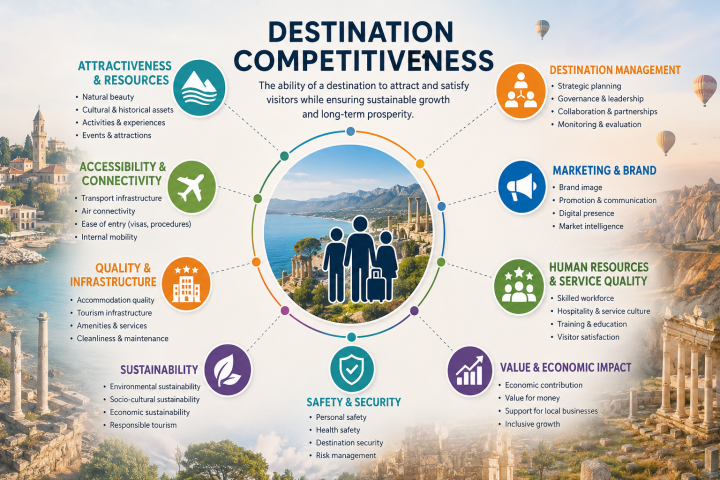
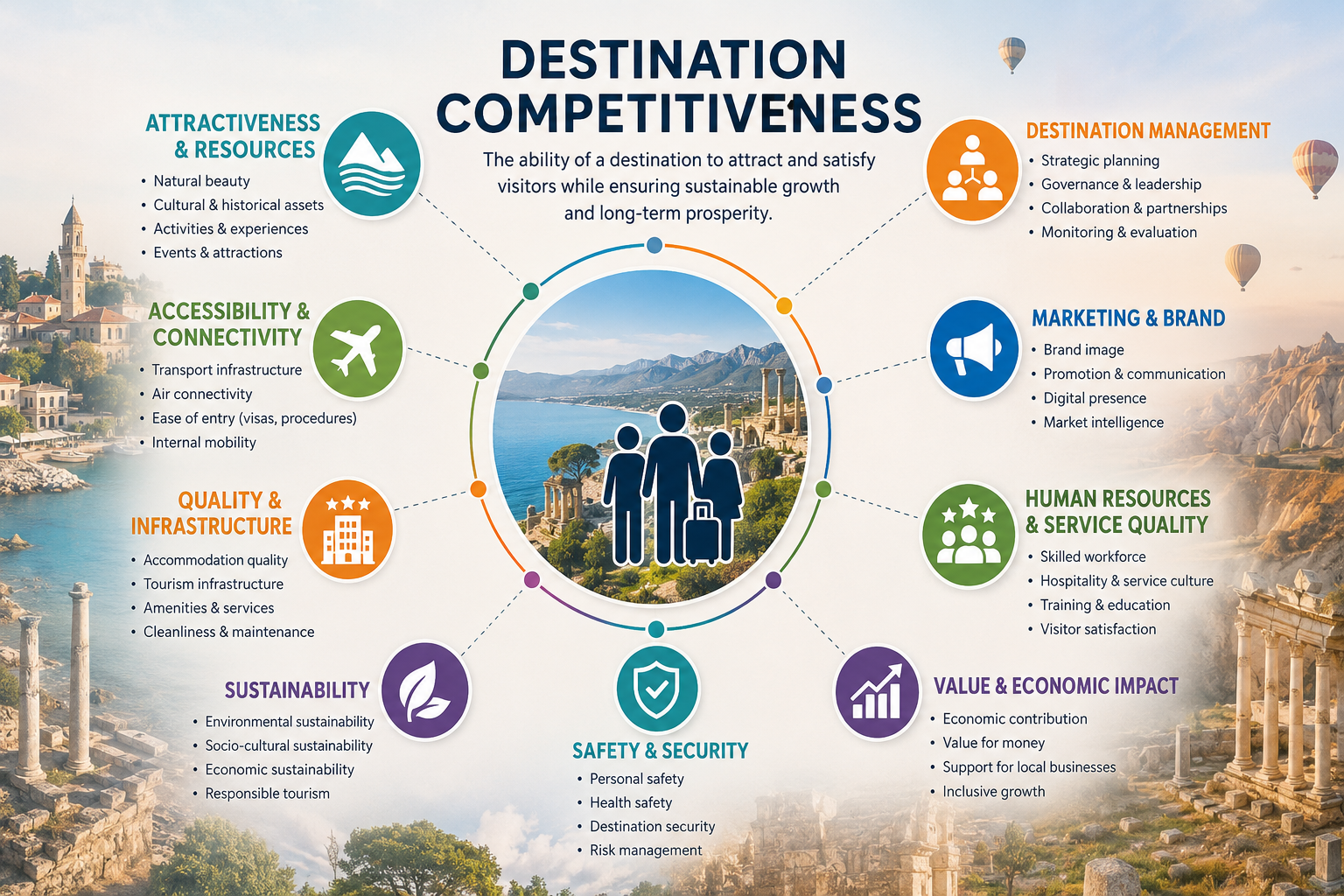
Destination Competitiveness
Destination Management and Development Destination Branding
-
2026

Destinations that stand out in tourists' minds are those of which potential visitors are aware and that they have, to some extent, a desire to visit. A destination that ranks first among the most prominent places is highly likely to become the first choice for a trip. Therefore, destinations compete with one another to be included in the consideration set of potential visitors. Destinations are competitive to the extent that they can attract potential visitors and satisfy them. Although destinations primarily compete for economic reasons by seeking to attract tourist spending, economic performance is only one dimension of tourism competitiveness. Owing to the unique nature of tourism, a destination's ability to compete also depends on its social, cultural, political, technological, and environmental strengths. Competitive destinations not only achieve increases in visitor numbers and tourism revenues but also make positive contributions to sectors associated with tourism.
The concept of destination competitiveness is related to a destination's capabilities, such as its attractiveness, economic performance, visitor satisfaction with the destination experience, and sustainability. From this perspective, D'Hauteserre defines destination competitiveness as a destination's ability to better protect, sustain, and, over time, enhance its market position and market share compared with its competitors. Dwyer and Kim, on the other hand, define it as a destination's ability to provide the goods and services associated with the tourism experience that tourists consider important more effectively than competing destinations. The primary objective of destination competitiveness has also been identified as improving the standard of living of the local population, and this objective has influenced the definition of the concept. Crouch and Ritchie, among the first scholars to define the concept, describe destination competitiveness as "the ability to increase visitor numbers and tourism revenue by offering satisfying and unforgettable experiences, while enhancing the well-being of the local community and ensuring the conservation of the destination's natural resources for future generations," thereby emphasising this dimension of the concept.
Natural resources are key factors that give one destination an advantage over another and provide a competitive edge. Preserving a destination's cultural and natural integrity, ecological balance, and biodiversity enables the region to maintain its attractiveness over the long term, thereby allowing the destination to retain its competitive advantage. Destination competitiveness is based on a wide range of factors influenced not only by supply and demand but also by the destination's external environment. Ultimately, the competitiveness of destinations depends on their ability to maximise performance across each of these dimensions. For destinations seeking to succeed in a competitive environment, four fundamental principles have been recommended as a roadmap: (1) prioritising the environment, (2) making tourism the leading sector, (3) strengthening distribution channels in the market, and (4) building a dynamic private sector.
References
Akkuş, G. (2016). Destinasyon rekabetçiliği için deneyimsel turizm: Turist perspektifinden bir değerlendirme [Experiential tourism for destination competitiveness: An evaluation from the perspective of tourists] (Yayımlanmamış doktora tezi). Atatürk Üniversitesi; Buhalis, D. (2000). Marketing the competitive destination of the future. Tourism Management, 21(1), 97–116; Dwyer, L., & Kim, C. (2003). Destination competitiveness: Determinants and indicators. Current Issues in Tourism, 6(5), 369–414; Kozak, M. (1999). Destination competitiveness measurement: Analysis of effective factors and indicators. European Regional Science Association (ERSA) Conference Papers, 289.
See Also
Ritchie, J. R. B. ve Crouch, G. I. (2003). The Competitive Destination: A Sustainable Tourism Perspective. UK: CABI Publishing.