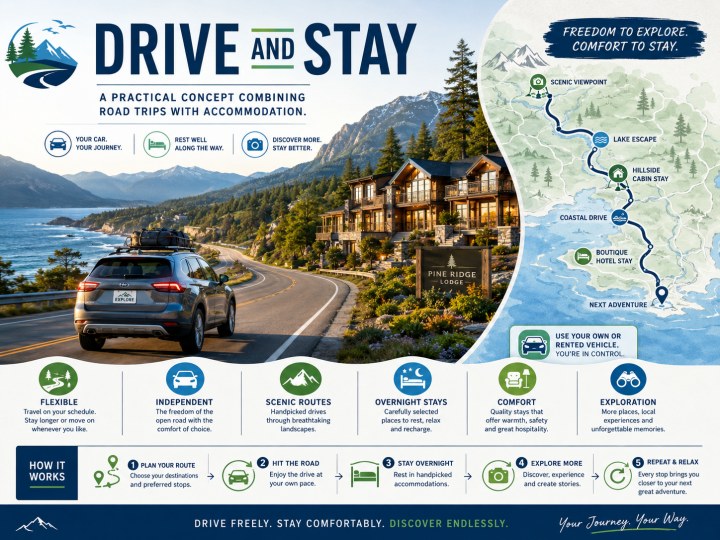
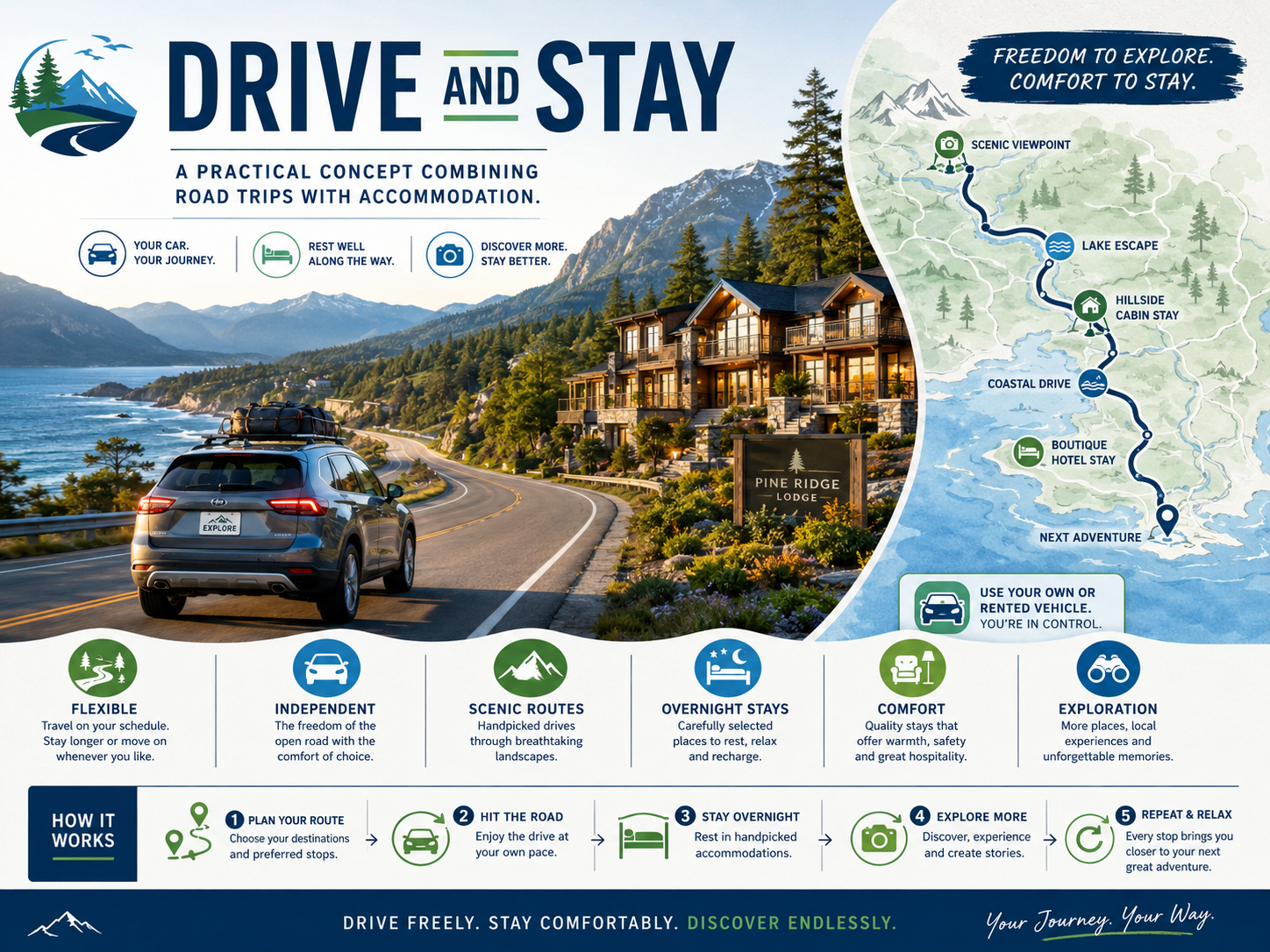
Drive and stay
ACCOMMODATION AND HOSPITALITY ESTABLISHMENTS Hotels Alternative Accommodation Unconventional Hotels Motel
-
2026

Drive tourism, a tourism trend originating with the introduction of the automobile, has attracted interest following the catastrophic impact of COVID-19. In response to the effects of the pandemic, people have started to seek alternative ways of experiencing tourism. Limitations and lockdowns have altered travel behaviour. In the new era, technology-enabled and more isolated forms of tourism have started to be preferred over traditional mass tourism practices.
Derived from drive/self-drive tourism, the drive-and-stay concept has emerged prominently among more isolated forms of tourism. It refers to road trips combined with accommodation. Tourists can travel along the route using their private or rented vehicles, either individually or as an isolated group of people. In instances of need or personal choice, tourists may choose to overnight along the route. Private vehicles empower tourists to fulfil their desires for independence and are regarded as significant enablers of visitors’ quest for exploration. Motivated by scenic routes and the pleasure of driving itself, drivers and passengers have the opportunity to select routes, determine stopping points, and decide on accommodation. In other words, drive-and-stay experiences allow tourists to explore destinations while making the journey itself part of the travel experience.
Road trips have a very significant position in modern tourism, as they symbolise freedom, self-reliance, and exploration. According to popular belief, tourists would want to feel the thrill of spontaneity or adventure in their activities and/or accommodation choices. It is considered to be one of the forms of travel that allow travellers to escape from the monotony of life. However, recent research asserts that it necessitates careful pre-planning prior to the trip, especially for international tourists. The tourist needs to take into account the road situation, infrastructure, and facilities, as well as hospitality services. Accordingly, drive and stay has become a popular tourism product. Drive-and-stay packages offered by travel agencies provide comfortable transport as well as convenient accommodation options. Moreover, certain hotels have begun offering options that include classic automobile excursions paired with accommodation amidst rural landscapes. Applications and websites have also been created in order to provide tourists with the ability to select the best drive-and-stay options.
While drive tourism is a broader form of tourism in which the travelling and driving experience is a significant part of the tourism experience, drive and stay can be viewed as a more focused and practically realised version of the concept that combines driving with accommodation and related tourism experiences. However, the scarcity of studies specifically focusing on drive and stay highlights the necessity for further research on the concept.
References
Butler, G., & Hannam, K. (2012). Independent tourist’s automobilities in Norway. Journal of Tourism and Cultural Change, 10(4), 285–300. https://doi.org/10.1080/14766825.2012.718441; du Cros, H., & Ong, C. E. (2011). Self-drive tourism in China. In B. Prideaux & D. Carson (Eds.), Drive tourism: Trends and emerging markets (pp. 103–118). Routledge; Gursoy, D., & Chi, C. G. (2020). Effects of COVID-19 pandemic on hospitality industry: Review of the current situations and a research agenda. Journal of Hospitality Marketing & Management, 29(5), 527–529. https://doi.org/10.1080/19368623.2020.1788231; Hosen, N., Paulino, I., & Hamzah, A. (n.d.). Road tripping in the system of automobility: Structured freedom and the future of self-drive tourism; Katırcıoğlu, E. (2025). Drive and stay. Türkiye Turizm Ansiklopedisi. https://turkiyeturizmansiklopedisi.com/drive-and-stay--10546; Keles, Y., & Katircioglu, E. (2025). Virtual reality—A tool for sustainable development in tourism or a treat for the future? A systematic review and a SWOT analysis. Tourism: An International Interdisciplinary Journal, 73(3), 410–428. https://doi.org/10.37741/t.73.3.2; Norris, J. (2026, August 24). Why fly when you can drive? Melbourne to Sydney via the Sapphire Coast. Drive Stay Play. https://drivestayplay.com.au/story/why-fly-when-you-can-drive-melbourne-to-sydney-via-the-sapphire-coast-i17o; Park House Hotel & Spa. (2026). Drive & stay. https://parkhousehotel.com/experiences/drive-and-stay; Shi, Y., Chen, G., & Shi, H. (2026). Enhancing the self-drive tourism experience along scenic routes: Identifying must-be, hybrid, and value-added attributes. Tourism Review, 1–30. https://doi.org/10.1108/TR-07-2025-0705; Stewart, S. I., & Vogt, C. A. (1999). A case-based approach to understanding vacation planning. Leisure Sciences, 21(2), 79–95. https://doi.org/10.1080/014904099273165; Wu, M. Y., Pearce, P. L., & Li, Q. (2018). Chinese behind the wheel: Factors affecting their satisfaction with international self-drive holidays. Journal of Destination Marketing & Management, 9, 12–19. https://doi.org/10.1016/j.jdmm.2017.09.004