Hotel Manager
Hospitality Management Hotel Management Hospitality Administration Tourism Industry Professionals Hospitality Managers
-
2026

The hotel manager occupies a position at the intersection of operational leadership, commercial management, and human resource management. The scope of this role varies according to the size, ownership structure, and organizational model of the property. The title itself is not used uniformly across the hotel industry. In smaller establishments, the hotel manager is typically the individual responsible for all aspects of the property's operations. In large chain hotels and resorts, however, organizational hierarchies are often more complex. A hotel manager or resident manager may oversee day-to-day operations, while a general manager (GM) assumes overall responsibility and reports directly to owners, corporate headquarters, or regional executives (Barrows et al., 2011, p. 313). Consequently, the distinction between these titles depends largely on organizational structure. For example, InterContinental Hotels Group (IHG) defines the general manager as the executive responsible for operational leadership, revenue optimization, guest satisfaction, and property safety (IHG, 2026). Accordingly, the term hotel manager is used here in a broad sense to encompass senior property-level leadership while preserving the original terminology employed in cited studies.
Operational Scope
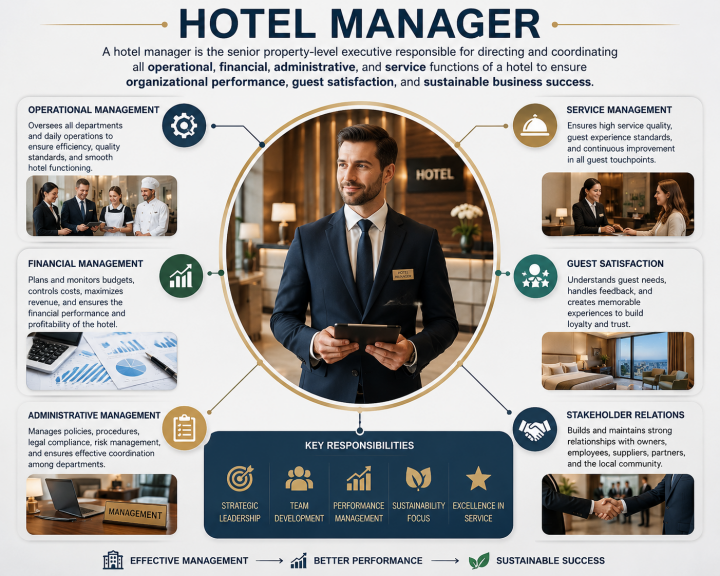
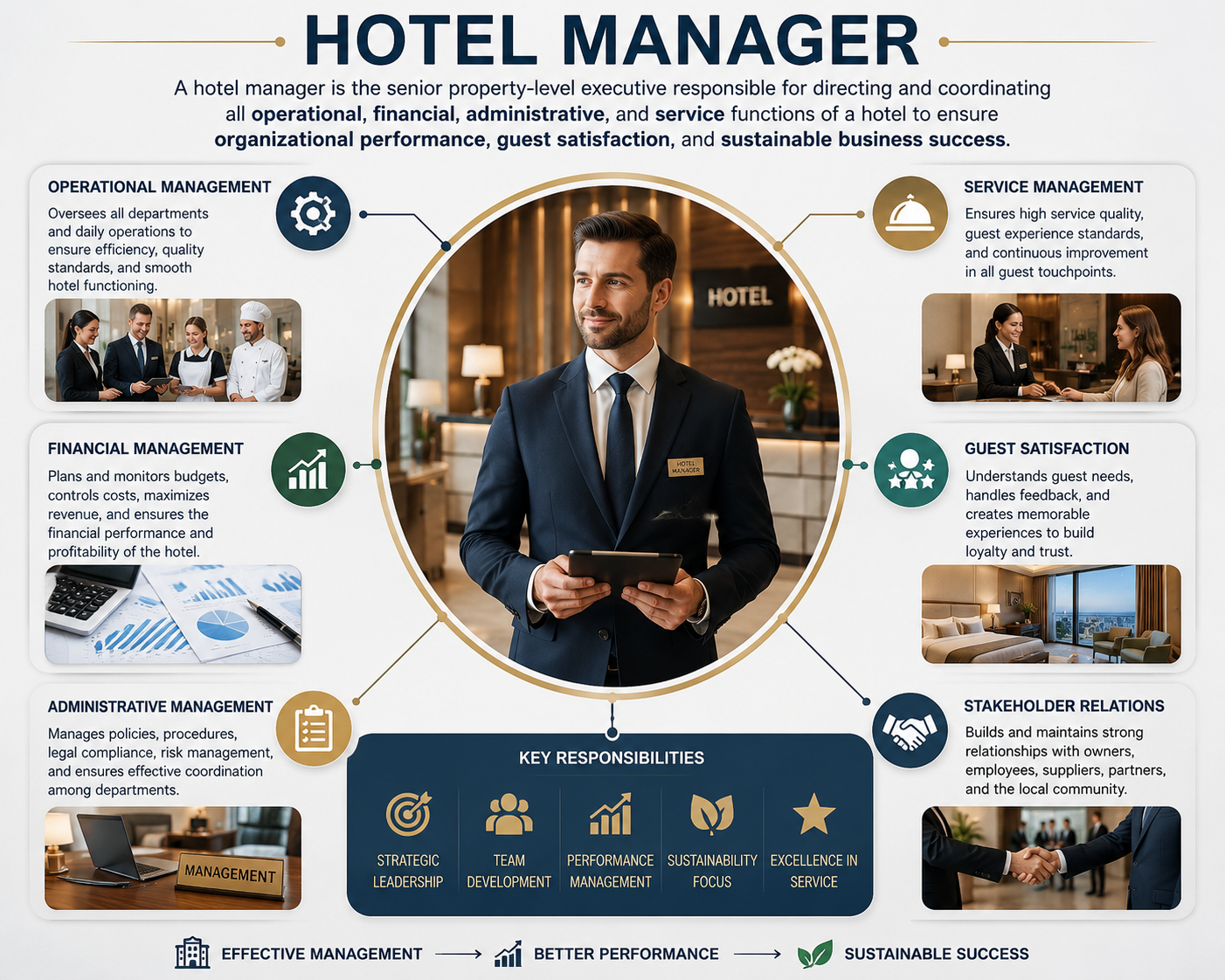
Managing a hotel requires coordinating multiple business functions simultaneously. Accommodation, food and beverage operations, sales and marketing, revenue management, finance and accounting, human resources, engineering, security, housekeeping, front office operations, and property operations, maintenance, and energy costs (POMEC) all fall within the manager's area of responsibility. These functions are highly interdependent: pricing decisions influence occupancy levels, staffing shortages affect service quality, and maintenance failures directly impact guest satisfaction and organizational reputation. The manager's primary responsibility is to integrate these diverse functions into a coherent operational system.
Commercial responsibilities include pricing strategies, demand forecasting, competitor analysis, group business evaluation, and revenue budgeting. Decisions concerning brand positioning, digital marketing, and market segmentation are closely linked to commercial performance. Financial management encompasses budgeting, forecasting, cash-flow monitoring, cost control, procurement, investment planning, and legal risk management.
Human resource management constitutes another critical dimension of the role. Because hospitality is fundamentally a people-oriented industry, service quality depends largely on employees' competence, motivation, and job satisfaction. Recruitment, training, performance evaluation, succession planning, internal communication, conflict resolution, and organizational culture therefore represent central managerial responsibilities. These challenges are intensified by the continuous nature of hotel operations, which commonly involve long working hours, shift work, weekend duties, relocation, and a strong expectation of managerial presence. Consequently, employee turnover, work-family conflict, and organizational knowledge loss generate significant operational and financial costs (Cullen & McLaughlin, 2006; Xiao & O'Neill, 2010).
Hotel managers must also balance the expectations of multiple stakeholder groups, including guests, employees, owners, suppliers, public authorities, local communities, and brand representatives. Reconciling service quality with cost efficiency, employee well-being with operational requirements, and brand standards with local conditions represents one of the defining characteristics of the position. Consequently, ethical conduct and stakeholder-oriented leadership have become essential managerial competencies rather than optional attributes (Bharwani & Talib, 2017; Tavitiyaman et al., 2014).
Competency Profile
Bharwani and Talib (2017) classify hotel general manager competencies into four principal categories. Cognitive competencies include strategic thinking, analytical reasoning, decision-making, and change management. Functional competencies encompass revenue management, financial analysis, cost control, quality management, crisis management, human resource practices, and legal knowledge. Social competencies comprise communication, active listening, teamwork, cultural intelligence, and employee development. Finally, meta-competencies include resilience, adaptability, self-awareness, ethical judgment, and continuous learning.
Similarly, Tavitiyaman et al. (2014) identify leadership ability, ethical conduct, and concern for the local community among the most significant characteristics of successful hotel general managers. Together, these studies indicate that effective hotel management requires a combination of business expertise, interpersonal competence, and ethical leadership.
Career Paths
There is no universally defined career path leading to hotel management. In the United Kingdom, career progression historically followed a structured internal promotion system, beginning with management training, continuing through assistant management positions across multiple departments, and culminating in general management appointments involving transfers to increasingly complex properties (Guerrier, 1987). Ladkin and Riley (1996) estimated that individuals required an average of 11.19 years after entering the industry at age eighteen to obtain their first hotel management position.
Career trajectories differ across countries. In the United States, the food and beverage and rooms divisions have traditionally represented the primary routes to general management, accounting for approximately three-quarters of GM career histories (Nebel et al., 1995). Studies conducted in China demonstrate more diverse career patterns, with greater emphasis on prior experience in sales, marketing, and human resource management, as well as experience gained outside the hotel sector (Li et al., 2007). Despite these variations, hotel management remains a position that generally requires extensive professional experience accumulated over many years.
The Role of Formal Education
Formal education has become increasingly important, particularly within internationally branded hotel companies. Academic qualifications in hospitality management, business administration, finance, or marketing strengthen competencies in strategic management, financial planning, and commercial decision-making while facilitating career advancement (Harper et al., 2005). Research conducted in Scotland indicates that managers holding formal qualifications attained their first general management position approximately two years and eight months earlier than their non-qualified counterparts after controlling for time spent in education.
Nevertheless, formal education alone is insufficient preparation for hotel management. Practical knowledge acquired through operational experience—including handling service failures, resolving guest complaints, managing employee conflicts, and understanding departmental operations—remains indispensable. Effective hotel management therefore depends upon the complementary integration of academic education and professional experience.
Ethical Leadership and Managerial Well-being
Ethical leadership has measurable organizational consequences. Jiang (2026) demonstrated a positive relationship between ethical leadership and employees' proactive behavior within hotel organizations, indicating that fair, consistent, and ethical managerial conduct encourages initiative and organizational commitment.
Research based on ego-depletion theory further suggests that managers' sleep quality, self-regulation capacity, and ethical leadership behavior are closely interconnected and directly influence employee behavior (Jiang, 2026). Consequently, maintaining managers' physical and psychological well-being should be regarded not only as a personal concern but also as an important organizational responsibility, given its implications for leadership effectiveness.
Debates and Contemporary Approaches
One enduring debate concerns whether hotel management should primarily be regarded as a craft acquired through operational experience or as a professional business discipline. Guerrier (1987) distinguished between two managerial archetypes within the British hotel industry: the traditional manager, whose authority derives largely from operational experience and long-term industry involvement, and the modern manager, whose leadership is supported by formal education and a strategic business perspective. Harper et al. (2005) similarly observed that although operational experience—particularly within food and beverage departments—remains important, the role of the general manager has increasingly shifted toward commercial and strategic leadership.
Another widely discussed issue is presenteeism, or the expectation that managers should maintain continuous physical presence at the workplace. Cullen and McLaughlin (2006) identified this practice as deeply embedded within Irish hotel management culture, driven by perceived responsibility toward employees, symbolic representation of the brand, and the continuous nature of hotel operations. Long working hours persist despite their recognized costs and are consistently associated with work-family conflict, employee turnover, and career abandonment (Xiao & O'Neill, 2010).
Contemporary developments increasingly position the hotel manager as a strategic leader rather than solely an operational supervisor. Digital transformation, labor shortages, sustainability initiatives, and evolving guest expectations have substantially expanded managerial responsibilities. Commercial judgment, financial literacy, technological competence, cultural intelligence, and ethical leadership are now regarded as essential alongside operational expertise. At the same time, human resource practices—including flexible scheduling, work-family support, employee well-being, and systematic talent development—are increasingly viewed as strategic sources of competitive advantage rather than administrative functions (Xiao & O'Neill, 2010; Boella et al., 2026, pp. 317–318).
References
Barrows, C. W., Powers, T., & Reynolds, D. R. (2011). Introduction to management in the hospitality industry (10th ed.). Wiley; Bharwani, S., & Talib, P. (2017). Competencies of hotel general managers: A conceptual framework. International Journal of Contemporary Hospitality Management, 29(1), 393–418. https://doi.org/10.1108/IJCHM-09-2015-0448; Boella, M. J., Goss-Turner, S., & Ramakrishnan, S. (2026). Human resource management in the hospitality industry: A guide to best practice (11th ed.). Routledge; Cullen, J., & McLaughlin, A. (2006). What drives the persistence of presenteeism as a managerial value in hotels? Observations noted during an Irish work-life balance research project. International Journal of Hospitality Management, 25(3), 510–516. https://doi.org/10.1016/j.ijhm.2004.09.006; Guerrier, Y. (1987). Hotel managers' careers and their impact on hotels in Britain. International Journal of Hospitality Management, 6(3), 121–130; Harper, S., Brown, C., & Irvine, W. (2005). Qualifications: A fast-track to hotel general manager? International Journal of Contemporary Hospitality Management, 17(1), 51–64. https://doi.org/10.1108/09596110510577671; IHG. (2026). General manager jobs. Retrieved January 17, 2026, from https://careers.ihg.com/en/career-paths/hotel-jobs/general-manager-jobs/; Jiang, R. (2026). Hotel managers' sleep quality, ethical leadership, and hotel employees' proactive behavior. International Journal of Hospitality Management, 134, Article 104555. https://doi.org/10.1016/j.ijhm.2026.104555; Ladkin, A., & Riley, M. (1996). Mobility and structure in the career paths of UK hotel managers: A labour market hybrid of the bureaucratic model? Tourism Management, 17(6), 443–452. https://doi.org/10.1016/0261-5177(96)00053-2; Li, L., Tse, E. C.-Y., & Xie, L. (2007). Hotel general manager profile in China: A case of Guangdong Province. International Journal of Contemporary Hospitality Management, 19(4), 263–274. https://doi.org/10.1108/09596110710747607; Nebel, E. C., III, Lee, J.-S., & Vidakovic, B. (1995). Hotel general manager career paths in the United States. International Journal of Hospitality Management, 14(3–4), 245–260. https://doi.org/10.1016/0278-4319(95)00026-7; Tavitiyaman, P., Weerakit, N., & Ryan, B. (2014). Leadership competencies for hotel general managers: The differences in age, education, and hotel characteristics. International Journal of Hospitality & Tourism Administration, 15(2), 191–216. https://doi.org/10.1080/15256480.2014.901069; Xiao, Q., & O'Neill, J. W. (2010). Work–family balance as a potential strategic advantage: A hotel general manager perspective. Journal of Hospitality & Tourism Research, 34(4), 415–439. https://doi.org/10.1177/1096348009350645
See Also
General Manager; Hospitality Industry; Lodging Management