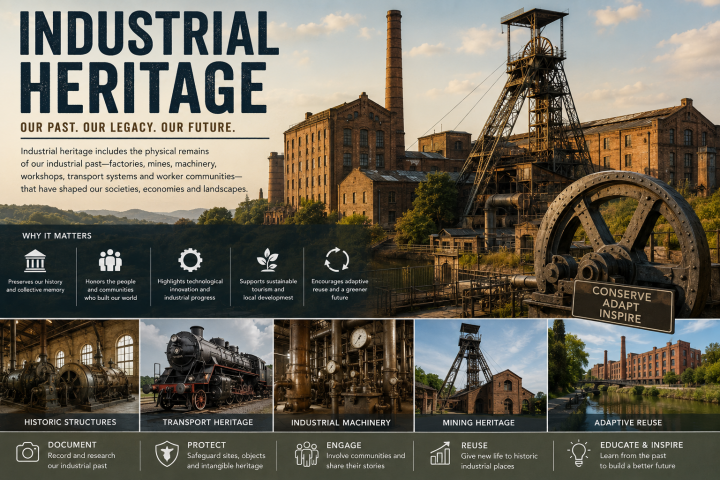
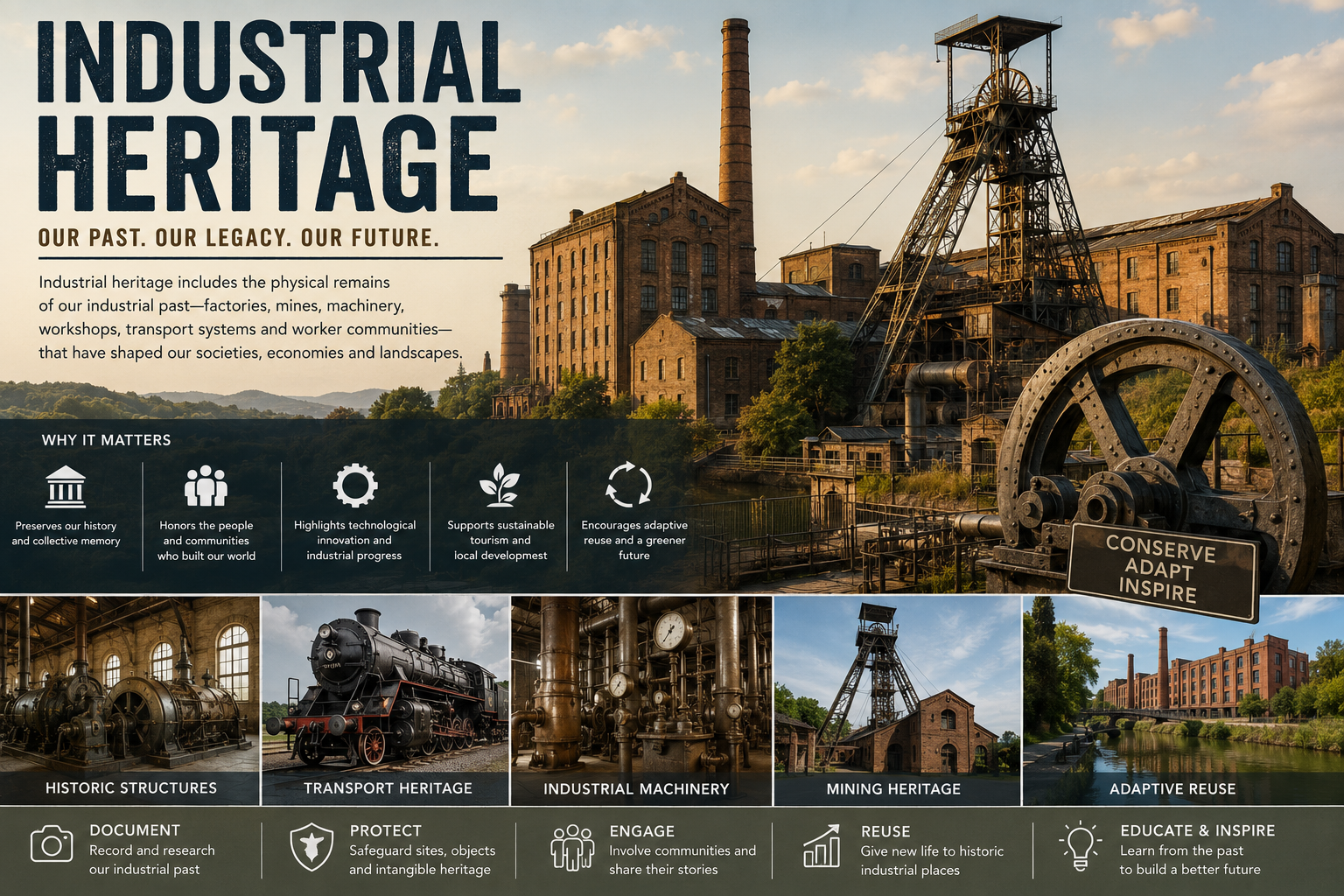
Industrial Heritage
Archaeological Conservation and Heritage Management Heritage, Culture, and Museum Studies Heritage Management Cultural Heritage Management Cultural Heritage Protection Conventions
-
2026

The Industrial Revolution began in Great Britain in the eighteenth century and spread throughout the world, bringing about profound social and economic transformation. With the introduction of steam power in industry and transportation, cities expanded rapidly, and their populations increased through migration. Owing to the ease of transporting raw materials, the first large-scale industrial facilities were established along riverbanks and later developed along railway corridors. The Industrial Revolution was characterised by the transition from agrarian economies dependent on manual labour to industrialised economies driven by mechanisation.
By the late twentieth century, rapid technological advances had transformed production processes, rendering many traditional industrial areas obsolete. This development gave rise to the term brownfield to describe abandoned or underused industrial sites. The earliest initiatives aimed at preserving disused industrial structures and sites emerged in the United Kingdom, the birthplace of the Industrial Revolution. The term industrial archaeology, coined by Michael Rix in the 1950s, refers to the branch of archaeology concerned with investigating and preserving industrial heritage threatened by neglect and demolition. As an interdisciplinary field, industrial archaeology examines both tangible and intangible evidence, including documents, artefacts, stratigraphy, structures, settlements, and natural and urban landscapes associated with industrial activity.
In 1965, with the establishment of the International Council on Monuments and Sites (ICOMOS), the institutional framework for safeguarding industrial heritage gained recognition within the broader field of monument and site conservation. A major milestone was reached in 1973 with the First International Conference on the Conservation of Industrial Monuments (FICCIM), held at the Gorge Museum in Ironbridge Gorge, United Kingdom. The historic town derives its name from the Iron Bridge spanning the River Severn in Shropshire, widely recognised as the world's first cast-iron bridge and an enduring symbol of the Industrial Revolution.
Before the 1970s, efforts to preserve industrial heritage were largely undertaken within the framework of monument conservation. However, an important conceptual shift followed the conferences held in Ironbridge (1973) and Bochum (1975). Consequently, the third conference, held in Stockholm in 1978, formally shifted the focus from industrial monuments to industrial heritage. During the same period, the establishment of The International Committee for the Conservation of the Industrial Heritage (TICCIH) further broadened the scope of the field, leading to the widespread adoption of the term industrial heritage. International recognition of industrial heritage was further strengthened through the inscription of industrial sites on the UNESCO World Heritage List. The first industrial heritage property nominated by ICOMOS and inscribed on the World Heritage List in 1978 was the Wieliczka Salt Mine (Poland), recognised as “an outstanding example of a type of building, architectural or technological ensemble or landscape which illustrates a significant stage or stages in human history.”
Under the auspices of the United Nations (UN), ICOMOS serves as the principal advisory body for cultural properties nominated for inscription on the UNESCO World Heritage List, while TICCIH acts as its specialist international organisation for industrial heritage. In 2003, TICCIH adopted the Nizhny Tagil Charter for the Industrial Heritage, which established the principal concepts and the fundamental principles for the documentation, protection, conservation, and interpretation of industrial heritage. The joint ICOMOS–TICCIH principles for the conservation of industrial heritage sites, structures, areas, and landscapes, commonly known as The Dublin Principles, were formally adopted at the 17th ICOMOS General Assembly on 28 November 2011. This document defines industrial heritage as follows:
“The industrial heritage consists of sites, structures, complexes, areas and landscapes as well as the related machinery, objects or documents that provide evidence of past or ongoing industrial processes of production, the extraction of raw materials, their transformation into goods, and the related energy and transport infrastructures. Industrial heritage reflects the profound connection between the cultural and natural environment, as industrial processes – whether ancient or modern – depend on natural sources of raw materials, energy and transportation networks to produce and distribute products to broader markets. It includes both material assets – immovable and movable – and intangible dimensions such as technical know-how, the organisation of work and workers, and the complex social and cultural legacy that shaped the life of communities and brought major organisational changes to entire societies and the world in general.”
Although originating in Europe, TICCIH has developed into a global organisation under the auspices of the United Nations, thereby extending its activities worldwide. This international scope was clearly demonstrated at the 15th TICCIH Congress, held in Taiwan in 2012, which resulted in the Taipei Declaration and brought Asian industrial heritage to the forefront of international heritage discourse. Meanwhile, approaches to industrial heritage in North America developed almost simultaneously with those in the United Kingdom. One of the most prominent examples was Detroit, often referred to as the “Motor City”. As manufacturing industries declined, many North American cities experienced severe unemployment and rapid population loss. In response, strategies were developed to transform abandoned industrial sites into tourism attractions in order to stimulate employment and revitalise local economies throughout the Rust Belt.
The adaptive reuse of abandoned industrial sites for tourism also gained prominence in Europe, largely driven by the expansion of cultural tourism. An examination of major international policy documents—including the International Cultural Tourism Charter (ICOMOS, 1999), the Riga Charter (FEDECRAIL, 2002/2005), the Cardiff Declaration (ECTN, 2005), the Malta Declaration (Europa Nostra Congress, 2006), the Siem Reap Declaration (UNWTO–UNESCO, 2015), and the Thessalia Charter (ECTN, 2016)—demonstrates that industrial heritage has become firmly integrated within the broader concept of cultural heritage, with sustainability recognised as one of its fundamental principles.
Furthermore, numerous cultural initiatives supported by the European Union address industrial heritage either directly or as part of wider cultural heritage programmes. The European Capital of Culture (ECoC) programme, particularly through the example of Glasgow, has played a significant role in promoting urban regeneration through the revitalisation of former industrial landscapes. Another notable example is the Zollverein Coal Mine Industrial Complex in Essen, which was inscribed on the UNESCO World Heritage List in 2001. When the Ruhr Region was designated European Capital of Culture in 2010, Essen served as the central city under the slogan “Essen for the Ruhr”.
The Industrial Heritage Trail (Route der Industriekultur), developed by the Ruhr Regional Association (RVR) in cooperation with the International Building Exhibition (IBA) Emscher Park (1990–1999), connected former industrial sites into an integrated tourism network. This initiative subsequently became the model for the European Route of Industrial Heritage (ERIH), now the largest information and tourism network dedicated to industrial heritage in Europe. ERIH is organised around Anchor Points, such as the Zollverein Coal Mine Industrial Complex, thematic routes focusing on industries including textiles, steel, and mining, and numerous regional routes. Since 2019, ERIH has been certified as a Cultural Route of the Council of Europe.
References
Douet, J. (Ed.). (2013). Industrial heritage re-tooled: The TICCIH guide to industrial heritage conservation (1st ed.). Routledge. https://doi.org/10.4324/9781315426532; ICOMOS. (2011). Joint ICOMOS–TICCIH principles for the conservation of industrial heritage sites, structures, areas and landscapes. XVIIth General Assembly, Paris; Rix, M. (1967). Industrial archaeology. Historical Association; The International Committee for the Conservation of the Industrial Heritage. (1975). TICCIH Congress 1973, Shropshire, UK: Ironbridge Gorge Museum Trust; TICCIH. (2003). The Nizhny Tagil Charter for the Industrial Heritage. The International Committee for the Conservation of the Industrial Heritage.