Macedonia Should Prioritize Cultural Tourism, Says Tourism Expert
-
11 Jun, 2026
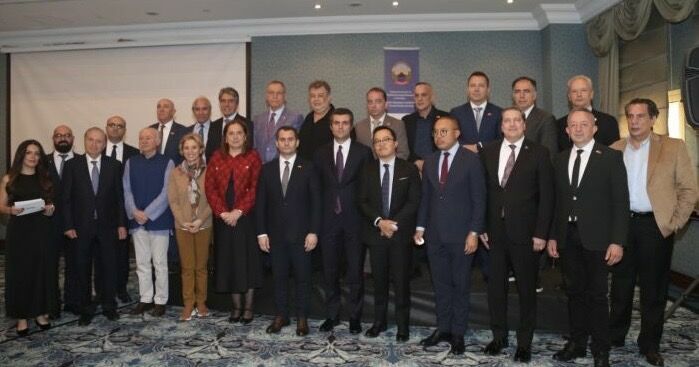
ISTANBUL – Speaking at the “Macedonia Connect: Culture, Gastronomy and Tourism Gathering” held at the Grand Cevahir Hotel & Convention Center, Fest Travel founder Faruk Pekin emphasized that North Macedonia should focus on promoting its cultural heritage rather than competing in mass seaside tourism.
The event was jointly organized by the North Macedonia Cultural Center and the Prestige International Business Development Platform, bringing together representatives from the tourism, culture, and business sectors.
Opening the event, Mehmet Gözcü, President of the Prestige International Business Development Platform, noted that the organization has hosted 15 previous meetings aimed at strengthening ties between consulates and the business community. He stated that the 16th gathering was organized in cooperation with the Consulate General of the Republic of North Macedonia in Istanbul.
“Tourism Strengthens Cultural Ties”
Addressing participants, İdris Fazlioski, Consul General of the Republic of North Macedonia, highlighted the strong historical and cultural connections between the two countries.
“North Macedonia is an important tourism destination distinguished by its history, culture, and natural beauty at the heart of the Balkans,” Fazlioski said. “Our country offers visitors a rich experience shaped by Ottoman, Byzantine, and European influences. The capital, Skopje, combines a historic stone bridge, a traditional bazaar, and a modern urban landscape, creating a unique atmosphere where past and present coexist.”
Fazlioski also pointed out that Turkish visitors rank first among foreign tourists visiting North Macedonia and emphasized that relations between the two countries continue to deepen not only diplomatically but also through culture, gastronomy, tourism, and people-to-people connections.
“Macedonia Is Fortunate Not to Have a Coastline”
During a panel discussion, tourism expert Faruk Pekin argued that North Macedonia’s lack of a coastline should be viewed as an advantage rather than a disadvantage.
“Sea-sand-sun tourism and cultural tourism are entirely different products,” Pekin said. “In many ways, Macedonia is fortunate not to have a coastline. Türkiye has suffered significant damage from an overreliance on mass coastal tourism. North Macedonia should learn from this experience and concentrate on what it does best—cultural tourism. It must market the cultural assets it already possesses.”
Pekin noted that the Carpathian biodiversity corridor extends into North Macedonia and highlighted the country’s forests, endemic plant species, canyons, waterfalls, and Lake Ohrid, a UNESCO World Heritage Site.
“North Macedonia’s natural environment is truly exceptional,” he added. “At present, Turkish tourists are attracted by ease of travel and affordability, but those factors may be temporary. Sustainable tourism growth depends on promoting unique cultural assets that cannot be found elsewhere. Tourism planning should therefore be developed with a long-term perspective, looking 30 to 50 years ahead.”
Culture Must Accompany Gastronomy
Dime Ratajkoski, Director of the North Macedonia Cultural Center, stressed that gastronomy alone would not be sufficient to attract visitors.
“We must offer tourists a complete experience that combines culture, tourism, gastronomy, and local identity,” he said. “Visitors should feel the energy and spirit of the places they visit.”
Ratajkoski also suggested developing joint cultural projects inspired by the Balkan lynx, regarded as a national symbol in North Macedonia, and Istanbul’s famous street cats.
Shared Heritage, Shared Table
Speaking at the event, Tümay İmamoğlu, Head of Gastronomy Tourism at TÜRSAB, underlined the deep historical and cultural ties between Türkiye and North Macedonia.
“Had Mustafa Kemal Atatürk not received part of his military education in Manastır, today’s Bitola, the Republic of Türkiye might never have existed,” İmamoğlu said. “Our culinary traditions are also closely linked. We sit at opposite ends of the same table.”
Describing North Macedonia as a crossroads of religions, trade routes, traditions, cuisine, and history, İmamoğlu emphasized the country’s potential to position itself as a distinctive cultural tourism destination within the Balkans.