OECD: International Tourist Arrivals Reach Record High as Destinations Face New Challenges
-
01 Jul, 2026
International tourism continued its strong recovery in 2025, with international tourist arrivals in OECD countries reaching a record 847 million, according to the newly released OECD Tourism Trends and Policies 2026 report. The figure represents an estimated 3.4% increase over 2024, following the robust 8.1% growth recorded the previous year.
While the sector continues to generate economic growth, employment and tax revenues, the OECD warns that destinations must become more resilient and adaptable as geopolitical tensions, changing travel behaviour and increasingly frequent extreme weather events reshape the global tourism landscape.
OECD Secretary-General Mathias Cormann emphasized that cooperation between governments and the private sector will be essential to sustain tourism growth in the years ahead.
“Tourism continues to grow, generating business opportunities, jobs and tax revenues across the OECD. Governments and businesses need to work together to sustain this growth and build resilience. This means applying the lessons of the pandemic and the conflict in the Middle East to strengthen crisis preparedness, and managing tourism and visitor flows to ensure the sector delivers lasting benefits,” Cormann said.
Geopolitical Tensions Continue to Influence Travel
According to the report, the ongoing conflict in the Middle East has disrupted international travel patterns and increased transportation costs, reducing traveler confidence in several markets. Destinations in the region have been most directly affected, while countries relying on Gulf aviation hubs for international connectivity have also experienced negative impacts.
The OECD expects these effects to continue in the near future, requiring destinations and tourism businesses to adjust their strategies to evolving geopolitical risks.
At the same time, travelers are increasingly considering issues such as safety, affordability and flexibility when making travel decisions. This trend is encouraging demand for more familiar destinations, shorter holidays and lower-cost travel options.
As airlines, tour operators and tourism businesses prepare their programmes for 2027 and beyond, destinations are encouraged to anticipate changing visitor behaviour and develop more resilient tourism strategies.
Record Growth in Several OECD Destinations
The report highlights significant differences in tourism performance across OECD member countries.
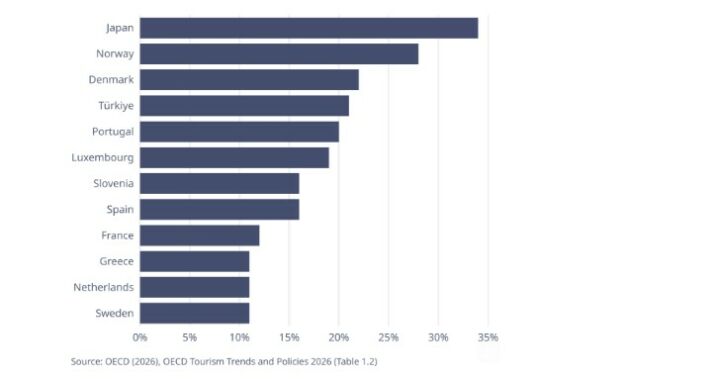
Four destinations achieved double-digit growth in international arrivals during 2025, setting new national records:
- Finland: +16.5%
- Japan: +15.8%
- Korea: +15.7%
- Norway: +12.5%
Japan and Korea continued to benefit from the strong recovery that began in 2024, supported by expanded international air connectivity and the relatively weak Japanese yen, which has made travel to the country more attractive for international visitors.
Some Destinations Continue to Face Challenges
Not all OECD countries experienced growth in 2025. International arrivals declined in several destinations and, in some cases, remained below pre-pandemic levels.
Among the countries reporting decreases were:
- United States: –5.5%
- Ireland: –2.8%
- Germany: –0.8%
- Canada: –0.6%
Israel's tourism industry remains the most severely affected by the ongoing conflict in the Middle East, with international arrivals still 70.8% below pre-pandemic levels, making it one of the slowest tourism recoveries among OECD destinations.
Building a More Resilient Tourism Sector
The OECD concludes that although international tourism has regained its growth momentum, future success will depend on destinations' ability to respond effectively to external shocks. Crisis preparedness, sustainable destination management, diversified tourism markets and improved visitor flow management are identified as key priorities for ensuring that tourism continues to generate long-term economic and social benefits.
According to a recent OECD survey, one-third of OECD member countries expect tourism performance in 2026 to exceed 2025 levels, with many anticipating new records in visitor arrivals despite continuing global uncertainty.
The OECD Tourism Trends and Policies 2026 report underscores that while global tourism has entered a new phase of growth, resilience and adaptability will be the defining characteristics of successful destinations in the years ahead.