Tofaş Marks More Than Two Decades of Support for Hierapolis
-
05 Oct, 2026
The Turkish automaker continues to support excavation and conservation at the UNESCO-listed ancient city in southwestern Türkiye, where newly uncovered marble structures and plans for an open-air museum are shaping the latest phase of research.
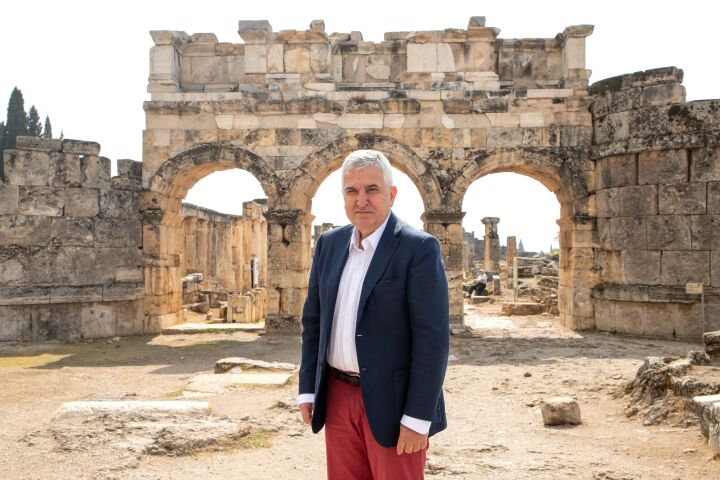
Tofaş, a Turkish automotive manufacturer, has reaffirmed its support for archaeological excavation and restoration at Hierapolis, extending a partnership that began in 2005.
Located beside Pamukkale in Türkiye’s Denizli province, the ancient city has been inscribed on the UNESCO World Heritage List together with Pamukkale since 1988. Ongoing work combines archaeological research, architectural conservation and improvements to visitor access.
Cengiz Eroldu, chief executive of Tofaş, described cultural heritage protection as a long-term investment in future generations.
“We do not view our support for cultural heritage as a sponsorship relationship; we regard contributing to the preservation of these monuments as an investment in the future,” Eroldu said.
He thanked Türkiye’s Ministry of Culture and Tourism and the Denizli Governor’s Office, and acknowledged the contributions of former excavation director Professor Francesco D’Andria, current director Professor Grazia Semeraro and the archaeological team.
From Monumental Gateways to the “Gate to Hell”
According to the company, its support initially focused on work at the Frontinus Gate before extending to the ancient theatre, the necropolis and the Martyrium of Saint Philip.
The partnership subsequently expanded to include excavation and restoration at the Ploutonion, the sanctuary known as the “Gate to Hell,” and conservation work on a marble statue of Hades.
An international team of approximately 40 archaeologists, architects, conservators and other specialists, principally from Türkiye and Italy, contributes to the excavations.
The Ploutonion has yielded evidence that has helped researchers reassess the area’s religious history. Excavations in 2013 uncovered Archaic-period material and a Phrygian relief of Cybele, indicating that the site was used for worship before the city was established.
According to the project account, finds dating to the sixth century BC point to an earlier sacred use of the cave and its surroundings.
Associated in antiquity with Hades, god of the underworld, the sanctuary developed around a natural opening where thermal water and gases emerge. Ancient geographer Strabo’s descriptions of lethal gases helped guide investigations, while bird bones recovered during excavation provided further evidence considered alongside the written accounts.
A locally carved marble statue depicting Hades seated on his throne is now preserved at Denizli Archaeology Museum.
Restoring a Fountain Built Across a Fault
Since 2022, a major focus of work has been the Sanctuary of Apollo and the Severan Nymphaeum, a monumental fountain decorated with representations of Zeus, Hera, Apollo, Artemis and Leto.
The programme includes structural conservation, restoration and the development of visitor routes to make the monument more accessible and easier to interpret.
Recent investigations indicate that the fountain was built directly across a major geological fault running through the sanctuary. Researchers identified the movement of thermal water along the fault, accompanied by the gas emissions long associated with Hierapolis.
The structure offers evidence of engineering responses to these challenging conditions. Arches carried the building across the fault, and surviving sections still rise more than 12 metres.
New Finds and Plans for an Open-Air Museum
During the 2026 excavation season, work expanded into the area in front of the fountain, where new visitor routes are planned. Archaeologists uncovered additional marble structures beneath a thick layer of travertine.
Conservation is continuing alongside excavation. Original architectural elements were reassembled at the monument’s northern corner in 2025, and the 2026 programme includes plans to re-erect three further columns using surviving original components.
The project also envisages displaying architectural fragments that cannot be returned to the façade on specially designed steel supports in front of the fountain. Information panels and multimedia content would integrate these displays into a proposed Nymphaeum Open-Air Museum.
Figured architectural friezes currently preserved in Hierapolis Museum are also intended for display in the new space. The aim is to explain both the ancient architecture and its relationship with the geothermal and seismic forces that have shaped the site.
International Research and New Technology
The Italian Archaeological Mission is working with Denizli Museum and researchers from universities in Türkiye and Italy, supported by conservators, architects and experienced local workers.
Elsewhere in the ancient city, teams are maintaining visitor routes and conserving structures around the theatre, residential areas, the Ploutonion and the Sanctuary of Saint Philip. Research in the Hellenistic-Roman necropolis is examining marble sarcophagi and the spatial organisation of burial grounds.
Drone-based thermal imaging is being used to document temperature variations in areas affected by seismic fractures. Researchers are also systematically cataloguing the fountain’s architectural blocks and recording excavation finds.
Together, these projects seek to preserve Hierapolis while helping visitors understand how its monuments, religious traditions and natural environment developed in close relationship with one another.