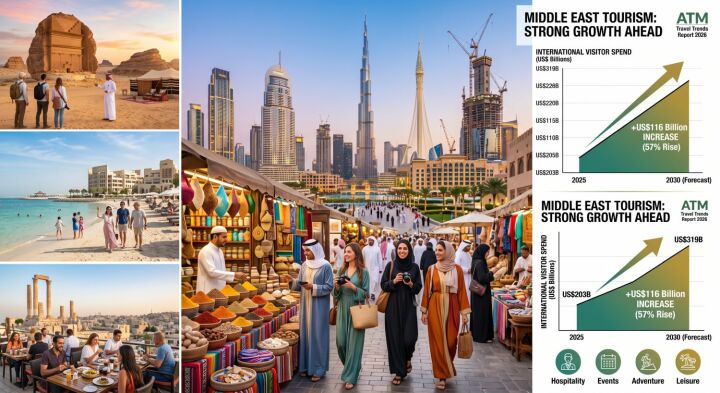
Visitor spending in the Middle East expected to rise 57% by 2030
-
17 Sep, 2026
According to information compiled by The Encyclopedia of World Tourism from the ATM Travel Trends Report 2026, international visitor spending in the Middle East is expected to increase by 57% between 2025 and 2030. International travel across the MENASA region is forecast to grow by 17% in 2027, while long-haul travel from China to the Middle East is projected to increase by 160% by 2030.
The ATM Travel Trends Report 2026, prepared by Arabian Travel Market in collaboration with Tourism Economics, an Oxford Economics company, points to the growing role of the Middle East, North Africa and South Asia (MENASA) region in the future expansion of global tourism.
According to the report, international visitor spending in the Middle East is expected to rise by 57% between 2025 and 2030. Long-haul source markets are projected to become one of the main drivers of future growth, with travel from China to the Middle East forecast to increase by 160% by 2030.
Global travel reached record levels in 2025
According to data presented by Dave Goodger, Managing Director for EMEA at Tourism Economics, global travel reached record levels in 2025.
Total visitor nights worldwide rose to 24 billion, 16% above 2019 levels. In-destination spending increased by 26% compared with 2019, reaching USD 7.2 trillion.
International arrivals also exceeded 1.5 billion for the first time.
MENASA outperformed global travel growth
The MENASA region, covering the Middle East, North Africa and South Asia, made a significant contribution to the expansion of global travel.
In 2025, total travel volumes across the region were nearly 50% above 2019 levels. According to the report, this represented approximately three times the growth recorded globally.
During the same period, MENASA accounted for more than half of the worldwide increase in international travel.
Strong recovery forecast for 2027
While geopolitical instability is expected to continue affecting travel to the Middle East during 2026, Tourism Economics forecasts a strong recovery in 2027.
International travel worldwide is expected to grow by 8% in 2027, compared with a projected 17% increase across the MENASA region.
This would mean that international travel growth in MENASA could be more than twice the global rate.
The research also indicates that recovery periods following major disruptions to travel have shortened considerably. While recovery took approximately 24 months in the early 2000s, the period has fallen to around 10 to 12 months in recent years.
Goodger: Consumers increasingly see travel as an essential need
Dave Goodger said that despite economic and geopolitical uncertainty creating disruptions during 2026, the long-term outlook for travel remains positive.
“Consumers increasingly see travel as an essential need. People are prioritising experiences over possessions,” Goodger said.
He added that favourable demographics, rising prosperity and continued investment in tourism capacity were supporting confidence in the region’s long-term momentum.
China expected to become a major growth market
Long-haul source markets are expected to play an increasingly important role in the region’s future tourism growth.
China stands out in particular, with long-haul travel from the country to the Middle East forecast to increase by 160% by 2030.
The projected growth is expected to strengthen the position of Middle Eastern destinations in Asian source markets while contributing to further diversification of the region’s international visitor profile.
316 million international visitors expected by 2030
According to Tourism Economics forecasts, international travel across the MENASA region is expected to reach 316 million visitors by 2030.
International visitor nights are projected to rise to 2.3 billion, while travel spending is forecast to reach USD 408 billion.
Compared with 2025, these figures represent increases of 36% in international visitor numbers, 46% in overnight stays and 55% in spending.
The report indicates that MENASA is expected to remain one of the fastest-growing regions in the global travel economy in terms of both visitor volumes and tourism expenditure over the coming years.