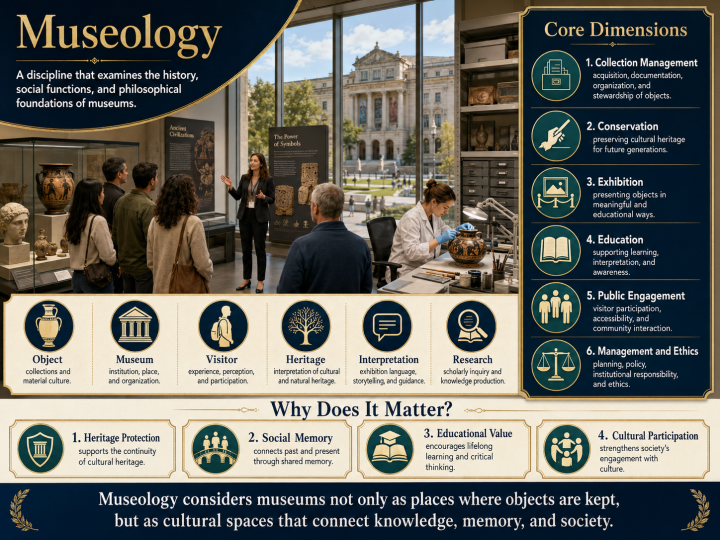
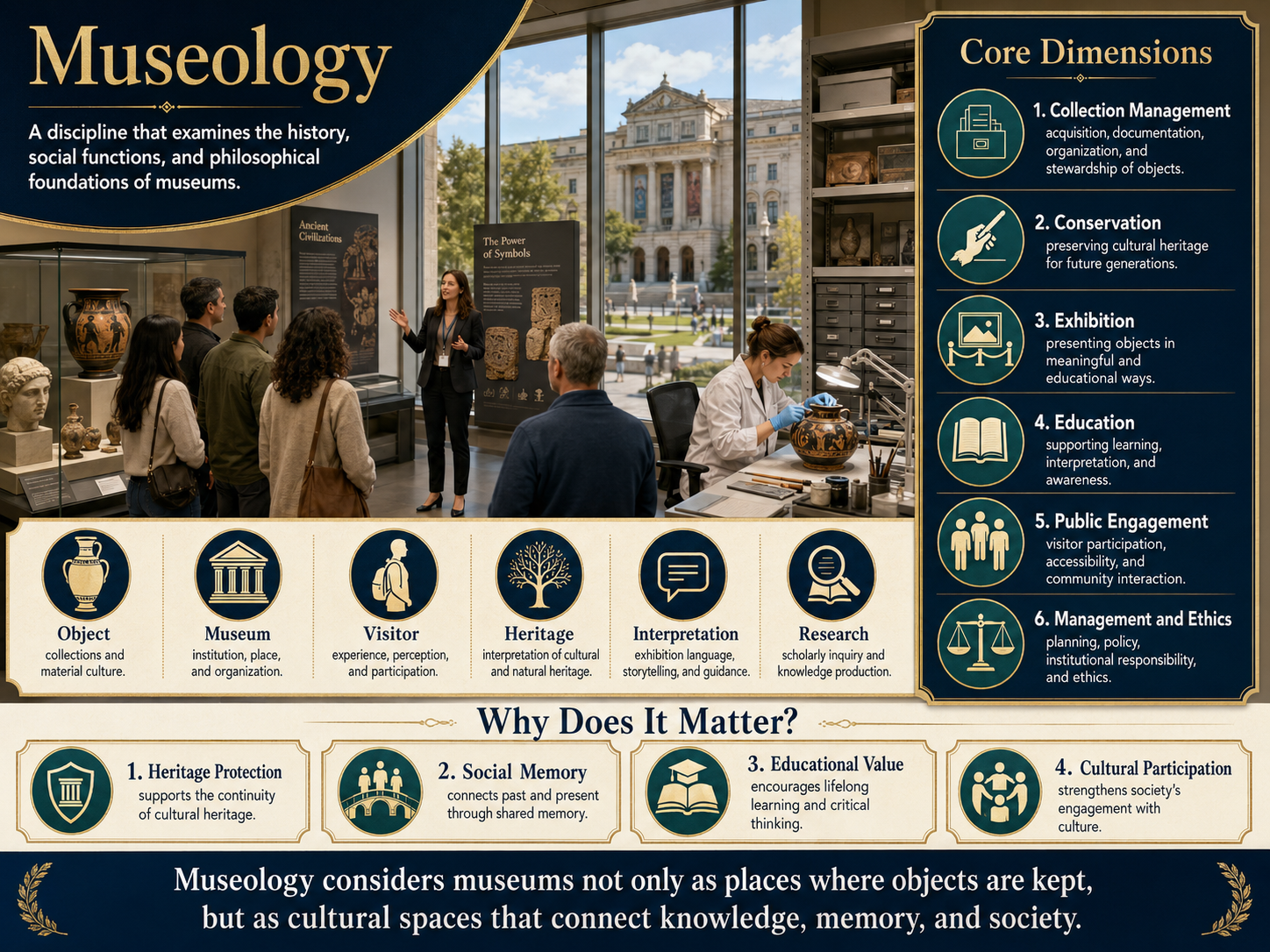
Museology
EDUCATION AND ACADEMIC FIELDS Heritage, Culture, and Museum Studies Museum Studies DISCIPLINES, CONCEPTS, AND RESEARCH AREAS
-
2026

The concept, derived from the German word musologie and popularised through the French term muséologie, is known in English as Museum Studies or Museum Science. Etymologically derived from a combination of the Ancient Greek words ‘mouseion’ (a sacred place dedicated to the Muses) and ‘-logia’ (science, research, discourse), the term ‘museology’ draws on a body of literature spanning approximately two centuries. The term was first used in German texts in Georg Rathgeber’s 1839 work Aufbau der niederländischen Kunstgeschichte und Musologie. It also gained widespread use through the journal Zeitschrift für Musologie und Antiquitätenkunde sowie verwandte Wissenschaften, published by Johann Georg Theodor Graesse between 1878 and 1885.
From the 19th century onwards, museology has become increasingly complex and has taken on an interdisciplinary character. During this historical process, the development of museology has passed through three fundamental stages. During the Proto-Scientific Phase (the first half of the 1900s), the compilation of empirical museum studies that had not yet been tested using scientific methods but demonstrated internal consistency was encouraged. In the Empirical-Descriptive Phase, which lasted until 1976, the foundations of the discipline were laid by establishing the fundamental conditions and methods for the collection, storage, research, and evaluation of museum objects. In the Theoretical-Synthesis Phase, which remains relevant today, museologists seek to explain, through a holistic approach, collections comprising natural and cultural heritage, as well as the museum’s physical and human resources and its social relationships. Both the increase in academic publications and the contributions of institutional bodies such as the International Council of Museums (ICOM) have played a major role in this historical development.
Museology is structured along two main axes: theoretical and applied. Theoretical museology encompasses meta-museological studies based on theories of selection, conservation, and presentation. Applied museology, on the other hand, covers practical museum activities ranging from exhibition design to collection management and from archiving and budgeting to security and public relations. According to the traditional definition adopted by ICOM in 1970, museology is “the science of museums, which examines the history of museums, their social role, their specific research, educational and organisational systems, their relationship with the physical environment, and the classification of museum types.” However, this classical understanding has been criticised on the grounds that it positions the museum as an authoritarian institution that collects, preserves, and exhibits objects.
Zbyněk Zbyslav Stránský pioneered a radical paradigm by arguing that the subject of museology cannot be the museum, which is a physical institution. While serving as head of the Department of Museology, established in 1962 within the Moravian Museum in Brno, Stránský, with the support of the museum director at the time, founded the Brno School, thereby establishing museology as an autonomous discipline. According to him, the primary object of study in museology is the specific existential relationship that humans establish with reality. Museology is the science of endowing an object with museality because of human interest, musealising it, and transforming the resulting musealia into collective memory. This taxonomy, developed by Stránský, was introduced in the ICOFOM Study Series publications of the ICOM International Committee on Museology and standardised in the book Key Concepts of Museology, edited by André Desvallées and François Mairesse. Stránský’s theory was expanded by the New Museology movement, which gained international recognition through Peter Vergo’s 1989 book The New Museology. Criticising traditional museology’s object-centred approach and the curator’s absolute authority, this movement has redefined museums as instruments of social and political change and as forums where democratic participation, accessibility, social justice, and community engagement are fostered.
Currently, ICOFOM continues to engage in fundamental theoretical debates. In this context, key areas of critical discussion within contemporary and critical museology include coming to terms with the colonial past and the restitution of artefacts looted during the colonial era. Research conducted by critical museologists such as Bruno Brulon Soares and Anna Leshchenko, alongside bibliographic analyses, reveals that over 80 per cent of theoretical museology publications are centred on North America and Western Europe, whilst the experiences of communities from Latin America, Asia, and Africa are marginalised. In this regard, contemporary museology is concerned not only with how objects are preserved or exhibited but also with determining on whose behalf, through what power relations, and in accordance with what values these processes are carried out; consequently, it does not separate ethical standards[1] from object-centred practices. It positions these standards as the fundamental basis determining the museum’s social legitimacy, scientific credibility, and philosophical existence.
References
Brulon Soares, B. (Ed.). (2019). A history of museology: Key authors of museological theory. ICOFOM. https://icofom.mini.icom.museum/wp-content/uploads/sites/18/2023/03/2019_history_of_museology_bruno.pdf; Brulon Soares, B. (2021). Decolonising the museum? Community experiences in the periphery of the ICOM museum definition. Curator: The Museum Journal, 64(3), 439–455. https://doi.org/10.1111/cura.12436; Brulon Soares, B., & Leshchenko, A. (2018). Museology in colonial contexts: A call for decolonisation of museum theory. ICOFOM Study Series, 46, 61–79. https://doi.org/10.4000/iss.895; Desvallées, A., & Mairesse, F. (2011). Dictionnaire encyclopédique de muséologie. Armand Colin; Mairesse, F. (2016). What is Zbyněk Z. Stránský’s “influence” on museology? Museologica Brunensia, 5(2), 27–36. https://hdl.handle.net/11222.digilib/136261; Maroević, I. (1998). Introduction to museology: The European approach. Müller-Straten; Vergo, P. (Ed.). (1989). The new museology. Reaktion Books.
[1] The Code of Ethics for Museums was revised at ICOM’s 41st Ordinary General Assembly. The revised code can be accessed via the following link: https://icom.museum/wp-content/uploads/2026/07/ICOM-Code-of-Ethics-for-Museums_2026_EN.pdf