Saint Paul Trail
EVENTS, FESTIVALS, AND ORGANIZED GATHERINGS Events by Spatial Format
-
2026

The Saint Paul Trail is a long-distance cultural route that commemorates the missionary journeys of Saint Paul of Tarsus, one of the most influential figures in the early history of Christianity. Following the regions through which Paul is believed to have travelled during his missions in Anatolia, the trail combines religious heritage, ancient history, and the natural landscapes of southern Türkiye, making it one of the country's most significant cultural hiking routes.
The route is associated with Saint Paul’s missionary journeys, undertaken between approximately AD 45, when he began preaching Christianity beyond the eastern Mediterranean, and AD 67, the traditional date of his death. During these journeys, Paul visited a number of important Roman cities, establishing Christian communities that would later play a crucial role in the spread of Christianity throughout the Roman world. Although the precise itinerary of his travels cannot be reconstructed with certainty, the trail follows regions closely connected with the historical and biblical accounts of his first missionary journey.
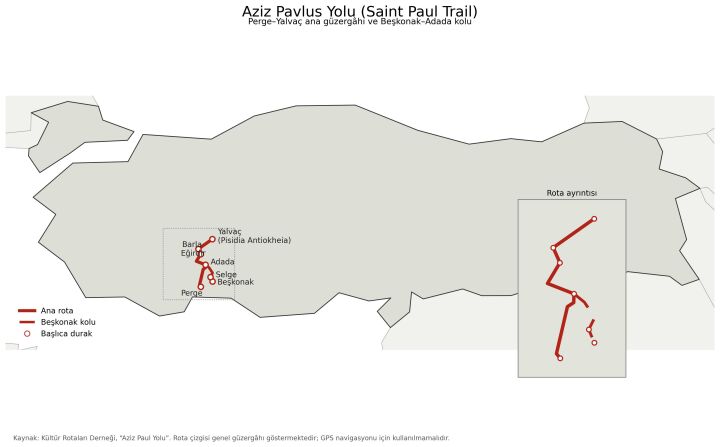
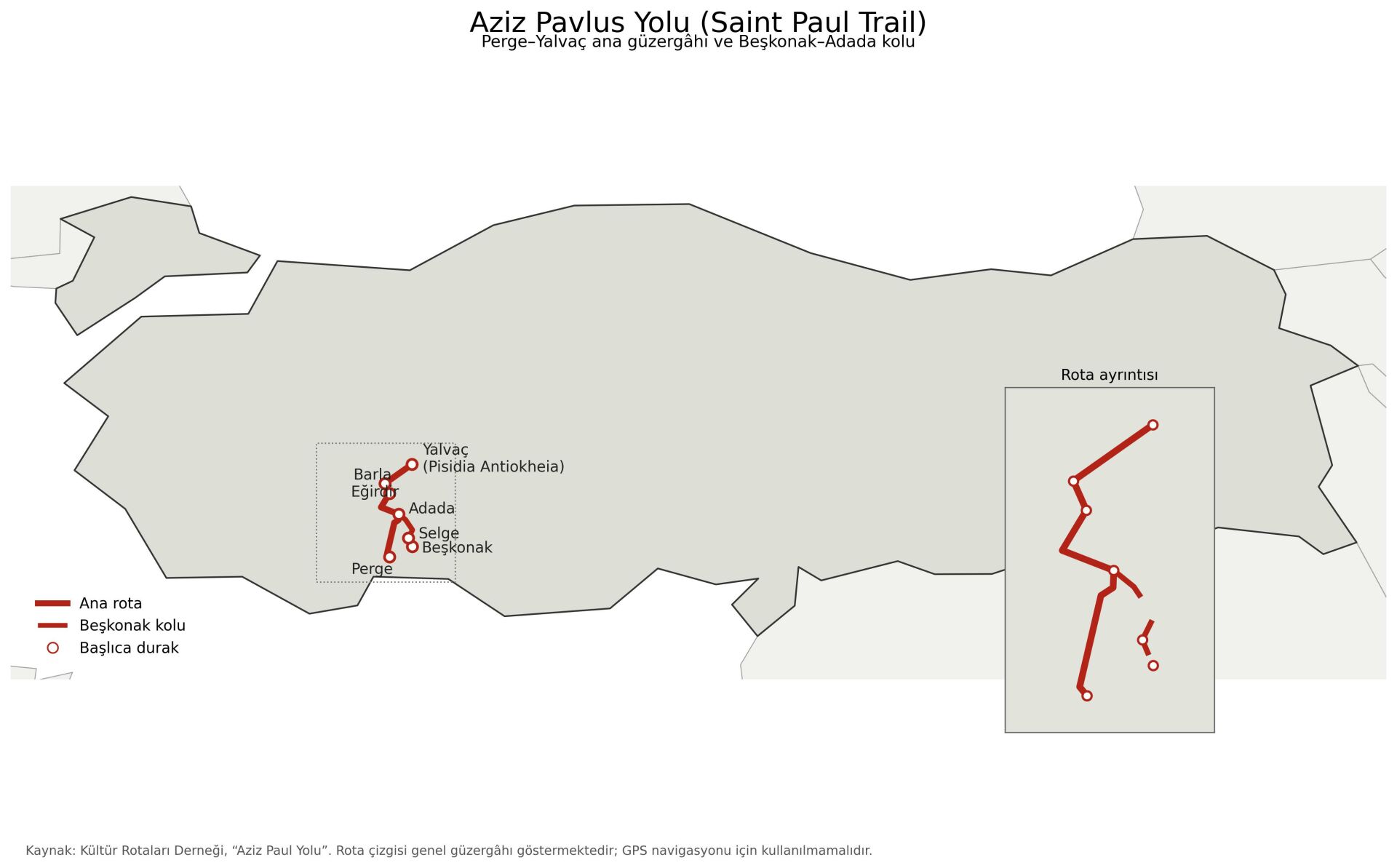
The Saint Paul Trail was developed under the leadership of Kate Clow, with the support of volunteers who also contributed to the creation of several other cultural hiking routes in Türkiye. Established as the country's second major long-distance walking trail after the Lycian Way, it extends between the ancient cities of Perge and Pisidian Antioch, near present-day Yalvaç. Because the route symbolically follows in the footsteps of Saint Paul through Asia Minor, it was named the Saint Paul Trail. Rather than attempting to reproduce Paul's exact route, the trail seeks to evoke the geographical and historical setting in which his missionary activities took place.
Designed to provide hikers with an impression of the landscapes through which Saint Paul is traditionally believed to have travelled, the route begins at the ancient city of Perge, east of Antalya, and extends to Yalvaç, northeast of Lake Eğirdir. Covering approximately 500 kilometres, it can generally be completed on foot in around twenty-seven to thirty days, depending on walking pace. Throughout its course, the trail presents a remarkable combination of archaeological sites, mountain scenery, forests, traditional villages, and historic pathways, offering visitors an experience that integrates cultural exploration and outdoor recreation.
A second branch of the trail begins at Beşkonak, situated near the entrance to Köprülü Canyon National Park, approximately 80 kilometres northeast of Antalya, before joining the main route at the ancient Roman city of Adada. The trail follows sections of surviving Roman roads, old caravan routes, shepherds' paths, forest tracks, and traditional village roads, some of which are also suitable for mountain biking. Compared with the Lycian Way, the Saint Paul Trail traverses a more secluded and less developed landscape. Beginning at sea level, it gradually ascends to elevations of approximately 2,200 metres, while optional side routes allow experienced hikers to reach peaks approaching 2,800 metres.
The recommended hiking seasons are April–May and September–October, when weather conditions are generally favourable. Accommodation is available primarily in village houses, family-run guesthouses, and small local pensions situated along the route, allowing visitors to experience the hospitality of rural Anatolia. The trail is clearly marked with internationally recognised red-and-white waymarks and directional signs, making navigation relatively straightforward. Hikers with limited time may also complete shorter sections of the route, with the section ending at Eğirdir providing a popular seven- or eight-day alternative.
Beyond its function as a recreational hiking route, the Saint Paul Trail represents an important example of cultural heritage tourism. It offers insight into the historical geography of early Christianity while preserving traditional rural landscapes that have changed little over the centuries. Visitors encounter ancient settlements, Roman engineering structures, historic mountain passes, and villages where local customs and ways of life continue to reflect the cultural diversity of the region. Consequently, the trail serves not only as a destination for outdoor enthusiasts but also as a means of promoting historical awareness, intercultural dialogue, and sustainable cultural tourism in Anatolia.
References
Gül, A., Aydemir, Ç., Gökal, M., & Akın, T. (2020). GIS-based identification of cultural routes: The case of Isparta Province. GSI Journals Serie C: Advancements in Information Sciences and Technologies, 3(2); Kültür ve Turizm Bakanlığı. (t.y.). St. Paul (Aziz Paulus). https://isparta.ktb.gov.tr/TR-71232/st-paul-aziz-paulus.html (Erişim tarihi: 12 Temmuz 2025); Morgezi. (t.y.). St. Paul Trail. https://morgezi.com/treks/st-paul-yolu (Erişim tarihi: 12 Temmuz 2025); Gang-Gang. (t.y.). The St. Paul Trail. https://www.gang-gang.net/nomad/turkey/turkey02.html (Erişim tarihi: 12 Temmuz 2025); Culture Routes Society. (t.y.). The Saint Paul Trail. https://cultureroutesinturkey.com/tr/aziz-paul-yolu/ (Erişim tarihi: 12 Temmuz 2025); Ulutürk, M. (2009). Apostles. Mesa Publishing.
See Also: