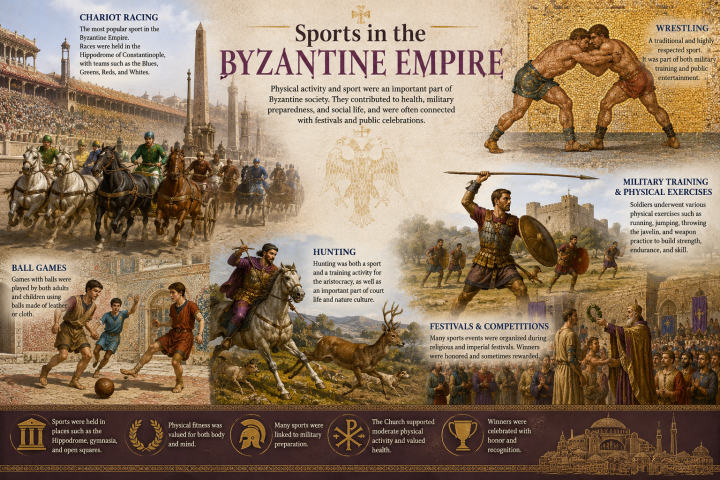
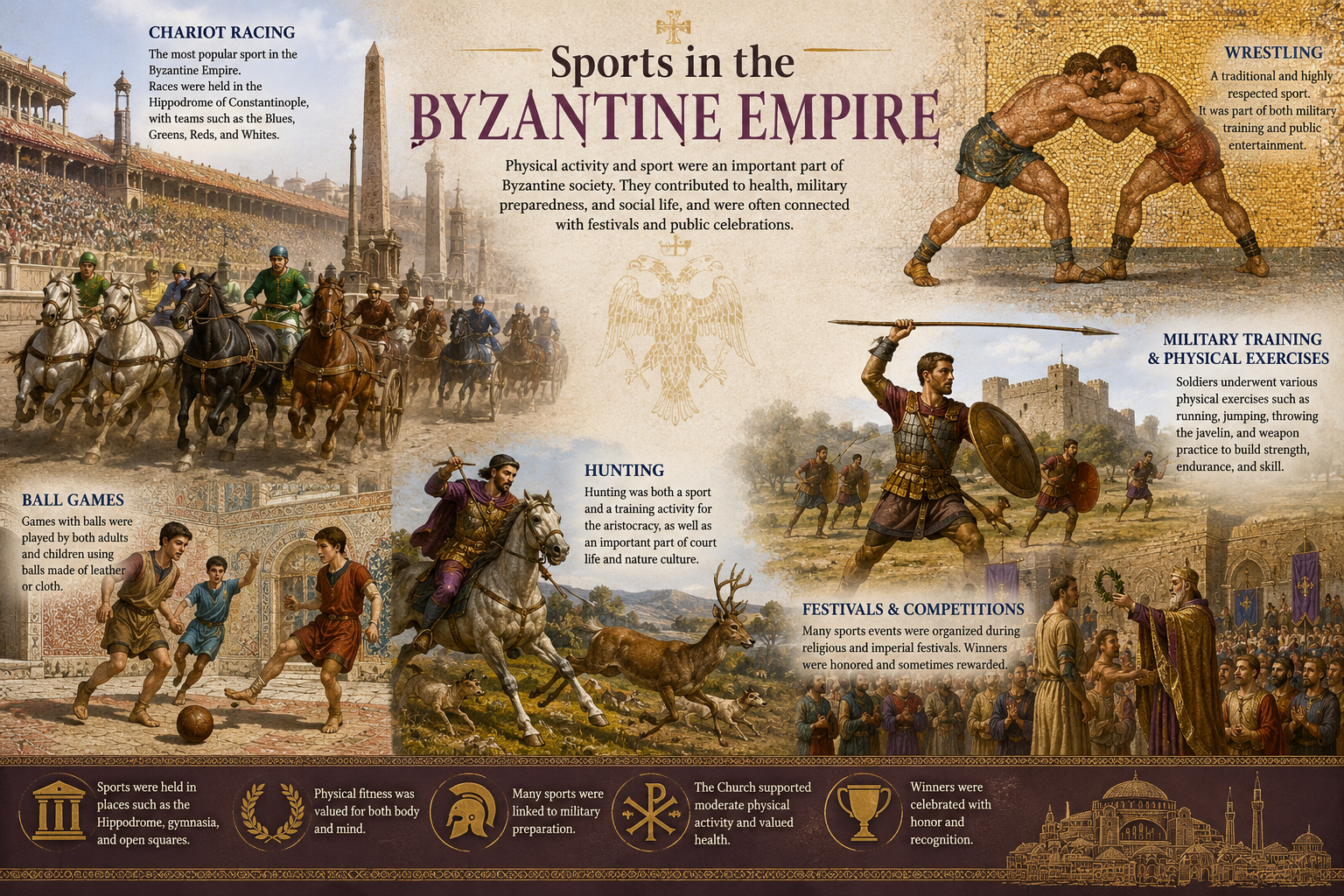
Sports in the Byzantine Empire
DISCIPLINES, CONCEPTS, AND RESEARCH AREAS History Cultural History Recreation and Sport Sciences
-
2026

As a cultural element, sports have been actively pursued throughout every period of human history, influenced by the cultural context within which they functioned and were practised. During the Byzantine period, sports possessed an amateur character, with participants engaging in them for entertainment rather than monetary gain. The origins of this amateur character have been interpreted in various ways by different historians.
Christianity, with its distinct ethical worldview, prohibited most pagan festivals and games involving bloodshed. Consequently, sports in the Byzantine period assumed a character significantly different from that of the Roman period.
Primary Characteristics of Byzantine Sports
1. The first characteristic of Byzantine sports was the absence of violence. This was explicitly prohibited by both imperial legislation and ecclesiastical law. However, the prohibition did not extend to all forms of the ludi. This was because the canons did not permit the performance of bloody acts, granting approval solely to chariot races and gymnastic competitions held in circuses for public entertainment.
2. The second characteristic of Byzantine sports was their amateur nature. Following the abolition of violent games, the Byzantines developed new forms of games whose primary objectives were entertainment, celebration, and recreation. According to certain Byzantine thinkers, movement links the soul with the body. Accordingly, athletics, walking, swimming, hunting, and similar sports were regarded as natural human activities. In contrast to this positive approach, some members of the clergy categorised all forms of sport and dance as inherently evil.
3. The pursuit of Byzantine sports for health-related purposes constitutes another characteristic. The practice of using physical activities for health benefits was common in the West, just as it was in Byzantium. Gymnastic exercises, physiotherapy, and massage, alongside activities such as equestrianism, swimming, walking, and dancing, were particularly prevalent during the Byzantine period.
4. Another characteristic of Byzantine sports was their use as a means of military preparation. The individuals who expressed views on this subject were generally emperors and military commanders. They argued that games and sporting activities helped soldiers relax, reduce combat stress, and develop a sense of self-control. It is well documented that numerous sporting activities, such as equestrianism, archery, athletics, rowing, and hunting, were practised during intervals between military drills. The most favoured activity was mounted archery (shooting at a target with a bow and arrow while on horseback).
References
Mandel, R. (1976). The first modern Olympics (ss. 74–94). University of California Press; Karagiannopoulos, J. (1978). History of the Byzantine State (Cilt 1, ss. 621–645). Sakkoula; Hunger, H. (1981). The classical tradition in Byzantine literature: The importance of rhetoric. İçinde M. Mullett & R. Scott (Ed.), Byzantium and the Classical Tradition (s. 41). University of Birmingham; Carter, J. M. (1986). Sport, crime and peasants in thirteenth century England. Canadian Journal of History of Sport, 17(2), 37–43; Giatsis, S. G. (2007). Sport in Byzantium. Erytheia, 28, 15–40.