Tourism Climatology
Climate-Friendly Destination Environmental and Natural Sciences Climate Science
Elazığ, 2026
-
2026

Etymology: The term “climatology” derives from the Greek roots klima (slope, region; the angle at which the sun’s rays strike the earth) and logos (knowledge, science), and denotes the scientific study of the long-term average behaviour of atmospheric conditions. The compound term “tourism climatology” developed as an applied extension of this general climatological knowledge to tourism research.
Historical development: The earliest references to the climate–tourism relationship date back to 1936 (Scott et al., 2006). The term gained currency as an independent research field only in the late 1980s and early 1990s, however, once debates over global climate change began to permeate the tourism sector (Scott & Lemieux, 2010).
First systematic formulation: Chris R. de Freitas is credited with the first systematic articulation of the concept, in a reference work that defined the field’s scope and methodological boundaries (de Freitas, 2003).
First quantitative instrument: The founding contribution to the applied branch of tourism climatology is Zbigniew Mieczkowski’s study in The Canadian Geographer, which introduced the Tourism Climatic Index (TCI) (Mieczkowski, 1985). This study is widely regarded as the first comprehensive method to convert climate data into a quantitative, comparable measure for tourism purposes.
Institutional context: The field’s academic institutionalization took shape through the Commission on Climate, Tourism and Recreation (ISBCCTR), established in 1999 within the International Society of Biometeorology; the commission held its first conference in October 2001 in Halkidiki, Greece (de Freitas, 2017).
Content and Scope
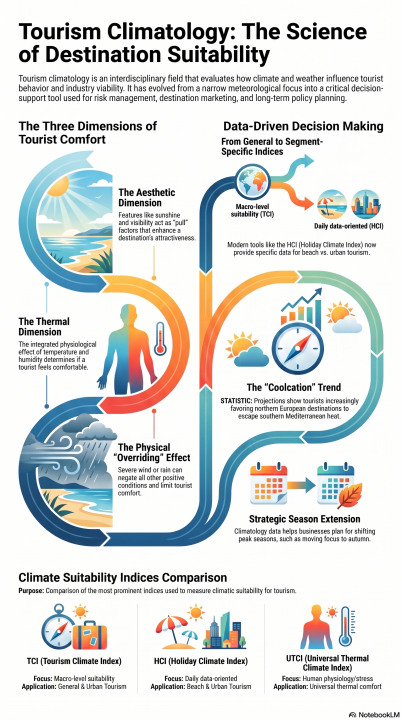
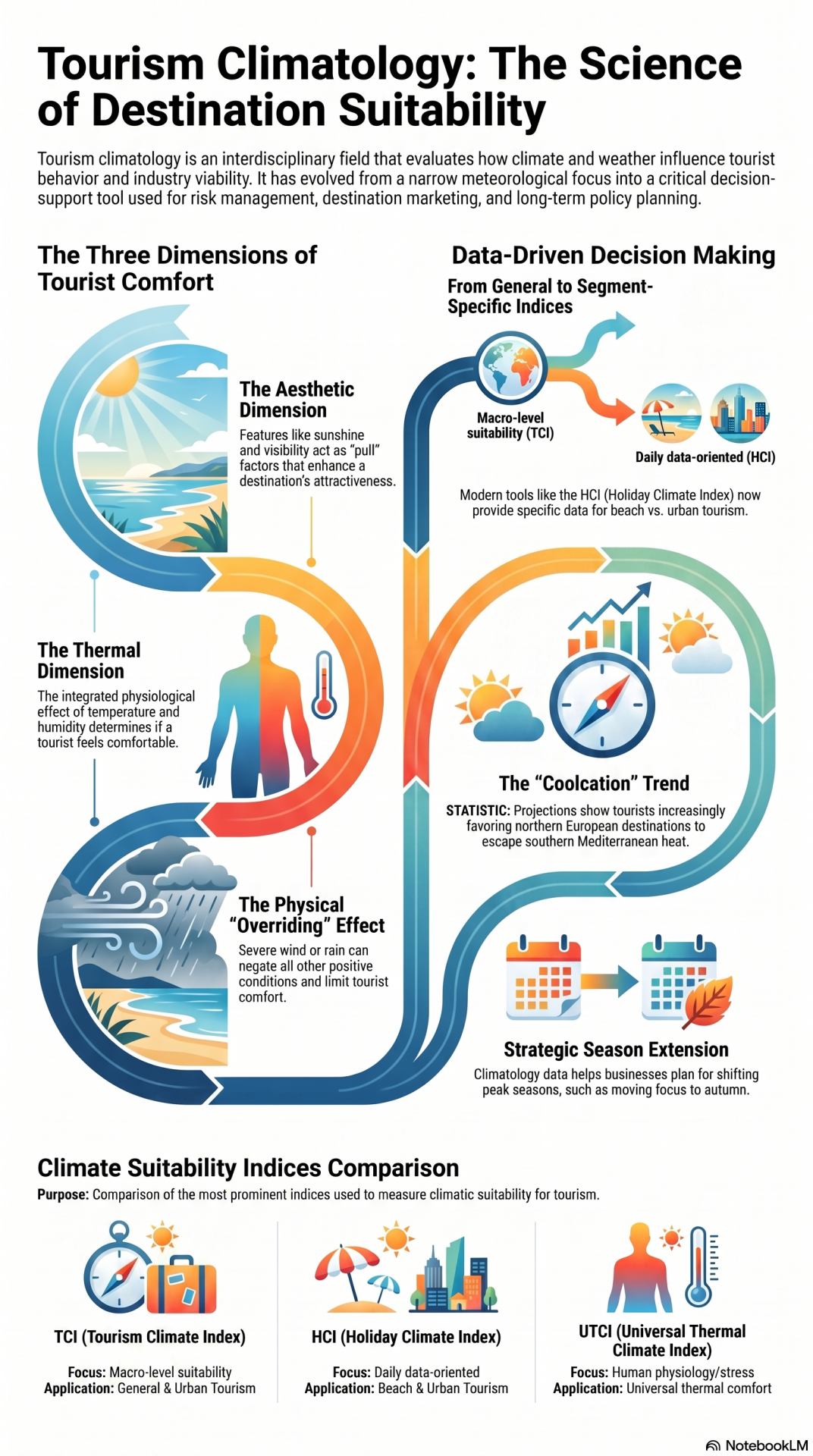
Core components: The conceptual structure of tourism climatology is addressed, according to the de Freitas (1990, 2003) framework most widely accepted in the literature, along three dimensions:
- Aesthetic dimension: encompasses sunshine/cloud cover ratio, visibility, and day length, functioning as “pull” factors that enhance touristic attractiveness.
Physical dimension: includes wind, precipitation, snow, ultraviolet radiation levels, and air pollution, and carries an “overriding effect” that limits comfort and can, when severe, negate all other conditions. - Thermal dimension: the integrated physiological effect of temperature, wind, radiation, and humidity; measured through energy-balance indices (PET, UTCI) and a direct determinant of tourist comfort (de Freitas, 2003).
- Applications and contexts of use: Tourism climatology operates across four principal application axes: (1) the quantitative assessment of destination-scale climatic suitability through indices; (2) the biometeorological modelling of tourist comfort; (3) the projection of climate change’s effects on tourism demand, seasonality, and destination geography; and (4) the integration of climate information into destination management, marketing, and public policy processes (Scott & Lemieux, 2010; Matzarakis, 2006). Findings generated within this framework inform a wide range of decisions, from seasonal capacity planning by hotel and travel businesses to destination-diversification strategies pursued by national tourism ministries.
Distinction from related concepts: Unlike general climatology, tourism climatology is applied rather than descriptive in character, linking climate data directly to tourist behaviour and business decisions. The field should also not be confused with “tourism meteorology”: whereas meteorology focuses on short-term weather forecasting, tourism climatology concerns itself with long-term climate averages, seasonality patterns, and climate change scenarios. Finally, the term “tourism biometeorology” designates the subset of the field concerned specifically with human thermal comfort (de Freitas, 2003; Matzarakis et al., 2007).
Definitions and Findings in the Literature
Prominent definitions: de Freitas (2003) defines tourism climatology as “the evaluation of environmental information for decision making and business planning in the recreation and tourism sector,” a definition that emphasizes the field’s applied rather than descriptive character. Scott and Lemieux (2010), by contrast, situate the field within a broader frame, describing climate as a resource and a source of risk that carries “varying degrees of sensitivity” for all tourism destinations and operators; this approach draws attention to the risk-management function of climate information alongside its planning function. de Freitas (2017), in turn, characterizes the field as having evolved over time into a “genuinely multidisciplinary” structure, noting that a subject initially approached from a predominantly meteorological perspective is today integrated with economics, marketing, and the behavioural sciences.
Convergence and divergence among definitions: All three definitions converge in emphasizing climate’s dual function for tourism, as both resource and constraint. The principal difference lies in emphasis: de Freitas (2003) offers a narrow definition that foregrounds the decision-support function, whereas Scott and Lemieux (2010) propose a broader frame centred on risk and vulnerability. de Freitas’s (2017) later work expands the definition further still, foregrounding the field’s interdisciplinary character. This progressive differentiation reflects the field’s transition from its narrow meteorological origins in the 1980s to the multidimensional, policy-oriented structure it has assumed since the 2000s.
Debates and Contemporary Approaches
Principal debates in the literature: The most prominent methodological debate in the field centres on Mieczkowski’s (1985) pioneering TCI index. Critics argue that the index’s weighting system, which assigns 50% weight to thermal comfort, rests on expert judgement rather than empirical data and is therefore subjective in character (Scott et al., 2016). A further criticism holds that the use of monthly average data fails to capture the decisions tourists make on a daily scale, thereby limiting the index’s temporal resolution (Rutty et al., 2020). It has also been noted that the TCI does not adequately model the “overriding effect” of precipitation, even though preference surveys show that the absence of rain is frequently more decisive than thermal comfort (Scott et al., 2016). Finally, the TCI has been criticized for failing to distinguish among different tourism segments, such as beach, urban, and winter tourism.
Current trends and reinterpretations: Developed in response to these criticisms, the Holiday Climate Index (HCI) offers a methodological restructuring by combining daily data, weights derived from preference surveys, and empirical validation against tourism demand data (Scott et al., 2016; Rutty et al., 2020). The HCI’s two distinct variants, Urban and Beach, provide concrete evidence of the field’s evolution toward segment-specific modelling. In parallel, biometeorological indices that model human thermal comfort more directly, such as PET and UTCI, have become increasingly common complementary tools in tourism planning (Höppe, 1999; Jendritzky et al., 2012). Another prominent recent trend involves integrating climate change projections into tourism demand models; García-León et al. (2025), in an analysis spanning 1,315 regions across Europe, project that under the highest-emission scenario tourism demand will decline markedly along the Mediterranean’s southern coasts, while northern European destinations stand to gain. This finding aligns with the trend the media has termed “coolcation,” whereby tourists increasingly favour cooler-climate destinations during the summer months.
Applications and effects on the field: Findings from tourism climatology translate into concrete planning decisions. Demiroglu et al. (2020) show that Antalya’s climatic suitability during July–August will decline over coming decades, while the early summer and autumn seasons stand to gain comparatively; this projection feeds directly into destination-level season-extension strategies. Similarly, the Ski Climate Index (SCI), developed by Demiroglu et al. (2021), links snow-reliability projections for Turkish ski resorts such as Uludağ to investment decisions on support systems. These examples demonstrate that tourism climatology functions not merely as an academic research field but also as a direct decision-support tool in destination management.
Table 1. Prominent Indices Used in Tourism Climatology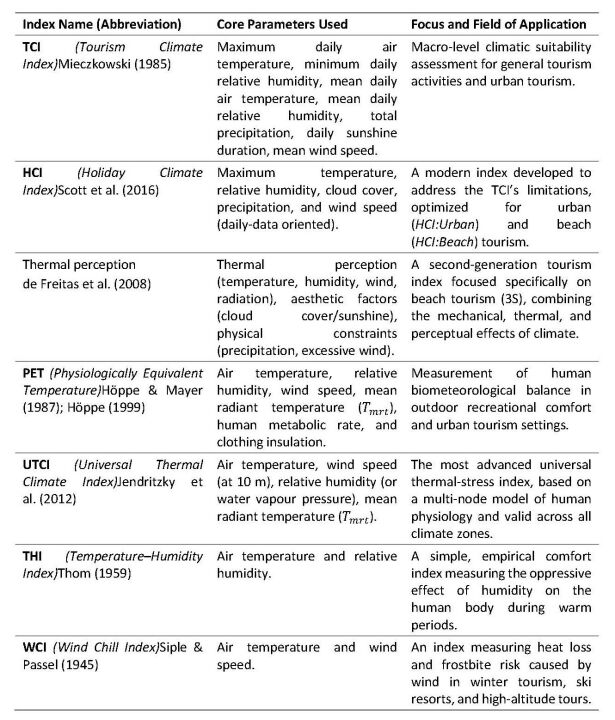
References
de Freitas, C. R. (2003). Tourism climatology: Evaluating environmental information for decision making and business planning in the recreation and tourism sector. International Journal of Biometeorology, 48(1), 45–54. https://doi.org/10.1007/s00484-003-0177-z; de Freitas, C. R. (2017). Tourism climatology past and present: A review of the role of the ISB Commission on Climate, Tourism and Recreation. International Journal of Biometeorology, 61(1), 107–114. https://doi.org/10.1007/s00484-016-1256-y; de Freitas, C. R., Scott, D., & McBoyle, G. (2008). A second generation climate index for tourism (CIT): Specification and verification. International Journal of Biometeorology, 52, 399–407. https://doi.org/10.1007/s00484-007-0134-3; Demiroglu, O. C., Saygili-Araci, F. S., Pacal, A., Hall, C. M., & Kurnaz, M. L. (2020). Future Holiday Climate Index (HCI) performance of urban and beach destinations in the Mediterranean. Atmosphere, 11(9), 911. https://doi.org/10.3390/atmos11090911; Demiroglu, O. C., Turp, M. T., Kurnaz, M. L., & Abegg, B. (2021). The Ski Climate Index (SCI): Fuzzification and a regional climate modeling application for Turkey. International Journal of Biometeorology, 65(5), 763–777. https://doi.org/10.1007/s00484-020-01991-0; García-León, D., Matei, N. A., Batista e Silva, F., Barranco, R., Dosio, A., & Ciscar, J.-C. (2025). European tourism demand in the face of climate change: Asymmetric impacts, demand reallocation, and deseasonalisation strategies. Environmental Research Letters, 20(2), 024043. https://doi.org/10.1088/1748-9326/adaa04; Höppe, P., & Mayer, H. (1987). Planungsrelevante Bewertung der thermischen Komponente des Stadtklimas. Landschaft + Stadt, 19, 22–29; Höppe, P. (1999). The physiological equivalent temperature—A universal index for the biometeorological assessment of the thermal environment. International Journal of Biometeorology, 43(2), 71–75. https://doi.org/10.1007/s004840050118; Jendritzky, G., de Dear, R., & Havenith, G. (2012). UTCI—Why another thermal index? International Journal of Biometeorology, 56(3), 421–428. https://doi.org/10.1007/s00484-011-0513-7; Matzarakis, A. (2006). Weather and climate related information for tourism. Tourism and Hospitality Planning & Development, 3(2), 99–115. https://doi.org/10.1080/14790530600938279; Matzarakis, A., de Freitas, C. R., & Scott, D. (Eds.). (2007). Developments in tourism climatology. Commission on Climate, Tourism and Recreation, International Society of Biometeorology; Mieczkowski, Z. (1985). The tourism climatic index: A method of evaluating world climates for tourism. The Canadian Geographer, 29(3), 220–233. https://doi.org/10.1111/j.1541-0064.1985.tb00365.x; Rutty, M., Scott, D., Matthews, L., Burrowes, R., Trotman, A., Mahon, R., & Charles, A. (2020). An inter-comparison of the Holiday Climate Index (HCI:Beach) and the Tourism Climate Index (TCI) to explain Canadian tourism arrivals to the Caribbean. Atmosphere, 11(4), 412. https://doi.org/10.3390/atmos11040412; Scott, D., & Lemieux, C. (2010). Weather and climate information for tourism. Procedia Environmental Sciences, 1, 146–183. https://doi.org/10.1016/j.proenv.2010.09.011; Scott, D., Jones, B., & McBoyle, G. (2006). Climate, tourism and recreation: A bibliography—1936 to 2006 (Working paper). University of Waterloo; Scott, D., Rutty, M., Amelung, B., & Tang, M. (2016). An inter-comparison of the Holiday Climate Index (HCI) and the Tourism Climate Index (TCI) in Europe. Atmosphere, 7(6), 80. https://doi.org/10.3390/atmos7060080; Siple, P. A., & Passel, C. F. (1945). Measurements of dry atmospheric cooling in subfreezing temperatures. Proceedings of the American Philosophical Society, 89(1), 177–199; Thom, E. C. (1959). The discomfort index. Weatherwise, 12(2), 57–61. https://doi.org/10.1080/00431672.1959.9926960