Tourism Morphology
Geography Cultural Geography
-
2026

Tourism morphology is a subfield that systematically examines the physical transformations produced by tourism in the built environment, land use, and the natural landscape, situating this inquiry at the intersection of urban geography and tourism planning. The terms destination morphology and resort morphology are used as alternative or context-specific expressions, the latter referring primarily to coastal tourism settings. The term morphology derives from the Greek word morphe ("form") and denotes an analytical approach that examines the physical structure of a phenomenon together with its transformation over time. The compound term tourism morphology emerged through the application of this urban-geographical approach to the study of tourism.
The disciplinary foundations of urban morphology date back to the work of German geographers at the end of the nineteenth century. Otto Schlüter (1899), who conceptualized the city as part of the broader landscape (Landschaft), is widely regarded as the founder of the field. Under his influence, the concept of the urban landscape (Stadtlandschaft) became central to human geography during the first three decades of the twentieth century. This intellectual tradition was subsequently developed within the British school of urban morphology through M.R.G. Conzen's Alnwick, Northumberland: A Study in Town-Plan Analysis (1960). The systematic use of the term tourism morphology in the academic literature accelerated from the late 2000s onward, particularly following the publication of Liu and Wall's (2009) study.
Who First Proposed or Used the Concept
Conzen established the theoretical foundations of the field (1960). Jinyang Liu and Geoffrey Wall systematically adapted these principles to tourism studies (2009), while Philip Feifan Xie and Kai Gu subsequently developed a comprehensive theoretical framework for tourism morphology (2018).
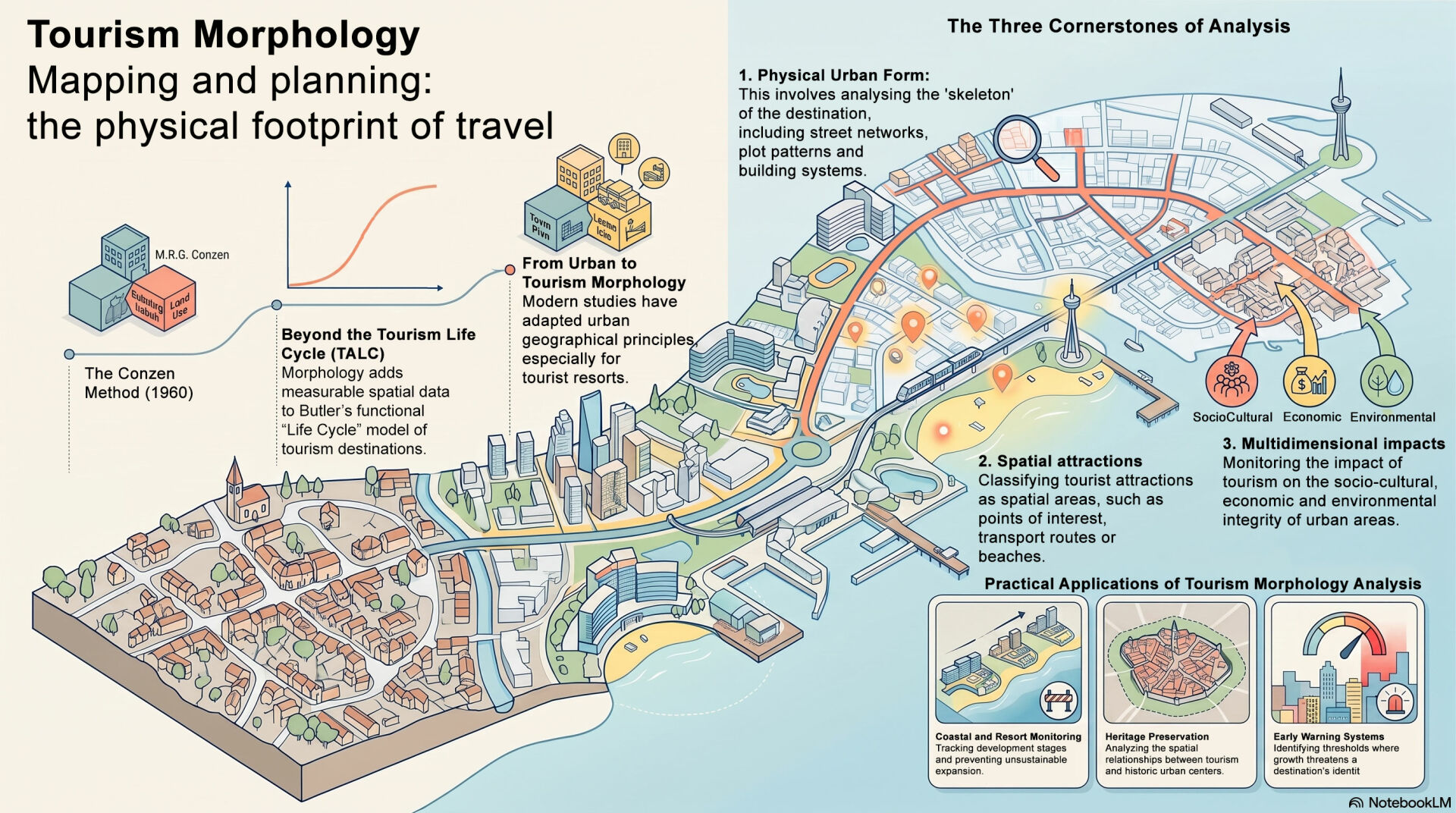
Urban morphology has historically evolved through two principal schools of thought: the British school pioneered by M.R.G. Conzen and the Italian school established by the architects Saverio Muratori and Gianfranco Caniggia (Whitehand, 2001; Maretto, 2013). Both traditions interpret the city as the cumulative outcome of individual and collective actions shaped by cultural conventions and long-term socioeconomic processes (Xie & Gu, 2018). Conzen's 1960 study of Alnwick established the methodological foundation of urban morphology through three analytical components—town plan, building fabric, and land use—while also introducing the concept of the fringe belt. Liu and Wall extended this tradition to tourism destinations through their article Resort Morphology Research: History and Future Perspectives (2009, Asia Pacific Journal of Tourism Research). Xie and Gu subsequently provided the field with a comprehensive theoretical framework in The Morphology of Tourism: Planning for Impact in Tourist Destinations (2018, Routledge), the first book-length publication devoted exclusively to tourism morphology (Xie & Gu, 2018).
Content and Scope
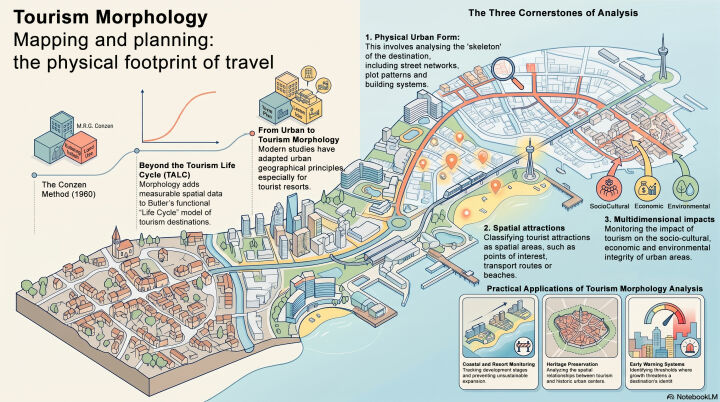
What physical imprint does tourism leave on a destination once it becomes established, and how does that imprint evolve over time? This question forms the starting point of tourism morphology. Liu and Wall (2009) defined destination morphology as the physical form of a destination, the functions associated with that form, and the processes through which both evolve. They argued that tourism-oriented settlements differ morphologically from other urban areas precisely because of their distinctive functional characteristics. Xie (2022), in turn, conceptualized tourism morphology as a multidimensional field in which urban morphology and tourism are integrated. This multidimensional perspective is reflected in three principal analytical components. The first comprises the urban form, including the natural environment together with street networks, plot patterns, and building systems. The second consists of tourism attractions, classified as points, lines, and areas, including points of interest, transportation routes, and spatial units such as beaches, parks, and tourism centers. The third encompasses the sociocultural, economic, environmental, and spatial impacts that tourism generates on urban form (Xie, 2022). Analyses based on these three components converge on four principal areas of application: (I) monitoring the developmental stages of coastal and resort settlements; (II) analyzing the spatial dimensions of the relationship between tourism and heritage conservation in historic urban centers; (III) examining the transformation of fringe belts under tourism pressure; and (IV) developing early-warning systems for destination planning.
Xie and Gu (2018) examined this conceptual framework through four case-study regions. These empirical investigations explored coastal resort morphology on Denarau Island, Fiji; destination morphology in a historic Chinese city; the redevelopment of the waterfronts of Auckland and Wellington in New Zealand; and fringe-belt transformation in the historic tourist city of Como, Italy. Similarly, Pratomo et al. (2022) investigated the morphology of urban riverfronts within the context of cultural heritage tourism planning in Indonesia.
These case studies also demonstrate why tourism morphology cannot rely solely on existing theoretical models. Butler's (1980) Tourist Area Life Cycle (TALC) model explains the functional and economic evolution of destinations through the stages of exploration, involvement, development, consolidation, stagnation, and rejuvenation or decline. However, it pays relatively little attention to the physical form of destinations and does not explicitly define the spatial characteristics associated with each stage. Tourism morphology seeks to address this limitation by making the physical and spatial dimensions of destination evolution observable, measurable, and comparable through cartographic, morphological, and statistical analysis.
Definitions and Findings in the Literature
The theoretical foundation of tourism morphology is based on three principal sources. The first is the Conzenian tradition of urban morphology, which interprets the historical layers of urban form through the analytical triad of street patterns, plot structure, and building fabric. The second is Butler's (1980) Tourist Area Life Cycle (TALC) model, which defines the functional stages of destination development but does not address their spatial counterparts. The third comprises tourism clustering studies conducted from the 1990s onward in historic European cities such as Venice, Prague, and Bruges. These studies demonstrated empirically that the concentration of tourism activities leads to functional changes at the plot level, alterations in street-network accessibility, and aesthetic modifications to building façades.
The concepts of resort morphology and tourism development were first introduced by Gilbert, whose 1939 study examined the growth patterns of English seaside resorts. This early conceptualization subsequently evolved along different theoretical trajectories before being reintegrated into evolutionary models between the 1970s and the 1990s. In the North American context, Wolfe's pioneering research during the 1950s examined the historical development of the Wasaga Beach resort area in Ontario, Canada, thereby broadening the research agenda concerning the relationships among recreational migration, tourism flows, and urban development.
Within the framework of coastal resort models, Barrett (1958) and Stansfield and Rickert (1970) demonstrated that increasing land values along coastlines encourage the emergence of linear commercial districts specializing in tourism. Butler's (2014) interpretation of the TALC model argues that such development may eventually exceed the carrying capacity of destinations, while Weaver (1993) emphasizes the emergence of both physical and social barriers separating local residents from visitors. Andriotis (2006) documented the spatial expansion that occurs when agricultural land is converted into second-home developments along unplanned coastal zones. More recently, Andriotis et al. (2024) examined this framework in Turkish coastal destinations using the Tourism Business District (TBD) model.
At the urban scale, the most comprehensive analytical framework is Ashworth and Tunbridge's (2000) tourist-historic city model. This model explains the concentration of food-and-beverage establishments and cultural functions within historic urban cores, while accommodation facilities tend to cluster in peripheral areas because of accessibility requirements. Similarly, the fringe-belt concept, originally developed in Conzen's (1960) Alnwick study, describes transitional zones that emerge during periods of limited urban expansion and accommodate large-plot land uses such as green spaces, institutional buildings, and military facilities. Within tourism morphology, these areas are regarded as strategic buffer zones that preserve the ecological, historical, and spatial continuity of destinations.
Debates and Current Approaches
Tourism morphology is a field that has not yet achieved full theoretical maturity. Mandaka et al.'s bibliometric analysis of publications indexed in Scopus over the past decade likewise demonstrates that the field continues to exhibit a fragmented publication pattern and limited interdisciplinary integration (2024). Liu and Wall (2009) argued that the complexity of the contextual factors shaping resort morphology has not been adequately addressed and emphasized the need for a more systematic research framework. They further noted that directly transferring models developed in Western contexts to Asian destinations is problematic because of differences in the pace, scale, and timing of tourism development. Similarly, Xie (2022), while recognizing the close relationship between urban morphology and tourism, concluded that the two bodies of literature remain only weakly integrated.
Current research trends increasingly focus on the application of Geographic Information Systems (GIS), geospatial big data, and advanced spatial analysis techniques. Liu and Wall (2009) emphasized that GIS provides powerful analytical capabilities for evaluating the accessibility of tourism facilities, examining the spatial concentration or dispersion of tourism activities, and monitoring morphological change through remote sensing technologies. Zheng et al. (2025), in their analysis of 406 tourism destinations across China, developed a comprehensive morphological assessment framework based on points, lines, planes, and solids. Their findings demonstrated that dense road networks and fragmented landscapes frequently develop simultaneously and that morphological characteristics vary according to the cultural or natural resource base of destinations. Space syntax, three-dimensional architectural component analysis, and geospatial artificial intelligence applications—although some remain at an early stage of development—have emerged as the principal directions of contemporary research.
From a practical perspective, tourism morphology seeks to transform analytical findings into early-warning systems capable of identifying thresholds beyond which tourism growth becomes unsustainable. It also aims to strengthen urban resilience through spatial planning strategies, including the establishment of coastal buffer zones and green corridors. Göker (2025) demonstrated that the quality of the spatial experience in coastal tourism exerts a direct positive influence on destination image and visitors' psychological well-being, which subsequently strengthens revisit intentions. This finding further illustrates the close relationship between tourism morphology and tourist behaviour.
The critical literature has also drawn attention to the potential loss of place identity resulting from tourism-induced spatial transformation. Xie and Gu (2018) argued that excessively touristified cities risk losing their distinctive sense of place and gradually evolving toward a condition of "placelessness." As an illustration, they pointed to the increasing dominance of tourist-oriented retail establishments over local businesses in metropolitan destinations such as Hong Kong and Macau. Similarly, Rothman's (1998) concept of the "devil's bargain" suggests that tourism generates an ongoing struggle over the spirit and identity of places, while Hannigan's (1998) notion of the "fantasy city" describes new urban environments deliberately designed for placemaking and place marketing. Together, these perspectives demonstrate that tourism morphology encompasses not only spatial transformation but also the cultural, social, and ethical dimensions of destination development.
References
Andriotis, K. (2006). Hosts, guests and politics: Coastal resorts morphological change. Annals of Tourism Research, 33(4), 1079–1098. https://doi.org/10.1016/j.annals.2006.04.003; Andriotis, K., Uşun, Ö. F., & Dinç, Y. (2024). Determining the model of tourism business district (TBD) in coastal resorts: A case study of Turkey. Geographical Review, 114(1), 31–50. https://doi.org/10.1080/00167428.2023.2174436; Ashworth, G. J., & Tunbridge, J. E. (2000). The tourist-historic city. Routledge; Barrett, J. A. (1958). The seaside resort towns of England and Wales (Doctoral dissertation, Queen Mary University of London). http://qmro.qmul.ac.uk/xmlui/handle/123456789/1380; Butler, R. W. (1980). The concept of a tourist area cycle of evolution: Implications for management of resources. The Canadian Geographer / Le Géographe canadien, 24(1), 5–12. https://doi.org/10.1111/j.1541-0064.1980.tb00970.x; Butler, R. (2014). Coastal tourist resorts: History, development and models. ACE: Architecture, City and Environment, 9(25), 203–228. https://doi.org/10.5821/ace.9.25.3626; Conzen, M. R. G. (1960). Alnwick, Northumberland: A study in town-plan analysis. Institute of British Geographers. https://doi.org/10.2307/621094; Gilbert, E. W. (1939). The growth of inland and seaside health resorts in England. Scottish Geographical Magazine, 55(1), 16–35. https://doi.org/10.1080/00369223908735100; Göker, G. (2025). Kıyı turizm deneyiminin destinasyon imaj algısı ve davranışsal niyete etkisinde mental iyi oluşun aracılık rolü. Yaşar Üniversitesi E-Dergisi, 20(80), 714–738. https://doi.org/10.19168/jyasar.1649888; Hannigan, J. (1998). Fantasy city: Pleasure and profit in the postmodern metropolis. Routledge; Liu, J., & Wall, G. (2009). Resort morphology research: History and future perspectives. Asia Pacific Journal of Tourism Research, 14(4), 339–350. https://doi.org/10.1080/10941660903310029; Mandaka, M., Nuryanti, W., & Widyastuti, D. T. (2024). Unveiling research trends in tourism morphology: A study of Scopus publications over the last decade. SSRN. https://doi.org/10.2139/ssrn.4941058; Maretto, M. (2013). Saverio Muratori: Towards a morphological school of urban design. Urban Morphology, 17(2), 93–106. https://doi.org/10.51347/jum.v17i2.3990; Pratomo, S., Anwar, W. F. F., & Roychansyah, M. S. (2022). Urban riverside morphology in cultural heritage area tourism planning. In International Academic Conference on Tourism (INTACT 2022): Post Pandemic Tourism: Trends and Future Directions (pp. 462–471). Atlantis Press. https://doi.org/10.2991/978-2-494069-73-2_33; Rothman, H. (1998). Devil's bargains: Tourism in the twentieth-century American West. University Press of Kansas; Schlüter, O. (1899). Bemerkungen zur Siedlungsgeographie. Geographische Zeitschrift, 5, 65–84. https://www.jstor.org/stable/27803584; Stansfield, C. A., Jr., & Rickert, J. E. (1970). The recreational business district. Journal of Leisure Research, 2(4), 213–225. https://doi.org/10.1080/00222216.1970.11970002; Weaver, D. B. (1993). Model of urban tourism for small Caribbean islands. Geographical Review, 83(2), 134–140. https://doi.org/10.2307/215251; Whitehand, J. W. R. (2001). British urban morphology: The Conzenian tradition. Urban Morphology, 5(2), 103–109. https://doi.org/10.51347/jum.v5i2.3896; Wolfe, R. I. (1952). Wasaga Beach: The divorce from the geographic environment. The Canadian Geographer / Le Géographe canadien, 1(2), 57–66. https://doi.org/10.1111/j.1541-0064.1952.tb01711.x; Xie, P. F. (2022). Towards a framework for the morphology of tourism. Tourism Planning & Development, 19(5), 377–391. https://doi.org/10.1080/21568316.2022.2072945; Xie, P. F., & Gu, K. (2011). Urban morphology and tourism planning: Exploring the city wall in Pingyao, China. Journal of China Tourism Research, 7(2), 229–242. https://doi.org/10.1080/19388160.2011.576938; Xie, P. F., & Gu, K. (2018). The morphology of tourism: Planning for impact in tourist destinations. Routledge; Zheng, Y., Liu, Z., Zhang, Y., et al. (2025). The morphology across tourism destinations: A case study in China. Journal of Geographical Sciences, 35, 2467–2489. https://doi.org/10.1007/s11442-025-2421-5
See Also: