Tourism Supply Capacity
DISCIPLINES, CONCEPTS, AND RESEARCH AREAS Economics Tourism Economics
-
2026

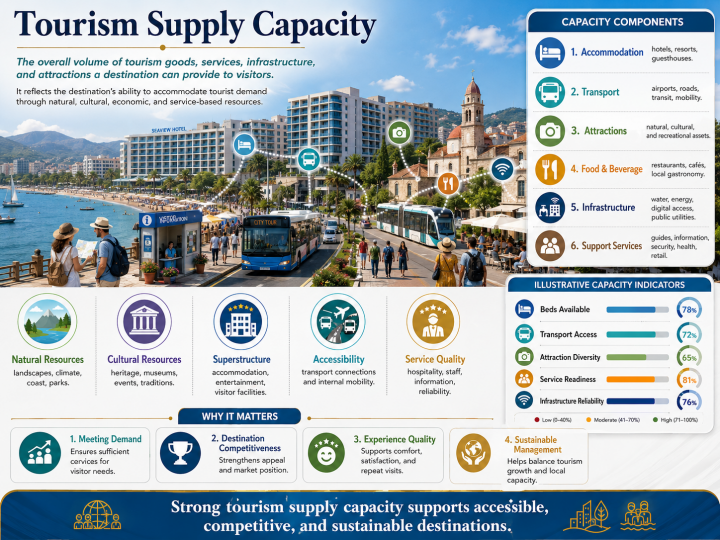
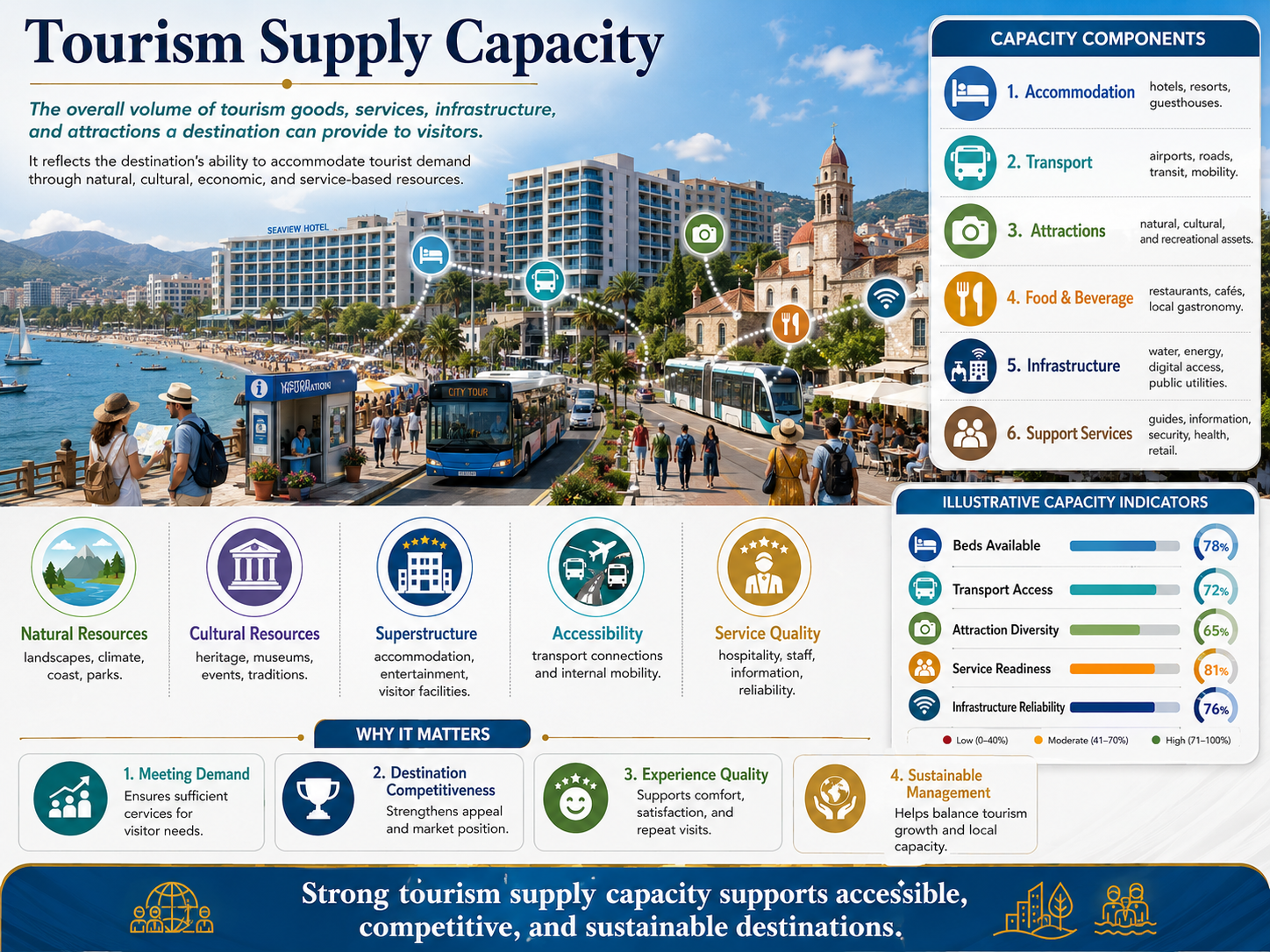
In dictionary terms, capacity refers to the amount that something can contain, its holding capability, the number of people or objects that can fit into a given area, or the production volume of an enterprise. Supply, on the other hand, refers to the act of offering, placing goods on the market, or presenting goods and services. Tourism supply is defined as the collection of tourism resources that a country is prepared to offer to tourists under certain conditions or as the set of goods and services made available to tourists in a particular market at a given price or free of charge. As a broad concept encompassing numerous components, tourism supply is generally classified into two categories: independent supply and dependent supply. The natural, historical, and cultural attractions of a region, together with hospitality and sacred sites, constitute the independent tourism supply. In contrast, the dependent tourism supply consists of the provision of tourism goods and services through facilities equipped with the necessary infrastructure and superstructure, enabling tourists to utilize these independent tourism resources for touristic purposes. The literature generally indicates that tourism supply comprises both tangible and intangible elements, including natural resources; historical, social, and cultural resources; infrastructure; tourism superstructure; services; and hospitality. When the components of tourism supply are evaluated at the scale of a geographical region or destination, they represent that region’s tourism supply potential. However, tourism supply potential does not fully correspond to actual tourism supply. In particular, transforming natural and socio-cultural assets into economic value for tourism—or, in other words, converting them into geo-economic assets—is possible only through the development of infrastructure and superstructure that enable tourists to access and benefit from these resources. In other words, the utilization of freely available resources suitable for tourism leads to the emergence of a destination as a tourist destination.
Within this framework, tourism supply capacity should be assessed from two perspectives: potential tourism supply capacity and actual tourism supply capacity. Potential tourism supply capacity refers to the quantity of tourism supply elements that a destination possesses, measured according to carrying-capacity criteria within the framework of sustainability principles. Actual tourism supply capacity, on the other hand, reflects the current level of utilization of a destination’s tourism supply elements. In other words, tourism supply capacity refers to the extent to which a destination’s natural, historical, cultural, and other attractions that are ready for use are actually utilized by tourists. It also encompasses the destination’s existing infrastructure components—such as transportation, healthcare, security, and information services—as well as its tourism superstructure, including the number of tourism enterprises—such as accommodation facilities, food and beverage establishments, entertainment venues, recreational facilities, and travel agencies—established to meet the diverse needs and expectations of visitors. In this context, for example, Olalı and Timur identify the number of available beds in a destination as the primary indicator of tourism supply capacity from an economic perspective, arguing that the economic dimension of tourism supply is essentially represented by bed capacity.
References
Avcı, N. (2007). Turizmde Taşıma Kapasitesinin Önemi, Ege Akademik Bakış/Ege Academic Review, 7(2): 485-501; Bahar, O. ve Kozak, M. (2018). Turizm Ekonomisi (Sekizinci baskı). Ankara: Detay Yayıncılık; Collander, D.C. (1993). Economics. ABD:Richard D.Irwin, Inc; İçöz, O. ve Kozak M. (2002). Turizm Ekonomisi, (İkinci baskı). Ankara: Turhan Kitabevi; Olalı, H. ve Timur, A. (1988). Turizm Ekonomisi, İzmir: Ofis Matbaacılık San. Ltd. Şti; https://sozluk.gov.tr/kelime/kapasite, (Erişim tarihi: 31.08.2026).