Touristic Lifestyle
Basic Research Theoretical Research DISCIPLINES, CONCEPTS, AND RESEARCH AREAS Sociology Sociology of Tourism Psychology Recreation Psychology
-
2026

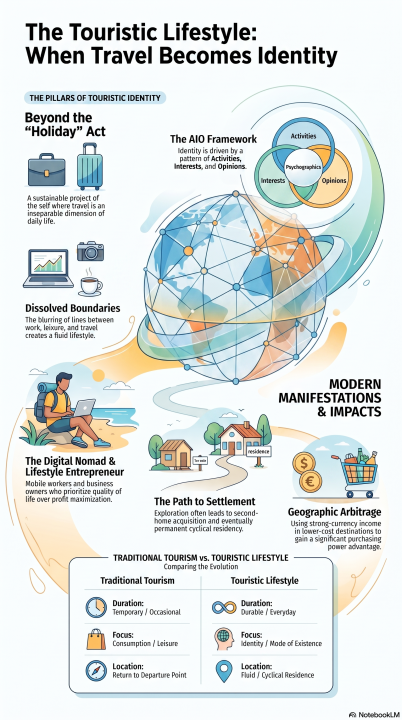
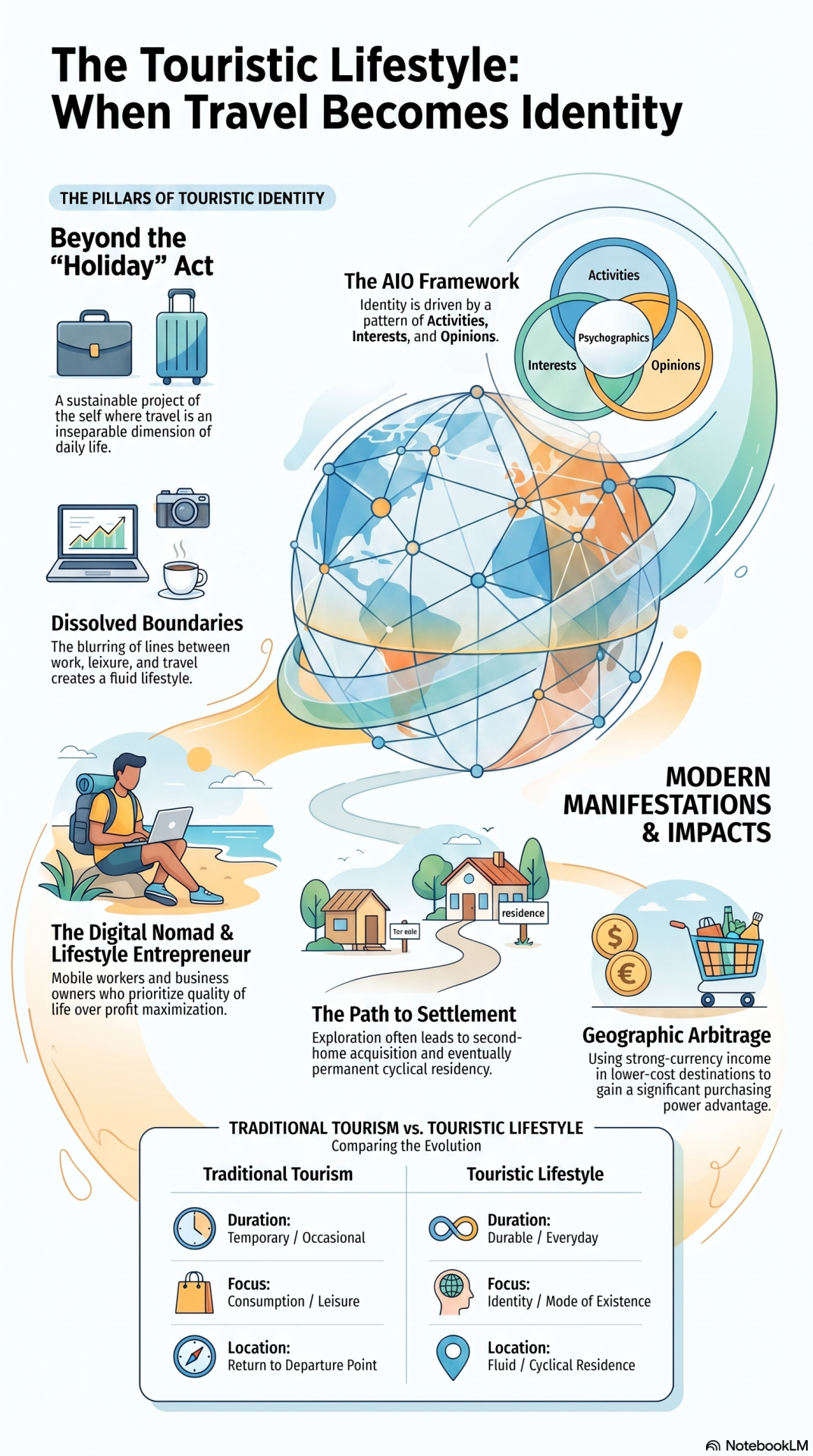
Touristic lifestyle denotes a multidimensional way of living, grounded in mobility and the pursuit of authentic experience, through which individuals convert travel from an occasional holiday act into a durable form of everyday identity.
Alternative labels such as tourist lifestyle and lifestyle mobilities recur throughout the literature. Closely related terms include lifestyle migration and residential tourism.
Etymological Origin
The English word “lifestyle” is a compound of “life” and “style,” yet the concept’s origin is not a purely linguistic pairing. The Austrian psychiatrist Alfred Adler first employed the term, in its German equivalent Lebensstil, as a central construct of individual psychology, using it to describe the largely unconscious, goal-directed organization of personality that takes shape in childhood. Plummer (1974) later carried the term into the marketing and consumer-behavior literature as a psychographic measurement tool.
“Tourism” follows a different etymological path. The word derives from the Greek tornos, a tool for drawing circles — that is, a compass — and so denotes a turning motion. This Greek root passed into Latin as tornus and tornare (to shape or turn on a lathe), and from there into Old French as tour (a turn, circuit, or excursion). The English word “tourist” entered the language in 1772, and “tourism” followed in 1811 (Richter & Theobald, 1994). The cyclical motion embedded in this etymology — movement that presupposes a return to the point of departure — also grounds the reading of touristic lifestyle as a recurring mobility rather than a permanent settlement.
Originator(s) of the Concept
Touristic lifestyle is not a unified theory advanced by a single thinker. Rather, it emerged at the intersection of five theoretical strands that developed in sequence and gradually converged.
Joseph T. Plummer introduced lifestyle to marketing as a psychographic segmentation tool in 1974, developing the AIO (activities, interests, opinions) framework. Jurdao Arrones (1979) contributed the term turismo residencial (residential tourism) to the literature. Benson and O’Reilly (2009) transformed lifestyle migration into a systematic sociological research program, defining it as a migration decision grounded in the belief in a better way of life. Cohen (2011) revisited Erik Cohen’s 1972 drifter typology to develop the concept of the lifestyle traveller. Finally, Cohen et al. (2013) proposed an integrative conceptualization that brought these strands together under the heading of lifestyle mobilities.
Content and Scope
Touristic lifestyle is a multicomponent concept through which individuals adopt travel and tourism experience as an inseparable dimension of everyday life. Far beyond the phenomenon of the holiday, it encompasses identity construction, forms of spatial belonging, and the pursuit of quality of life.
Core components of the concept:
Psychographic orientation: this dimension, denoting the behavioral pattern formed by activities, interests, and opinions, has translated into concrete marketing applications — as in Srihadi, Hartoyo, Sukandar, and Soehadi’s (2016) segmentation of the Indonesian tourist market into six lifestyle segments, and Stoyanova’s (2018) psychographic profiling of spa and wellness tourists in Bulgaria (Plummer, 1974).
Tourist involvement and place attachment: a six-factor measurement model validated in South Australia bridges Plummer’s (1974) AIO framework and Benson and O’Reilly’s (2009) emphasis on spatial settlement.
Mobility and fluidity: the dissolution of boundaries between work, leisure, and travel (Sheller & Urry, 2006; Cohen, Duncan, & Thulemark, 2015).
Identity construction: the transformation of the touristic experience, through a staged pattern spanning pre-consumption, consumption, and post-consumption, into a sustainable project of the self (Cohen, 2011; Bredvold & Skålén, 2016; Uriely, 2005).
Spatial settlement: the evolution of touristic visits into permanent or cyclical forms of residence (Benson & O’Reilly, 2009; O’Reilly, 2000).
Economic production: entrepreneurial forms that prioritize quality of life over profit maximization (Ateljevic & Doorne, 2000; Morrison, 2006).
Fields of application and contexts of use:
The concept functions differently across five distinct disciplinary fields. In tourism marketing, it serves as the principal tool for psychographic target-audience segmentation (Plummer, 1974; Woodside & Pitts, 1976; Srihadi, Hartoyo, Sukandar, & Soehadi, 2016). In human geography, it offers a framework for explaining international migration and settlement patterns (Benson & O’Reilly, 2009; King, Warnes, & Williams, 2000; Hayes, 2014). In sociology, it extends the new mobilities paradigm by conceptualizing the permeable boundaries among work, leisure, and travel (Sheller & Urry, 2006; Hannam, Sheller, & Urry, 2006; Cohen, Duncan, & Thulemark, 2015). In entrepreneurship studies, it accounts for business models that are not growth-oriented and instead prioritize quality of life (Ateljevic & Doorne, 2000; Bosworth & Farrell, 2011; Bredvold & Skålén, 2016). In cultural studies, it informs analyses of identity, status, and community belonging (Bauman, 1998; Maffesoli, 1996; Cohen, 2011).
Distinction from related concepts:
Touristic lifestyle diverges from the classical tourist typology (Plog, 1974; Cohen, 1972) in that these typologies describe a temporary travel inclination rather than a sustained mode of existence. This classical typological line traces back further still: Gray (1970) divided tourists into sun-sea-sand-oriented vacationers (sunlust) and exploration-driven travelers (wanderlust), while Smith (1989) expanded this binary — and Cohen’s (1972) fourfold classification — into seven categories. These early typologies are now regarded as conceptual precursors to psychographic segmentation, yet none carries the dimension of permanent identity and mode of existence that touristic lifestyle claims. Unlike lifestyle migration, touristic lifestyle does not necessarily entail geographic relocation.
Definition and the State of the Literature
The concept of lifestyle is grounded in the AIO framework Plummer (1974) developed; faced with the limits of demographic variables in explaining consumption preferences, this psychographic approach proved more explanatory of tourist behavior than socio-demographic variables, as Woodside and Pitts (1976) found. Urry’s (1990) conceptualization of the tourist gaze, which holds that everyday life is shaped by a touristic mode of looking, established one of the field’s theoretical foundations; Sheller and Urry (2006) extended this line by uniting tourism and migration under a single mobilities framework within the new mobilities paradigm.
Benson and O’Reilly (2009) defined lifestyle migration as a critical framework grounded in the search for a better life, and in their 2016 study extended the concept from lifestyle migration toward lifestyle in migration. Williams and Hall (2002), together with Torkington (2012), showed that tourism serves as the primary gateway into this migration and that the process unfolds in four stages: touristic exploration, second-home acquisition within Hall and Müller’s (2004) framework, seasonal or extended stays, and, eventually, permanent settlement. This staged model performs an integrative function, linking overlapping concepts such as retirement migration, second-home mobility, and amenity migration; O’Reilly’s (2000) ethnographic study of British migrants on the Costa del Sol was the first to demonstrate empirically the interweaving of tourism and migration.
Cohen, Duncan, and Thulemark (2015) deepened the definition by arguing that the boundaries among work, leisure, and travel have dissolved; Cohen (2011) theorized long-term backpacking as a sustainable alternative lifestyle through the concept of the lifestyle traveller. Uriely (2005), for his part, contended that the postmodern tourist experience can no longer be distinguished from everyday life.
In recent years, the digital nomadism literature has developed in close relation to this concept. As Woldoff and colleagues (2021) define it, the digital nomad is a mobile worker who, thanks to information and communication technologies, carries out work remotely while traveling. Hannonen (2020) offered a conceptual definition of the phenomenon, while Kozak and colleagues (2024) assessed the work–leisure patterns that distinguish digital nomads from tourists.
The principal difference among these definitions turns on whether the emphasis falls on spatial settlement (Benson & O’Reilly, 2009; Hall & Müller, 2004), psychographic segmentation (Plummer, 1974; Srihadi, Hartoyo, Sukandar, & Soehadi, 2016), or mobility and fluidity (Sheller & Urry, 2006). The common thread is the emphasis on tourism’s transformation from a temporary act of consumption into a lasting form of identity and existence.
Debates and Current Approaches
Although lifestyle-oriented travel and migration are romanticized in popular discourse through narratives of liberation and personal growth, the critical literature also reads the concept as a structural mechanism that deepens inequality. Bauman (1998) captured the globalizing world through the metaphor of the Tourist and the Vagabond, arguing that the same mobility is liberating for the upper classes and a necessity for the poor. Extending this line, Hayes (2014, 2018) developed the concept of geographic arbitrage to describe how migrants from the Global North spend strong-currency incomes in lower-cost Global South destinations, gaining a purchasing-power advantage; she showed that this dynamic drives speculative price increases in local housing markets and spatially displaces local populations, particularly fixed-income older residents.
In the entrepreneurship literature, lifestyle entrepreneurship, as defined by Ateljevic and Doorne (2000), denotes a business orientation that prioritizes quality of life over profit; Williams, Shaw, and Greenwood (1989), drawing on the Cornwall case, found that these businesses’ lack of growth reflects a deliberate choice rather than external failure. Maffesoli (1996) added a sociological dimension to the debate through the concept of neo-tribalism, emphasizing the emotional bonds that draw together communities sharing similar lifestyles.
In the Turkish context, the concept can be read on two levels. At the international level, the Benson and O’Reilly (2009) framework has frequently been applied to coastal cases: the British community in Fethiye (Bennett-Cook, 2023), British settlers in Didim (Nudralı & O’Reilly, 2009), and European retiree migrants along Turkey’s coastal regions (Südaş & Balkır, 2014) have all been examined through this lens. The intense in-migration and gentrification pressure experienced in destinations such as Bodrum, Fethiye, and Alanya have pushed first-wave migrants toward a secondary displacement into more remote destinations, a dynamic also documented in Özyurt’s (2023) study of Alanya from a eudaimonic well-being perspective. At the level of internal migration, studies examining lifestyle migration from Istanbul to Izmir show that migrants associate Izmir with its coastline, temperate climate, and liberal social atmosphere; this finding indicates that the concept manifests in Turkey not only as an international but also as a domestic form of mobility.
The digital nomad visa, introduced in 2024, has opened a new research agenda in the field: Günay, Toksöz, and Aslan (2024) examined the experiences of digital nomad families through a phenomenological study, while Taşdelen (2023) identified local hospitality as a factor placing Turkey seventh among global digital nomads’ preferred destinations, alongside language and administrative constraints as the principal structural barriers. At the practical level, the concept underpins target-audience identification in tourism marketing and informs regional development policy.
References
Ateljevic, I., & Doorne, S. (2000). Staying within the fence: Lifestyle entrepreneurship in tourism. Journal of Sustainable Tourism, 8(5), 378–392. https://doi.org/10.1080/09669580008667374; Bauman, Z. (1998). Globalization: The human consequences. Columbia University Press; Bennett-Cook, R. (2023). Fethiye: Turkey’s ‘Little Britain’ – Residential tourists’ identity and relationships. Journal of Tourism and Cultural Change, 21(1), 38–53. https://doi.org/10.1080/14766825.2022.2120817; Benson, M., & O’Reilly, K. (2009). Lifestyle migration: Expectations, aspirations and experiences. Ashgate; Benson, M., & O’Reilly, K. (2009). Migration and the search for a better way of life: A critical exploration of lifestyle migration. The Sociological Review, 57(4), 608–625. https://doi.org/10.1111/j.1467-954X.2009.01864.x; Benson, M., & O’Reilly, K. (2016). From lifestyle migration to lifestyle in migration: Categories, concepts and ways of thinking. Migration Studies, 4(1), 20–37. https://doi.org/10.1093/migration/mnv015; Bosworth, G., & Farrell, H. (2011). Tourism entrepreneurs in Northumberland. Annals of Tourism Research, 38(4), 1474–1494. https://doi.org/10.1016/j.annals.2011.03.015; Bredvold, R., & Skålén, P. (2016). Lifestyle entrepreneurs and their identity construction: A study of the tourism industry. Tourism Management, 56, 96–105. https://doi.org/10.1016/j.tourman.2016.03.023; Cohen, E. (1972). Toward a sociology of international tourism. Social Research, 39(1), 164–189. https://www.jstor.org/stable/40970087; Cohen, S. A. (2011). Lifestyle travellers: Backpacking as a way of life. Annals of Tourism Research, 38(4), 1535–1555. https://doi.org/10.1016/j.annals.2011.02.002; Cohen, S. A., Duncan, T., & Thulemark, M. (2015). Lifestyle mobilities: The crossroads of travel, leisure and migration. Mobilities, 10(1), 155–172. https://doi.org/10.1080/17450101.2013.826481; Duncan, T., Cohen, S. A., & Thulemark, M. (Eds.). (2013). Lifestyle mobilities: Intersections of travel, leisure and migration. Ashgate; Gray, H. P. (1970). International travel—International trade. Lexington Books; Günay, F., Toksöz, D., & Aslan, Z. (2024). The causes, process and result of becoming a digital nomad family: A phenomenological case study. Worldwide Hospitality and Tourism Themes, 16(3), 294–302. https://doi.org/10.1108/WHATT-03-2024-0042; Hall, C. M., & Müller, D. K. (Eds.). (2004). Tourism, mobility and second homes: Between elite landscape and common ground. Channel View Publications; Hannam, K., Sheller, M., & Urry, J. (2006). Editorial: Mobilities, immobilities and moorings. Mobilities, 1(1), 1–22. https://doi.org/10.1080/17450100500489189; Hannonen, O. (2020). In search of a digital nomad: Defining the phenomenon. Information Technology & Tourism, 22(3), 335–353. https://doi.org/10.1007/s40558-020-00177-z; Hayes, M. (2014). “We gained a lot over what we would have had”: The geographic arbitrage of North American lifestyle migrants to Cuenca, Ecuador. Journal of Ethnic and Migration Studies, 40(12), 1953–1971. https://doi.org/10.1080/1369183X.2014.880335; Hayes, M. (2018). Gringolandia: Lifestyle migration under late capitalism. University of Minnesota Press; Jurdao Arrones, F. (1979). España en venta: Compra de suelo por extranjeros y colonización de campesinos en la Costa del Sol. Ayuso; King, R., Warnes, T., & Williams, A. (2000). Sunset lives: British retirement to the Mediterranean. Berg Publishers; Kozak, M., Cetin, G., & Alrawadieh, Z. (2024). Repositioning work and leisure: Digital nomads versus tourists. International Journal of Tourism Research, 26(4), e2732. https://doi.org/10.1002/jtr.2732; Maffesoli, M. (1996). The time of the tribes: The decline of individualism in mass society (D. Smith, Trans.). Sage; Morrison, A. (2006). A contextualisation of entrepreneurship. International Journal of Entrepreneurial Behavior & Research, 12(4), 192–209. https://doi.org/10.1108/13552550610679159; Nudralı, Ö., & O’Reilly, K. (2009). Taking the risk: The British in Didim, Turkey. İçinde M. Benson & K. O’Reilly (Eds.), Lifestyle migration: Expectations, aspirations and experiences (ss. 126–152). Ashgate; O’Reilly, K. (2000). The British on the Costa del Sol: Transnational identities and local communities. Routledge; Özyurt, P. M. (2023). Moving lifestyle migration beyond the sun: A eudaimonic well-being approach. Journal of Tourism and Cultural Change, 21(4), 484–500. https://doi.org/10.1080/14766825.2022.2161908; Plog, S. C. (1974). Why destination areas rise and fall in popularity. Cornell Hotel and Restaurant Administration Quarterly, 14(4), 55–58. https://doi.org/10.1177/001088047401400409; Plummer, J. T. (1974). The concept and application of life-style segmentation. Journal of Marketing, 38(1), 33–37. https://doi.org/10.2307/1250164; Richter, L. K., & Theobald, W. (1994). Global tourism: The next decade: Exploring political roles of gender in tourism research; Sheller, M., & Urry, J. (2006). The new mobilities paradigm. Environment and Planning A, 38(2), 207–226. https://doi.org/10.1068/a37268; Smith, V. (Ed.). (1989). Hosts and guests: The anthropology of tourism (2nd ed.). University of Pennsylvania Press; Srihadi, T. F., Hartoyo, Sukandar, D., & Soehadi, A. W. (2016). Segmentation of the tourism market for Jakarta: Classification of foreign visitors’ lifestyle typologies. Tourism Management Perspectives, 19(A), 32–39. https://doi.org/10.1016/j.tmp.2016.04.002; Stoyanova, M. (2018). Psychological and psychographic profiles of spa and wellness tourists in Bulgaria. İçinde Traditions and innovations in contemporary tourism (ss. 114–125). Academic Publishing House “Science and Economics”; Südaş, İ., & Balkır, C. (2014). Guests and hosts: European retirees in coastal Turkey. Insight Turkey, 16(4), 123–142; Taşdelen, H. (2023). A qualitative study on Turkey’s image perception from the perspective of digital nomads [in Turkish]. Selçuk İletişim, 16(2), 293–322. https://doi.org/10.18094/josc.1286057; Torkington, K. (2012). Place and lifestyle migration: The discursive construction of ‘glocal’ place-identity. Mobilities, 7(1), 71–92. https://doi.org/10.1080/17450101.2012.631812; Uriely, N. (2005). The tourist experience: Conceptual developments. Annals of Tourism Research, 32(1), 199–216. https://doi.org/10.1016/j.annals.2004.07.008; Urry, J. (1990). The tourist gaze: Leisure and travel in contemporary societies. Sage; Williams, A. M., & Hall, C. M. (2002). Tourism, migration, circulation and mobility. İçinde C. M. Hall & A. M. Williams (Eds.), Tourism and migration: New relationships between production and consumption (ss. 1–52). Kluwer Academic Publishers; Williams, A. M., Shaw, G., & Greenwood, J. (1989). From tourist to tourism entrepreneur, from consumption to production: Evidence from Cornwall, England. Environment and Planning A, 21(12), 1639–1653; Woldoff, R. A., Woldoff, R., & Litchfield, R. C. (2021). Digital nomads: In search of freedom, community, and meaningful work in the new economy. Oxford University Press; Woodside, A. G., & Pitts, R. E. (1976). Effects of consumer life-styles, demographics, and travel activities on foreign and domestic travel behavior. Journal of Travel Research, 14(3), 13–15. https://doi.org/10.1177/004728757601400304
See Also
Residential tourism; Lifestyle mobilities
See Also: