Allocentric Tourist
DISCIPLINES, CONCEPTS, AND RESEARCH AREAS Business and Management Sciences Marketing
-
2026

Stanley Plog developed a seminal psychographic model of tourism based on personality type theory. Within this framework, tourists are classified along a continuum anchored by two contrasting poles: psychocentric (introverted) and allocentric (extroverted). Plog’s model remains one of the most widely recognized tourist typologies in the tourism literature, providing a framework for understanding how personality influences destination preferences and travel behavior.
Allocentric tourists exhibit a strong preference for independent, unplanned travel to remote and lesser-known destinations. In contrast, psychocentric tourists tend to participate in organized package tours and favor familiar, well-developed tourism environments. Subsequent refinements of the model acknowledge that most tourists occupy a midcentric position along the continuum, while relatively few fall at either extreme.
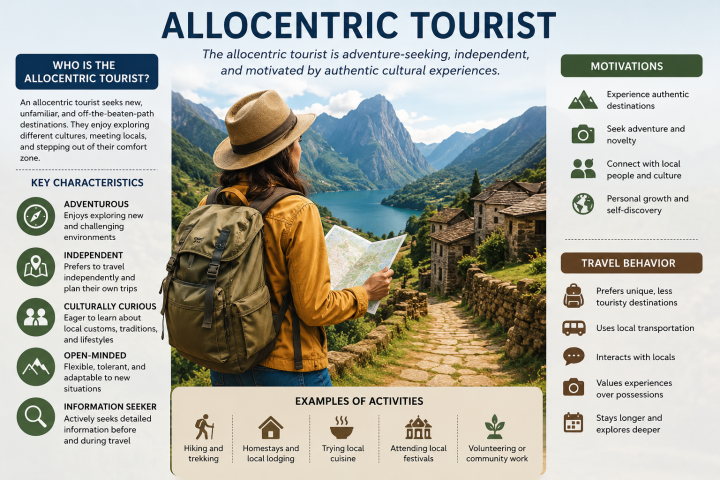
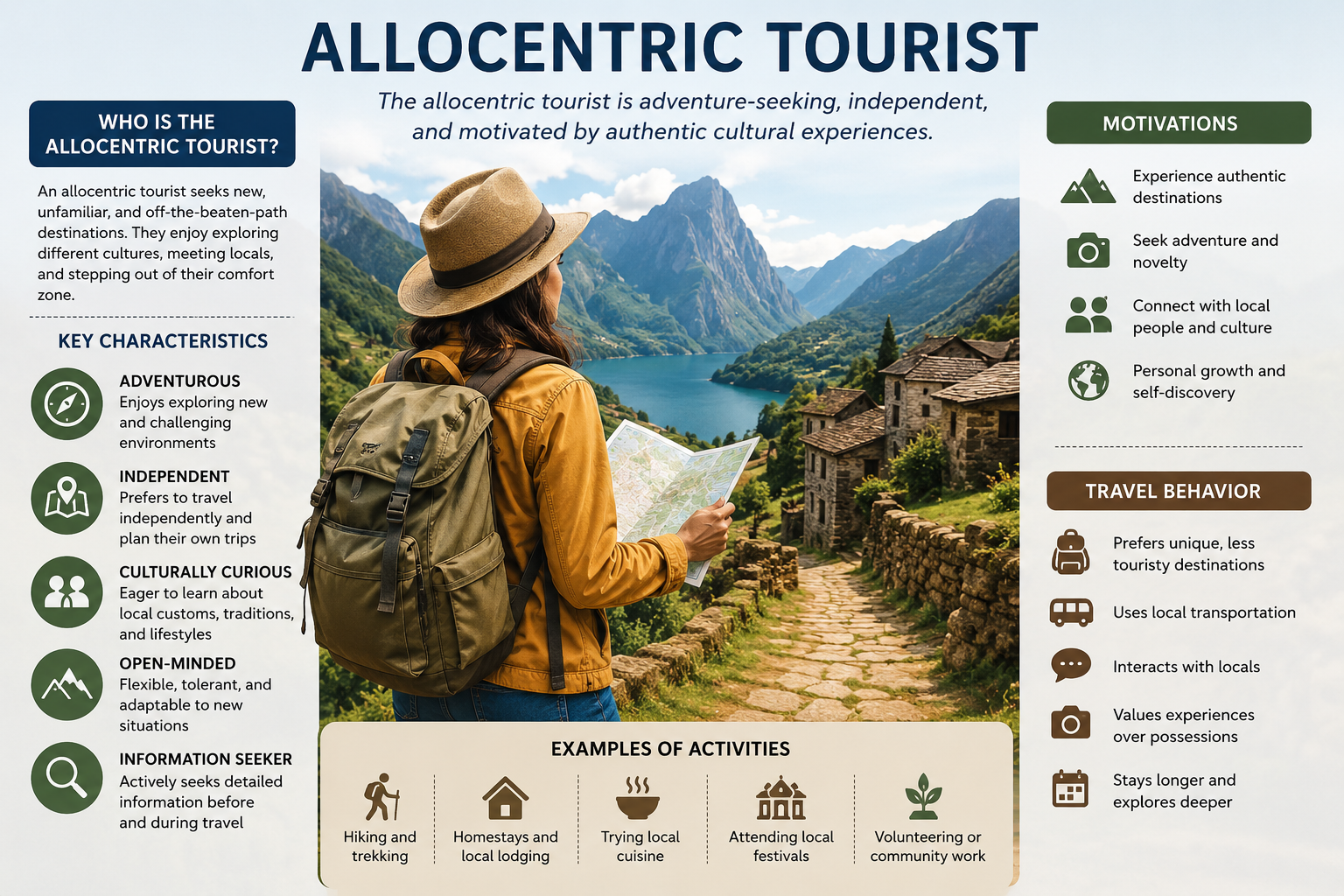
In tourism studies, tourist personality types are conceptualized as dimensional categories situated between these two poles. Within this framework, allocentric tourists are characterized by the following traits:
- A strong inclination toward novelty-seeking and exploration beyond established tourist routes;
- Minimal reliance on conventional tourism infrastructure, including travel agencies and package tours;
- A preference for free and independent travel (FIT), often involving spontaneous and unstructured itineraries;
- A desire for immersive interaction with local communities and cultures; and
- A pursuit of authentic, memorable, and adventurous experiences.
Historically, hippie travelers of earlier decades, as well as contemporary backpackers and adventure tourists, are frequently cited as representative examples of allocentric tourists. These individuals perceive travel as a way of life rather than merely a leisure activity and are motivated by a continuous desire to discover new places and encounter cultural differences.
Plog’s original typology has been both empirically tested and critically evaluated. Stephen L. J. Smith questioned the model’s applicability across different national and cultural contexts, while Stephen W. Litvin (2006) argued that tourists’ psychographic characteristics may change throughout different stages of life and travel experience, suggesting that the typology is somewhat static in nature. Nevertheless, subsequent studies have largely confirmed the usefulness of the model as a descriptive framework for understanding tourist behavior.
Cohen’s typology of tourist roles provides a complementary perspective. His explorer and drifter categories share several characteristics with Plog’s allocentric tourist, particularly their rejection of mass tourism structures and their pursuit of authentic experiences. More recently, the concept has been reexamined in relation to niche tourism forms such as adventure tourism, voluntourism, and slow travel, where allocentric motivations are especially prominent.
To fully understand the allocentric personality type and its behavioral manifestations, scholars recommend a comparative examination of Plog’s psychocentric and allocentric categories. Such an approach highlights the relational and dimensional nature of the typology, rather than treating the two categories as separate and mutually exclusive.
From a research perspective, the allocentric typology continues to inform both qualitative and quantitative studies of tourist motivation, satisfaction, and behavior. Mervyn S. Jackson’s development of the Tourist Personality Inventory represents an attempt to operationalize Plog’s conceptual framework within empirical research, thereby extending its applicability in tourism studies.
References
Cohen, E. (1979). A phenomenology of tourist experiences, Sociology, 13(2): 179–201; Dickinson, J. ve Lumsdon, L. (2010). Slow Travel and Tourism. Londra: Routledge; Jackson, M. (2006). Development of a Tourist Personality Inventory to Evaluate Parameters Associated with Tourist Crime Victimization (Yayımlanmamış doktora tezi). RMIT University, Melbourne; Litvin, S. W. (2006). Revisiting Plog’s model of allocentricity and psychocentricity… one more time, Cornell Hotel and Restaurant Administration Quarterly, 47(3): 245–253; Plog, S. C. (1974). Why destination areas rise and fall in popularity, Cornell Hotel and Restaurant Administration Quarterly, 14(4): 55–58; Plog, S. (2001). Why destination areas rise and fall in popularity: An update of a Cornell Quarterly classic, Cornell Hotel and Restaurant Administration Quarterly, 42(3): 13–24; Richards, G. ve Wilson, J. (2004). The Global Nomad: Backpacker Travel in Theory and Practice. Clevedon: Channel View Publications; Smith, S. L. J. (1990). A test of Plog’s allocentric/psychocentric model: Evidence from seven nations, Journal of Travel Research, 28(4): 40–44; Sørensen, A. (2003). Backpacker ethnography, Annals of Tourism Research, 30(4): 847–867.
See Also