Digital Detox Tourism
TOURISM TYPES AND FORMS Detox Tourism Emerging Tourism Types Detox Destinations Detox Destinations
-
2026

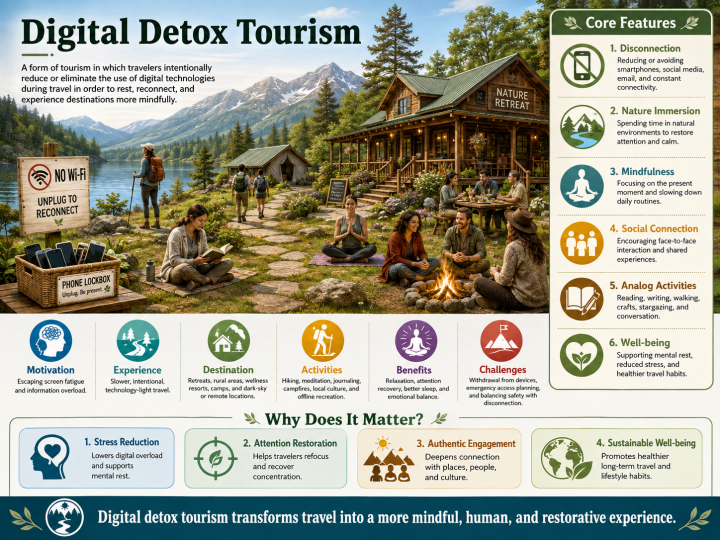
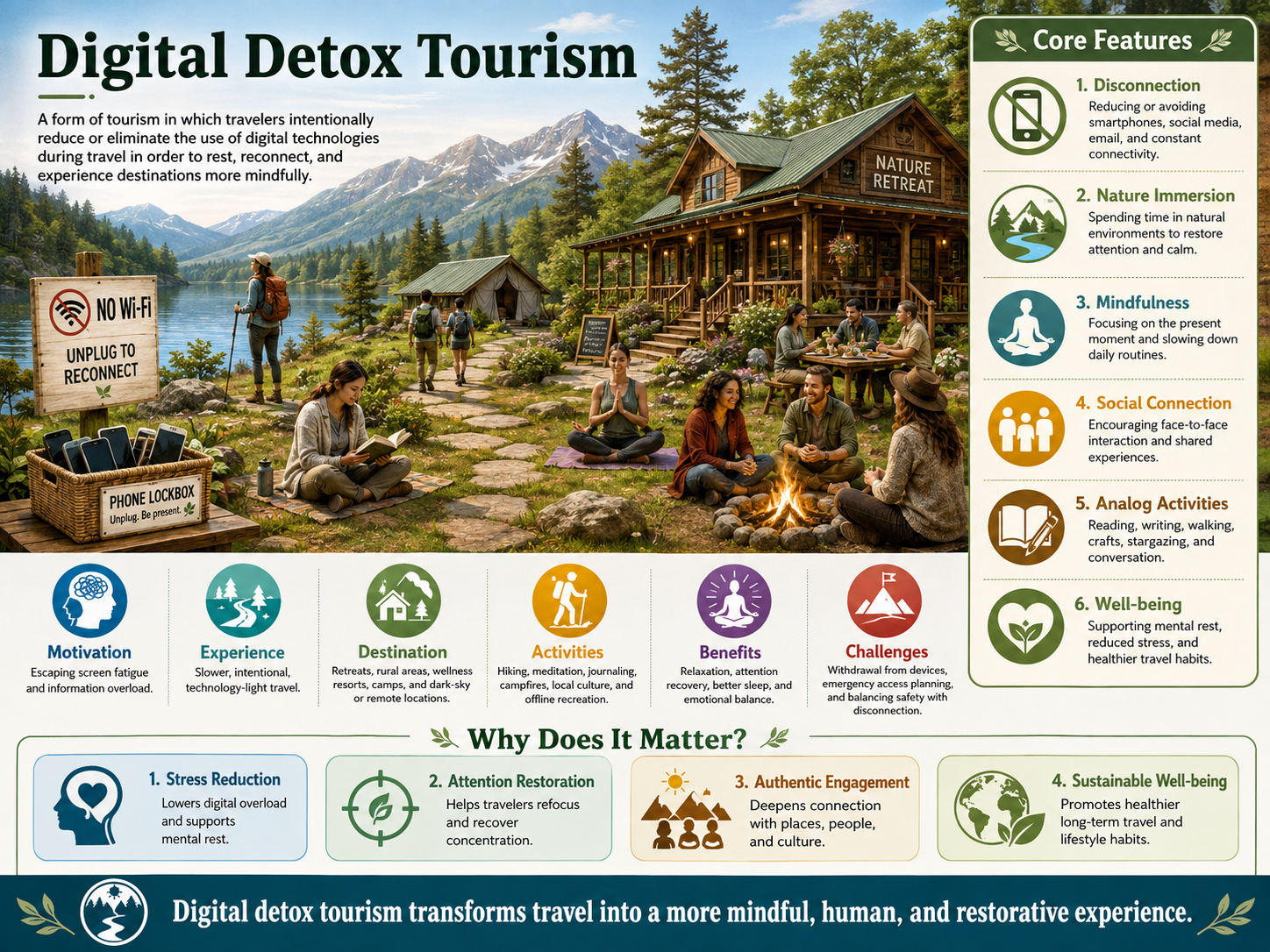
Digital detox tourism is a form of tourism in which travelers intentionally seek to minimize or completely eliminate their access to information and communication technologies. Initially perceived as a service inadequacy or infrastructural limitation in the tourism industry, the absence of technological connectivity, exemplified by “dead zones” lacking internet access, has evolved into a desirable feature and a luxury since the early 2010s. Camp Grounded (U.S.), established in 2011 by Silicon Valley native Levi Felix and hosting its first major event in 2012, represented a pivotal moment in the sector as the premier corporate digital detox camp, where electronic devices were prohibited and attendees adopted aliases. The academic literature began exploring this subject in 2012 through several research studies. This form of tourism is also referred to by similar terms, such as “digital-free tourism,” “offline tourism,” and “unplugged travel.”
Continuous engagement with technology for professional and recreational purposes has been associated with technological fatigue and a yearning to escape from screens. Research indicates that technology-related stress may motivate travelers to engage in offline pursuits during their journeys in order to reduce or avoid technological pressures. Digital detox tourism encompasses organized activities and initiatives during travel that promote disconnection from devices and platforms such as smartphones, laptops, tablets, and social media, facilitating relaxation by removing distractions and stressors. These vacations generally provide opportunities for technology-free engagement through mindfulness workshops and/or retreat initiatives, either in natural settings or within enclosed spaces.
Worldwide interest in digital detox tourism is emerging as a form of opposition to the incessant need for connectivity in contemporary societies. Millennials and digital natives—who have been immersed in technology and perceive themselves as perpetually monitored online—represent the largest demographic group for digital detox excursions. Studies suggest that the primary factors fueling this demand include escapism, self-improvement, mental and physical wellness, the enhancement of relationships, and the cultivation of essential skills such as self-control and mindfulness.
Digital detox tourism serves as both a means of individual regeneration and a sociocultural reaction to the overwhelming demands imposed by the neoliberal labor framework. Hotels and travel agencies are transitioning from “Wi-Fi Available” signage to “Guaranteed Wi-Fi-Free Zone” indicators, while vacations reminiscent of Robinson Crusoe’s isolation have increased in popularity. During the COVID-19 pandemic, remote work, online education, and increased screen exposure escalated technological fatigue to unprecedented levels. This circumstance triggered a significant increase in scholarly articles and consumer interest in digital detox tourism from 2020 to 2022. In the future, the sector is anticipated to progress toward adaptable and inclusive designs that facilitate the controlled use of technology rather than entirely offline paradigms. Simultaneously, the integration of digital detox with sustainable tourism, interaction with local communities, and environmental consciousness will be pivotal to the industry’s future.
References
Cai, W. ve McKenna, B. (2023). Power and resistance: Digital-free tourism in a connected world. Journal of Travel Research, 62(2): 290–304; Conti, E. ve Farsari, I. (2024). Disconnection in nature-based tourism experiences: An actor-network theory approach. Annals of Leisure Research, 27(4): 525–542; Gong, Y., Schroeder, A. ve Plaisance, P. L. (2023). Digital detox tourism: An Ellulian critique. Annals of Tourism Research, 103: 103646; Hassan, T. ve Saleh, M. I. (2024). Tourism digital detox and digital-free tourism: What do we know? What do we not know? Where should we be heading? Journal of Tourism Futures; Hu, H. F. ve Liu, Y. (2023). Digital-free tourism intention: The effects of message concreteness and intervention. Tourism Analysis, 28(3): 505–510; Li, J., Pearce, P. L. ve Low, D. (2018). Media representation of digital-free tourism: A critical discourse analysis. Tourism Management, 69: 317–329; Pearce, P. L. ve Gretzel, U. (2012). Tourism in technology dead zones: Documenting experiential dimensions. International Journal of Tourism Sciences, 12(2): 1–20; Stäheli, U. ve Stoltenberg, L. (2024). Digital detox tourism: Practices of analogization. New Media & Society, 26(2): 1056–1073.
See Also