Fourth Generation Tourism Scholars in Türkiye
Educational and Scientific Tourism Academic Tourism PEOPLE / BIOGRAPHICAL ENTRIES Tourism Academics and Researchers
(Türkiye)
-
2026

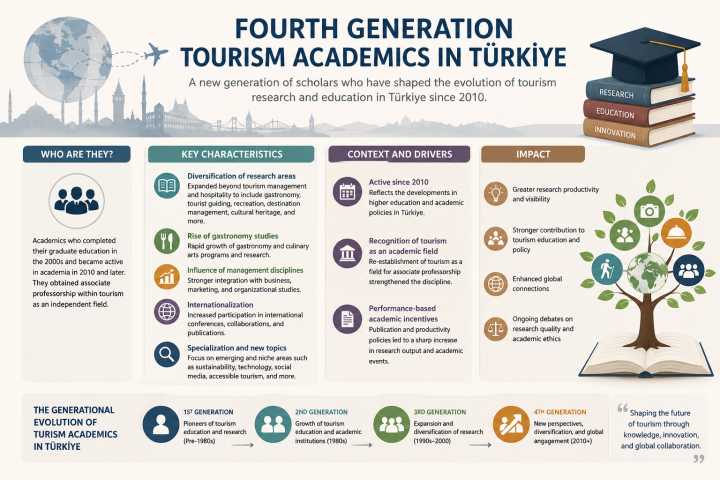
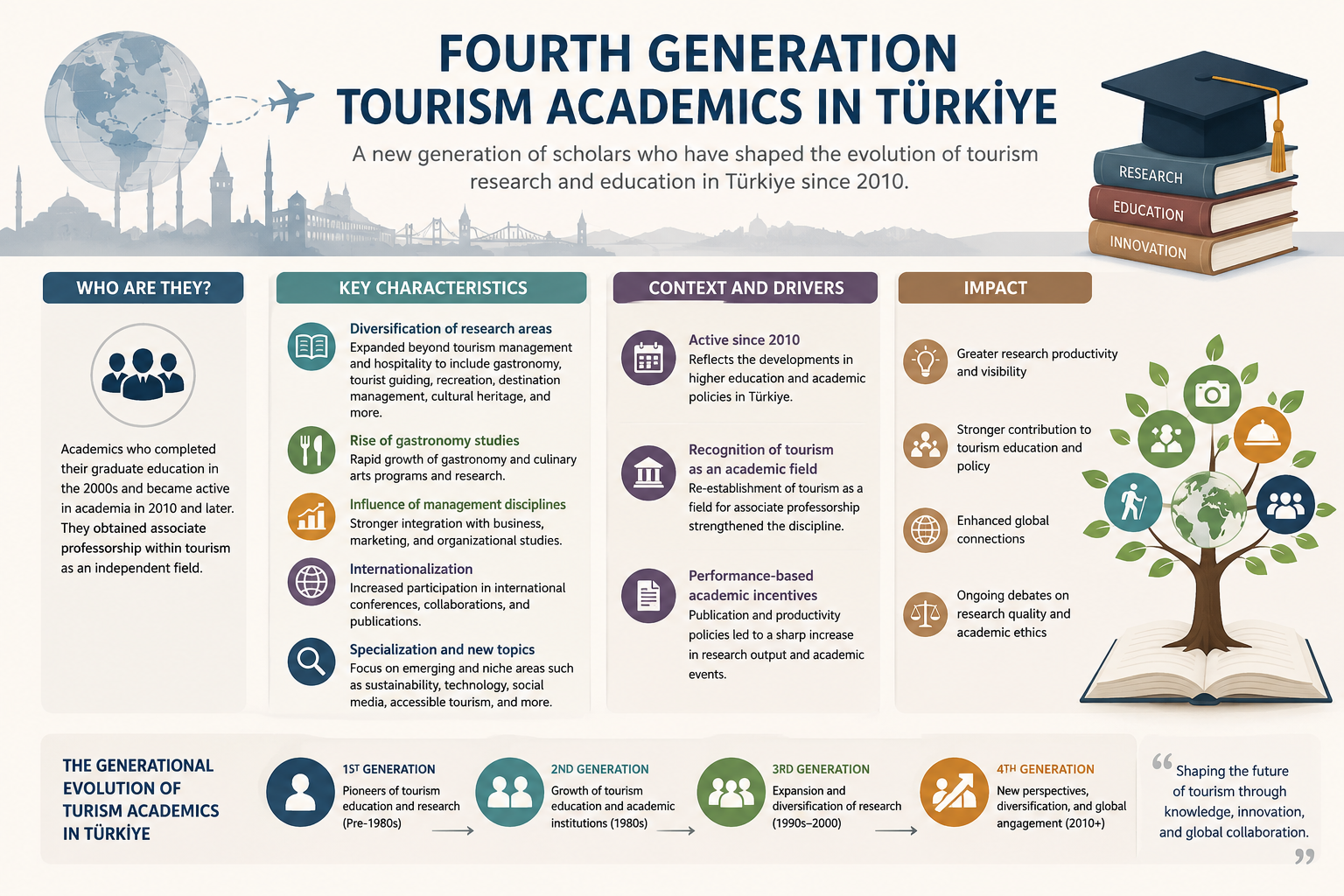
Fourth Generation Tourism Scholars in Türkiye refers to a group of tourism scholars who became prominent after 2010 and who represent a new phase in the evolution of tourism scholarship in the Republic of Türkiye. The concept emerged as an extension of Nazmi Kozak’s generational classification of Turkish tourism academics, which originally identified first-, second-, and third-generation scholars. Developments in higher education, academic promotion systems, research priorities, and disciplinary specialization after 2000 led to the recognition of a distinct fourth generation.
The Fourth Generation consists primarily of academics who completed their graduate education during the 2000s and obtained academic promotion and associate professorship qualifications within tourism as an independent academic field. Unlike earlier generations, whose work was largely concentrated in tourism management and hospitality, these scholars contributed to the diversification of tourism studies in Türkiye by expanding research into fields such as gastronomy, tourist guiding, recreation management, destination management, cultural heritage, and tourism planning.
One of the defining characteristics of this generation has been the rapid growth of tourism-related academic programs in Turkish universities. Particularly significant was the expansion of gastronomy and culinary arts departments, whose numbers increased dramatically after 2010. As a result, research output in gastronomy became one of the most dynamic areas within Turkish tourism scholarship. Recreation studies, although developing at a slower pace, also emerged as a recognized academic specialization with its own body of research and publications.
Another important feature of the Fourth Generation was its development within a changing academic policy environment. The re-establishment of tourism as a recognized field for associate professorship qualification in Türkiye strengthened the institutional position of tourism studies within higher education. At the same time, tourism research became increasingly influenced by management, marketing, and organizational studies, resulting in a substantial increase in business-oriented tourism scholarship.
The academic environment of this generation was also shaped by performance-based evaluation systems introduced in Turkish higher education during the 2010s. Policies encouraging publication productivity led to a significant increase in the number of articles, conference papers, books, and academic events related to tourism. The expansion of academic publishing created new opportunities for scholarly communication and international visibility. However, it also generated debates concerning publication quality, research impact, and academic ethics. Discussions regarding predatory publishing, conference quality, publication inflation, and ethical standards became recurring topics within the Turkish tourism academic community.
Compared with previous generations, Fourth Generation scholars demonstrated a stronger tendency toward specialization and thematic diversification. While earlier generations often focused on broad tourism issues, this generation increasingly examined specific topics and emerging areas of interest. Research themes such as gastronomy tourism, dark tourism, accessible tourism, event tourism, social media, tourism education, sustainability, tourism technology, and consumer behavior gained greater prominence.
The Fourth Generation also benefited from expanded internationalization within Turkish higher education. Increased participation in international conferences, collaborative research projects, academic exchange programs, and publications in international journals contributed to stronger connections between Turkish tourism scholars and the global academic community.
As a result, the Fourth Generation Tourism Scholars in Türkiye represents a period characterized by disciplinary diversification, institutional expansion, increased research productivity, greater international engagement, and the emergence of new research agendas that have significantly shaped the contemporary development of tourism scholarship in the Republic of Türkiye.
References
Kozak, N. (2000). Türkiye’de Akademik Turizm Literatürünün Gelişim Süreci Üzerine Bir İnceleme, Doğu Akdeniz Üniversitesi Turizm Araştırmaları Dergisi, 1(1): 15-55.
See Also:
See Also