Mağlova Aqueduct
Monumental and Historic Structures Aqueduct COUNTRIES AND TERRITORIES Türkiye
(İstanbul, Türkiye, 1564)

With the transition of human societies to settled life, cities and urbanization processes emerged, creating the need for zoning, infrastructure, and public utilities to support urban populations. Among these necessities, the provision of clean water was arguably the most essential, given its fundamental importance for human survival. Although various methods of water supply were developed throughout history, local water resources often proved insufficient to meet the demands of growing urban populations, making it necessary to transport water from distant sources. To achieve this, numerous hydraulic structures were constructed in accordance with the geographical characteristics of the terrain and the technical requirements of water conveyance and distribution systems.
Archival records indicate that Istanbul, which served as the capital of three major empires, has possessed an organized water supply system since the Roman period. These systems gradually deteriorated over time but were extensively restored during the Ottoman era. In addition, new water networks were constructed, creating an extensive system that extended for many kilometres. One of the most significant of these was the Kırkçeşme Water Supply System, commissioned by Sultan Suleiman the Magnificent and designed by Chief Architect Sinan. Construction of the transmission line began in 1554 and was largely completed by 1563. However, many of its aqueducts were severely damaged by the devastating flood that occurred in the same year. Following extensive repairs, the entire system was put into operation in 1564. The Kırkçeşme network incorporates numerous hydraulic structures of varying scales and monumental character, among which the Mağlova Aqueduct is regarded as its architectural masterpiece. Hydraulic engineer Kazım Çeçen emphasized its significance by stating, “Even if Mimar Sinan had built only the Mağlova Aqueduct during his lifetime, he would still have achieved the same renown and been recognized as a great engineer and architect.”
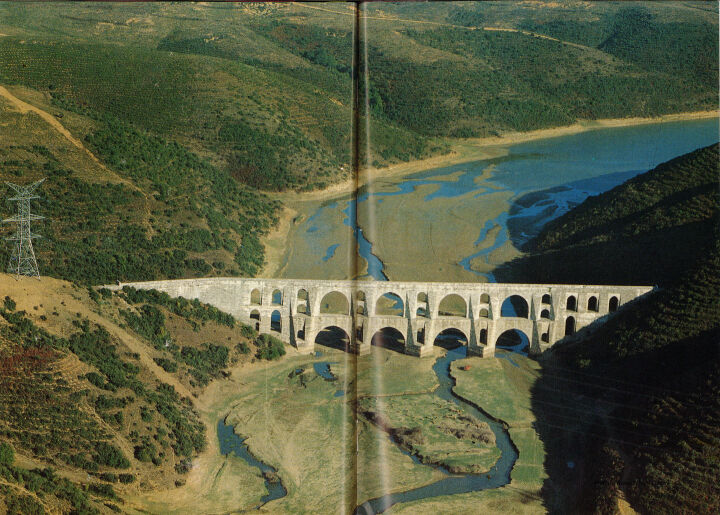
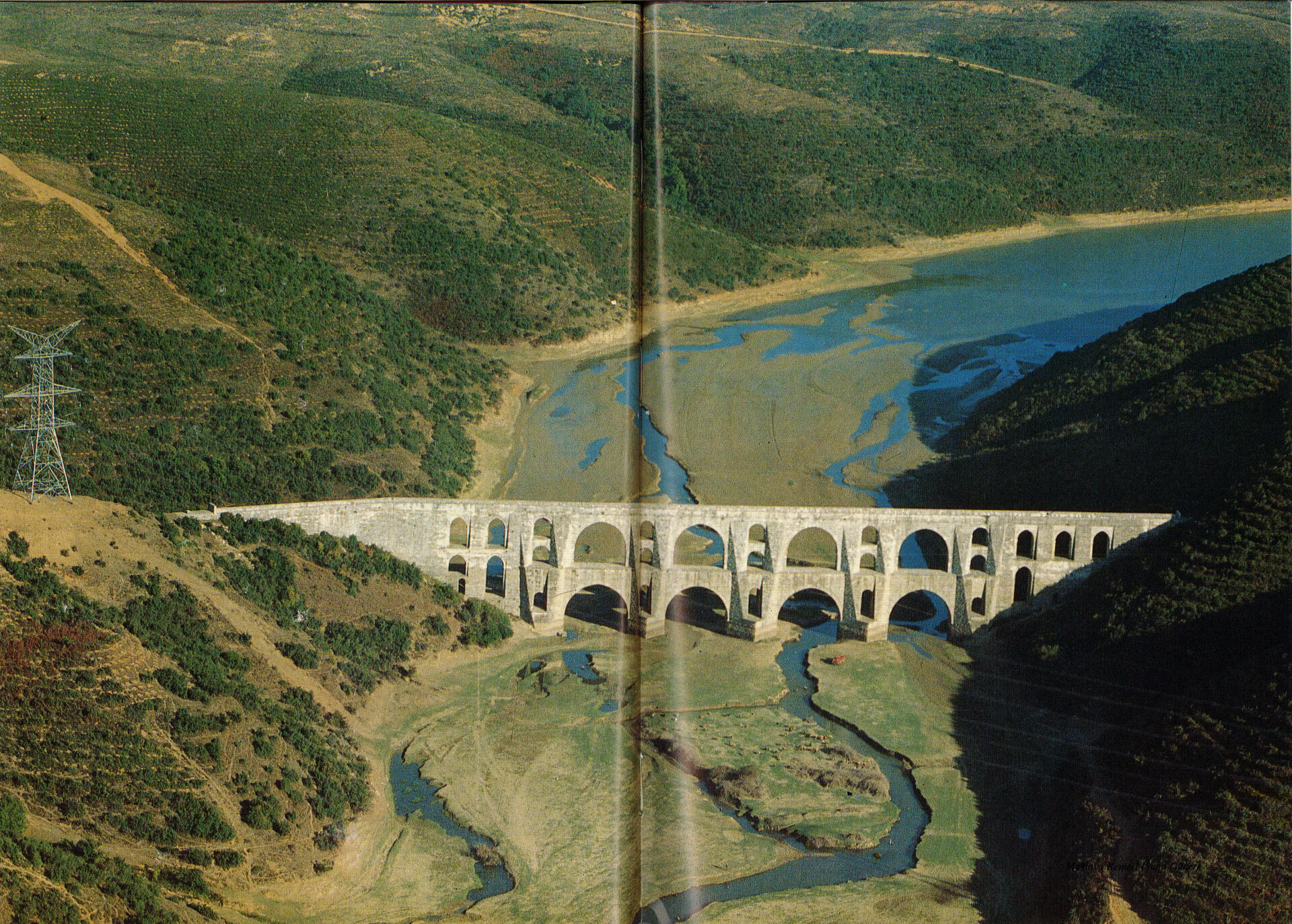
The Mağlova Aqueduct—referred to as Muallakkemer in Tezkiretü’l-Bünyan (the autobiographical account of Mimar Sinan dictated by the architect himself), Mağlova or Muğlava in Tezkiretü’l-Ebniye, and as the Aqueduct of Justinian by some Western scholars—is situated on the boundary between the Eyüpsultan and Sultangazi districts of Istanbul, near the Kemerburgaz Urban Forest. At the time of its construction, the aqueduct crossed the broad valley formed by the Alibey Creek; today, however, it stands within the Alibey Dam Reservoir. During periods of low water levels, the entire structure becomes visible once again. Owing to its proximity to the surrounding forest and its harmonious integration with the natural landscape, it remains an important destination for visitors exploring the area.
Architecturally, the Mağlova Aqueduct is distinguished by its two-tiered configuration and by a cross-section that gradually tapers upward. This design differentiates it from Roman aqueducts, providing greater structural stability and resistance to external forces such as wind and flooding. The elegantly proportioned piers narrow progressively toward the top, resembling the folds of a pleated skirt, while relieving arches incorporated into the supporting piers reduce structural mass and improve both stability and visual lightness. Rising approximately 47 metres from its foundations to its highest point and extending about 257 metres in length, the aqueduct incorporates smaller arches within its large supporting piers to reduce weight while allowing floodwaters and wind to pass through the structure. Altogether, it contains 33 arches, including several that also function as pedestrian passages. Extending across the entire valley, the aqueduct served multiple purposes simultaneously by conveying water through its upper channel, providing a bridge for pedestrian passage on its lower level, and allowing the natural flow of the river beneath.
Following the extensive restoration carried out after the catastrophic flood of 1563, the Mağlova Aqueduct continued to function for centuries. During the construction of the Alibey Dam, additional reinforcement works undertaken by the Istanbul Water and Sewerage Administration (İSKİ) ensured the preservation of the structure, enabling it to remain standing and operational for nearly 460 years. In recognition of its exceptional historical and cultural significance, the Turkish State Mint included the aqueduct in its Cultural Assets Series No. 2 and issued 1,250 commemorative coins with a face value of 30 YTL in 2005.
References
Çeçen, K. (1988). Mimar Sinan ve Kırkçeşme tesisleri. İSKİ Yayınları; Karakuş, F. (2019). İstanbul’daki Osmanlı Dönemi tarihi su sistemleri’nin incelenmesi. Türk Hidrolik Dergisi, 3(1), 14–30; Darphane ve Damga Matbaası Genel Müdürlüğü. (n.d.). Satıştan kaldırılan hatıra para. https://www.darphane.gov.tr/satistan-kaldirilan-hatira-para (Accessed October 31, 2025); Keyif Kurdu. (n.d.). İstanbul'da Kırkçeşme. https://keyifkurdu.com/cms/kultur-sanat-keyfi/kulturel/item/365-istanbul-da-kirkcesme (Accessed October 31, 2025); YouTube. (n.d.). Kırkçeşme [Video]. https://www.youtube.com/watch?v=ecd0hn6bwTk (Accessed October 31, 2025).
Map