Seven Churches Tour
Religious Tourism Destination RELIGION AND BELIEF SYSTEMS Religions Religious Tourism and Pilgrimage Religious Architecture and Sacred Heritage COUNTRIES AND TERRITORIES Türkiye
(Türkiye)
-
2026

The Seven Churches Tour is an internationally recognised religious heritage route and one of Türkiye's most distinctive biblical tourism products. The itinerary follows the seven early Christian communities addressed in the Book of Revelation—Ephesus, Smyrna, Pergamon, Thyatira, Sardis, Philadelphia, and Laodicea—which were located in the Roman province of Asia and are situated today in western Türkiye. Because these communities are directly associated with one of Christianity's most influential sacred texts, the route has long attracted pilgrims, biblical scholars, clergy, historians, archaeologists, and cultural tourists seeking to explore the historical landscapes of early Christianity.
The significance of the Seven Churches extends beyond their appearance in the Book of Revelation. Together, they represent one of the earliest organised Christian networks established outside Palestine and illustrate the geographical expansion of Christianity throughout Asia Minor during the first century CE. Over time, these cities evolved from local congregations into places of enduring religious memory, becoming important destinations for pilgrimage while preserving substantial archaeological evidence of Roman and Byzantine urban development. Consequently, the Seven Churches occupy a unique position at the intersection of biblical history, archaeology, cultural heritage, and tourism.
Within tourism studies, the Seven Churches Tour is commonly regarded as a specialised form of religious tourism, biblical tourism, and religious heritage tourism. Religious tourism encompasses travel motivated wholly or partly by religious, spiritual, or faith-related purposes, while biblical tourism refers specifically to journeys associated with places mentioned in the Bible. The Seven Churches Tour combines these characteristics by enabling visitors to experience locations that are simultaneously sacred, historical, and archaeological. Unlike pilgrimage routes centred upon a single shrine or holy site, the itinerary links several destinations whose collective significance derives from their shared biblical narrative rather than from an individual monument or religious institution.
The route also exemplifies the growing convergence of pilgrimage and heritage tourism. Contemporary pilgrimage is no longer understood solely as an act of religious devotion but increasingly incorporates educational, cultural, and experiential dimensions. Visitors seek opportunities not only to worship and reflect spiritually but also to understand the historical development of Christianity, examine archaeological remains, and engage with the cultural landscapes that shaped the earliest Christian communities. As a result, the Seven Churches Tour appeals to diverse visitor groups whose motivations frequently combine faith, historical curiosity, cultural learning, and heritage appreciation.
Recent developments in heritage tourism have further expanded the interpretation of sacred places. Religious sites are increasingly recognised as complex cultural landscapes where tangible heritage—including archaeological remains, architecture, inscriptions, and historic urban environments—coexists with intangible values such as belief, ritual, memory, identity, and tradition. Within this perspective, the Seven Churches represent more than archaeological sites or biblical landmarks; they constitute interconnected heritage resources whose significance derives from the continuous interaction between material evidence and religious meaning. Their interpretation therefore requires an interdisciplinary approach integrating archaeology, history, theology, heritage management, and tourism studies.
The international recognition of the Seven Churches has also contributed to the diversification of Türkiye's tourism portfolio. Although coastal tourism continues to dominate international arrivals, the Seven Churches provide an important alternative tourism product that appeals to niche markets seeking authentic religious and cultural experiences. Their concentration within a relatively compact geographical area enables visitors to follow the biblical sequence of the churches while simultaneously exploring some of western Anatolia's most significant archaeological sites. This combination of accessibility, historical continuity, and religious significance distinguishes the itinerary from many other Christian pilgrimage routes and strengthens its position within the global religious tourism market.
Beyond their tourism value, the Seven Churches contribute to the preservation and international interpretation of Türkiye's Christian heritage. They illustrate the multicultural history of Anatolia, where Greek, Roman, Byzantine, and later Ottoman civilisations interacted over many centuries. Today, the route functions not only as a pilgrimage itinerary but also as an educational and cultural corridor that promotes intercultural dialogue, historical awareness, and heritage conservation. Consequently, the Seven Churches Tour represents a distinctive example of how sacred landscapes continue to generate religious meaning while simultaneously supporting heritage preservation, destination development, and sustainable tourism.
Historical and Biblical Background
The origins of the Seven Churches are inseparable from the expansion of Christianity throughout the Roman province of Asia during the first century CE. Western Asia Minor constituted one of the most prosperous and strategically connected regions of the Roman Empire, characterised by extensive commercial networks, well-developed road systems, active maritime trade, and highly urbanised settlements. These conditions facilitated the circulation of merchants, travellers, ideas, and religious beliefs, creating an environment in which Christianity spread rapidly beyond its Palestinian origins. Rather than emerging in isolated settlements, the Christian communities of Roman Asia developed within influential urban centres that served as political, economic, and cultural hubs of the eastern Mediterranean.
The missionary activities traditionally associated with the apostles, particularly Paul, played a significant role in establishing communication networks among early Christian communities across Asia Minor. Although not every congregation addressed in the Book of Revelation was founded directly through Pauline missions, they developed within the broader missionary landscape created by apostolic preaching, correspondence, and interaction among Christian believers. Existing Jewish communities, Hellenistic cultural traditions, and Roman administrative structures further facilitated the dissemination of Christian teachings. Modern historical and sociological research has similarly demonstrated that urban connectivity, religious pluralism, and social networks were fundamental factors in the early expansion of Christianity throughout the Roman Empire.
The biblical importance of the Seven Churches derives from the seven letters recorded in the Book of Revelation, traditionally attributed to John of Patmos. According to Christian tradition, John composed these messages while exiled on the island of Patmos during the reign of Emperor Domitian in the late first century CE. Each letter addressed the circumstances of a specific Christian congregation, offering encouragement, criticism, warnings, and promises according to the spiritual condition of the community. Although directed to individual churches, these messages have historically been interpreted as possessing enduring theological significance for the universal Christian Church, thereby elevating the seven cities from local congregations to places of lasting religious importance.
Each of the seven cities occupied a distinctive position within Roman Asia. Ephesus, the provincial capital, functioned as one of the largest commercial and administrative centres of the eastern Mediterranean and became an important focus of early Christian missionary activity. Smyrna was renowned for its prosperous harbour, commercial vitality, and loyalty to Roman authority. Pergamon served as an administrative capital and an influential religious centre associated with the imperial cult. Thyatira developed as a manufacturing city distinguished by its commercial guilds, while Sardis, the former capital of the Lydian Kingdom, retained considerable political prestige despite its economic decline. Philadelphia occupied a strategic location connecting the interior of Anatolia with the Aegean coast, and Laodicea emerged as one of the wealthiest commercial centres of Roman Asia through banking, textile production, and medical activities. Collectively, these urban centres illustrate that Christianity expanded through economically dynamic and culturally interconnected cities rather than peripheral settlements.
The seven congregations also provide valuable historical insight into the relationship between Christianity and Roman society. The messages contained in Revelation reveal communities confronting persecution, imperial authority, religious pluralism, internal doctrinal disputes, and the moral challenges associated with prosperity and urban life. Consequently, the Seven Churches constitute an important source for understanding not only early Christian theology but also the social, political, and cultural environment in which Christianity evolved during the Roman period.
Following the legalisation of Christianity in the fourth century CE, the biblical association of the Seven Churches stimulated the gradual development of pilgrimage traditions throughout Asia Minor. Churches, basilicas, and commemorative monuments were constructed at or near several of the biblical locations, reinforcing their status as sacred destinations within the Christian world. During the Byzantine period, these sites became integrated into broader pilgrimage networks linking Jerusalem, Constantinople, and other important centres of Christian worship. Although demographic and political transformations altered the urban character of many of these cities in subsequent centuries, their biblical significance remained embedded within Christian memory.
From the nineteenth century onward, archaeological exploration renewed scholarly and international interest in the Seven Churches. Excavations undertaken at Ephesus, Pergamon, Sardis, and Laodicea revealed substantial evidence of Roman urban planning, early Christian architecture, and Byzantine occupation, significantly expanding knowledge of the historical settings described in the Book of Revelation. These investigations established stronger connections between the biblical narrative and the archaeological record while simultaneously laying the foundations for the modern interpretation of the Seven Churches as both internationally significant heritage sites and major destinations for religious and cultural tourism.
Evolution of the Seven Churches as a Pilgrimage and Heritage Route
Although the seven cities acquired religious significance during the formative centuries of Christianity, their evolution into a coherent pilgrimage route was a gradual process shaped by changing religious traditions, political transformations, archaeological discoveries, and developments in international tourism. During Late Antiquity and the Byzantine period, Christian pilgrims travelled extensively throughout the eastern Mediterranean to visit places associated with the life of Christ, the apostles, and the earliest Christian communities. Within these pilgrimage networks, the cities addressed in the Book of Revelation gradually emerged as destinations of theological importance, although they were generally visited individually or in conjunction with other sacred sites rather than as a single organised itinerary.
Following the incorporation of Anatolia into the Ottoman Empire, Christian pilgrimage to the Seven Churches continued, albeit on a more limited scale. Despite demographic changes and the decline of several ancient urban centres, the biblical importance of the seven cities remained firmly embedded within Christian tradition. European missionaries, diplomats, biblical scholars, and travellers visiting the Ottoman territories during the eighteenth and nineteenth centuries played an important role in reintroducing these locations to international audiences through travel narratives, historical descriptions, and archaeological observations. Their writings stimulated scholarly interest in the historical geography of early Christianity and encouraged systematic archaeological investigations that substantially expanded knowledge of the biblical cities.
Archaeological research has been fundamental to the modern interpretation of the Seven Churches. Excavations undertaken at Ephesus, Pergamon, Sardis, and Laodicea have revealed extensive remains of Roman streets, basilicas, episcopal complexes, public buildings, inscriptions, and Byzantine structures, confirming the historical importance of these settlements as major urban centres of Roman Asia. Rather than functioning solely as places of religious memory, the Seven Churches have consequently become archaeological landscapes that provide material evidence for the historical development of Christianity. The integration of archaeological discoveries with biblical interpretation has significantly enhanced both academic research and visitors' understanding of the route.
The emergence of the contemporary Seven Churches Tour is closely associated with the diversification of Türkiye's tourism industry during the late twentieth century. Increasing international interest in cultural heritage, biblical archaeology, and religious travel, together with improvements in transportation infrastructure and tourism services, encouraged travel agencies to develop organised itineraries connecting the seven biblical cities within a single package. Since the 1990s, the route has been promoted as one of Türkiye's most distinctive religious tourism products, offering visitors an opportunity to follow the geographical sequence of the churches described in the Book of Revelation while simultaneously experiencing the archaeological and cultural heritage of western Anatolia.
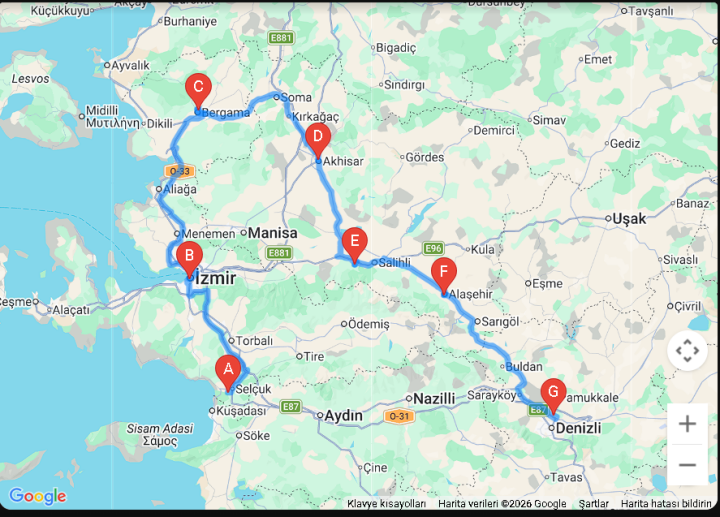
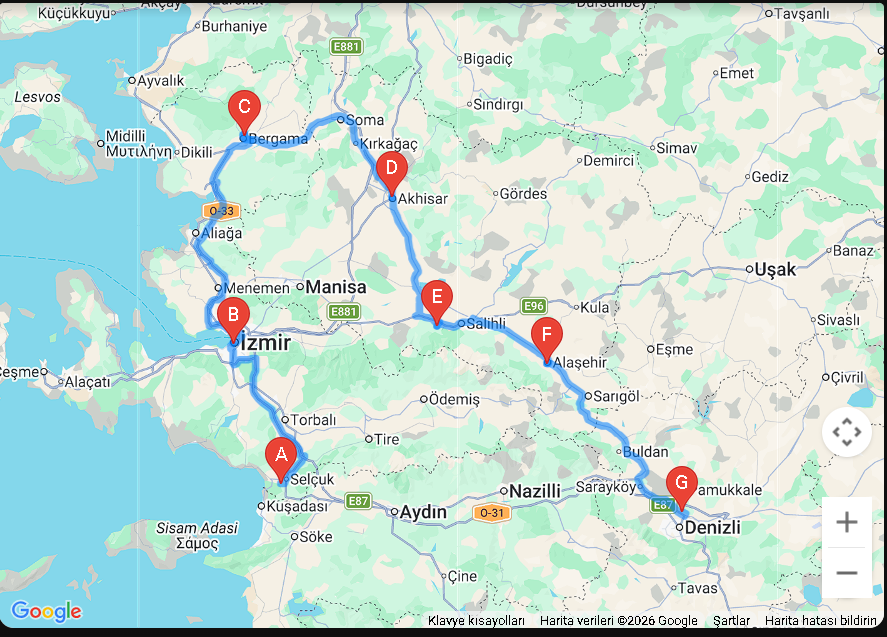
Today, the Seven Churches Tour generally follows a circular itinerary beginning in İzmir, the location of ancient Smyrna, before continuing to Ephesus, Pergamon, Thyatira, Sardis, Philadelphia, and Laodicea. Depending on the programme, tours typically last between five and seven days and frequently incorporate additional destinations closely associated with biblical history, including the House of the Virgin Mary, the Basilica of St. John, Hierapolis, and other locations connected with the missionary journeys of Saint Paul. Consequently, the route extends beyond the seven churches themselves, presenting visitors with a broader interpretation of the Christian heritage of western Türkiye.
The organisation of contemporary tours reflects the hybrid character of religious tourism. Most itineraries combine archaeological visits with biblical interpretation delivered by licensed tourist guides, clergy, theologians, or local experts. Rather than limiting the experience to sightseeing, programmes frequently include scriptural readings, group prayers, liturgical celebrations, hymn singing, and opportunities for individual reflection at locations associated with the seven congregations. These practices preserve the spiritual character of the pilgrimage while integrating educational and cultural components that appeal to visitors with different backgrounds and motivations.
The Seven Churches Tour also illustrates the transformation of pilgrimage into an experiential form of cultural travel. Contemporary visitors increasingly seek authentic encounters with sacred landscapes rather than solely fulfilling religious obligations. Walking through ancient streets, examining archaeological remains, and comparing the physical environment with biblical narratives enable participants to establish meaningful connections between historical evidence and religious tradition. Consequently, the route functions simultaneously as a pilgrimage, an educational journey, and a heritage experience, reflecting broader changes in the nature of religious tourism during the twenty-first century.
Unlike globally recognised Christian pilgrimage routes such as the Camino de Santiago or the Via Francigena, the Seven Churches Tour remains a relatively specialised niche product within the international tourism market. Nevertheless, its concentration of archaeological sites, direct association with one of Christianity's foundational texts, and accessibility within a compact geographical region provide a distinctive competitive advantage. These characteristics position the route as one of the most significant biblical heritage itineraries in the eastern Mediterranean while highlighting its considerable potential for further tourism development, destination branding, and international promotion.
Contemporary Seven Churches Tour: Visitor Profile and Pilgrimage Experience
The visitor profile of the Seven Churches Tour reflects the diversification of religious tourism in the contemporary era. While practising Christians continue to constitute the principal visitor group, the route increasingly attracts archaeologists, historians, theologians, university groups, heritage enthusiasts, and culturally motivated travellers seeking to explore the historical origins of Christianity. Consequently, the Seven Churches have evolved from destinations visited primarily for devotional purposes into internationally recognised religious heritage sites that accommodate multiple forms of cultural and spiritual engagement.
International demand is concentrated primarily among visitors from the United States, Germany, Italy, South Korea, and several other countries with established Christian pilgrimage traditions. Most participants travel through organised group tours arranged by churches, pilgrimage organisations, theological institutions, or specialised travel agencies. Independent travellers also represent a growing market segment, particularly those combining the Seven Churches with broader biblical itineraries that include Greece, Israel, Jordan, and other destinations associated with the New Testament. Previous studies characterise this market as a specialised niche within religious tourism, distinguished by relatively small group sizes, high educational levels, and strong cultural or spiritual motivations.
Research on contemporary pilgrimage demonstrates that visitor motivations extend beyond traditional religious obligations. Although spiritual devotion remains central for many participants, modern pilgrims increasingly seek opportunities for biblical learning, historical understanding, emotional reflection, and meaningful engagement with sacred landscapes. Recent studies identify four interrelated dimensions shaping pilgrimage experiences—spirituality, biblical experience, emotional fellowship (koinonia), and novelty—suggesting that pilgrimage functions as a multidimensional process of personal transformation rather than simply a religious journey. These dimensions are particularly evident within the Seven Churches Tour, where scriptural interpretation, archaeological exploration, and collective religious practices become mutually reinforcing components of the visitor experience.
Educational interpretation represents another defining characteristic of the route. Unlike pilgrimage destinations centred primarily on miraculous events or relics, the Seven Churches invite visitors to engage directly with the historical geography of early Christianity. Guided interpretation frequently combines biblical passages with archaeological evidence, enabling participants to compare the narratives of Revelation with the surviving remains of the ancient cities. This interaction between sacred text, the archaeological landscape, and historical explanation strengthens visitors' understanding of both the religious and historical significance of the sites while enhancing the educational value of the journey.
Authenticity has become an increasingly important element of visitor expectations. Pilgrims and heritage tourists alike seek experiences that preserve the historical integrity of archaeological sites while maintaining their religious atmosphere. Accordingly, well-conserved monuments, evidence-based interpretation, and opportunities for personal contemplation contribute substantially to visitor satisfaction. Contemporary research further suggests that authenticity is not derived solely from the physical preservation of monuments but also from visitors' emotional and intellectual engagement with the historical and spiritual meanings embedded within the landscape.
The Seven Churches Tour therefore represents a distinctive form of contemporary religious travel in which pilgrimage, education, archaeology, and cultural heritage converge. Rather than appealing exclusively to one type of visitor, the route accommodates multiple motivations and identities, illustrating the continuing evolution of religious tourism in response to changing patterns of travel, heritage consumption, and spiritual experience. Through this multidimensional character, the Seven Churches continue to occupy a unique position within the international landscape of biblical tourism while preserving their enduring significance for Christian pilgrimage and cultural heritage.
Heritage Significance, Tourism Development, and Future Perspectives
The Seven Churches represent one of the most important components of Türkiye's Christian cultural heritage and constitute a unique convergence of biblical history, archaeological evidence, religious tradition, and contemporary tourism. Their significance extends beyond the seven congregations described in the Book of Revelation, encompassing the material remains of Roman and Byzantine civilisation as well as the intangible religious values that continue to shape Christian pilgrimage. Consequently, the route is increasingly recognised as an integrated heritage landscape where historical authenticity, spiritual meaning, and tourism development intersect.
From a heritage perspective, the Seven Churches encompass both tangible and intangible cultural assets. Archaeological remains—including basilicas, episcopal complexes, public buildings, inscriptions, ancient streets, and urban infrastructure—provide physical evidence of the emergence and institutionalisation of Christianity in Roman Asia. These material remains are complemented by intangible heritage expressed through biblical narratives, pilgrimage traditions, liturgical practices, collective memory, and the enduring symbolic significance of the seven churches within Christian theology. Contemporary heritage scholarship emphasises that these dimensions should not be interpreted independently, as the cultural value of sacred places derives from the interaction between physical evidence and the meanings attributed to them by successive generations.
Authenticity remains one of the principal considerations in the conservation and interpretation of the Seven Churches. Within heritage tourism, authenticity encompasses not only the preservation of archaeological remains but also the protection of historical context, religious atmosphere, and landscape integrity. Visitors increasingly seek meaningful encounters with places that retain their historical credibility while preserving their spiritual character. Accordingly, conservation strategies should avoid excessive reconstruction or commercialisation that may compromise either the archaeological integrity of the sites or the authenticity of the visitor experience. Sustainable conservation therefore requires the careful integration of archaeological research, scientific restoration, historical documentation, and responsible tourism planning.
Interpretation constitutes another essential component of successful heritage management. Archaeological remains rarely communicate their historical and religious significance without appropriate contextualisation. Professional tourist guides, museums, interpretive centres, information panels, and digital media therefore play important roles in transforming archaeological evidence into accessible narratives for diverse visitor groups. Because the Seven Churches attract pilgrims, heritage tourists, scholars, and educational groups with varying levels of historical and theological knowledge, interpretation should present archaeological, historical, and biblical perspectives in a balanced and evidence-based manner. Such an approach enhances visitors' understanding while respecting the religious sensitivity of the sites.
Recent developments in heritage tourism have increasingly highlighted the role of digital technologies in improving interpretation and visitor engagement. Virtual reconstruction, augmented reality, mobile applications, artificial intelligence-assisted guiding systems, and immersive digital storytelling provide opportunities to visualise ancient urban environments and communicate complex historical information without affecting the physical integrity of archaeological remains. For destinations such as the Seven Churches, these technologies offer valuable tools for enhancing accessibility, strengthening educational interpretation, and supporting sustainable visitor management while preserving fragile archaeological resources.
From a tourism perspective, the Seven Churches constitute a specialised niche product with considerable opportunities for diversification and international positioning. Unlike mass tourism destinations characterised by high visitor volumes, the route appeals to relatively small but highly motivated visitor segments whose interests are centred on religion, archaeology, history, and cultural heritage. This niche character contributes to higher levels of visitor engagement and educational value while reducing some of the pressures commonly associated with mass tourism. Nevertheless, previous studies indicate that the route has not yet achieved its full tourism potential. Challenges include limited international visibility, fragmented destination branding, insufficient thematic integration among individual sites, and the absence of a comprehensive destination management strategy linking all seven locations into a coherent tourism product.
The concentration of all seven churches mentioned in the Book of Revelation within the territory of modern Türkiye provides the country with a distinctive competitive advantage in the global religious tourism market. Few destinations possess such a direct association with one of Christianity's foundational texts while simultaneously offering extensive archaeological remains and well-established tourism infrastructure. This unique combination creates significant opportunities for destination branding, thematic route development, and international marketing. Strengthening collaboration among archaeological authorities, tourism organisations, local governments, religious institutions, and local communities would further enhance the visibility and competitiveness of the route while ensuring that tourism development remains compatible with heritage conservation objectives.
The contribution of the Seven Churches extends beyond tourism development alone. Heritage routes of this nature support regional economies through accommodation services, transportation, guiding, food and beverage businesses, museums, and other tourism-related activities while simultaneously encouraging investment in heritage conservation and cultural infrastructure. Moreover, they contribute to intercultural dialogue by providing opportunities for visitors from different countries, denominations, and cultural backgrounds to engage with a shared historical and religious legacy. In this respect, the Seven Churches function not only as tourism destinations but also as places where cultural diplomacy, historical understanding, and religious dialogue converge.
Future development of the Seven Churches Tour should therefore be guided by integrated and sustainable management principles. Priorities include strengthening destination branding, improving visitor interpretation, expanding multilingual educational resources, incorporating innovative digital technologies, encouraging community participation, and ensuring that archaeological conservation remains central to tourism planning. Equally important is the development of collaborative management frameworks capable of coordinating archaeological research, heritage conservation, tourism marketing, and visitor services across the seven destinations. Such an integrated approach would reinforce both the international recognition of the route and its long-term sustainability as one of the world's most significant biblical heritage landscapes.
Ultimately, the Seven Churches Tour demonstrates how religious heritage can be interpreted through a multidisciplinary perspective that integrates biblical history, archaeology, cultural heritage, and tourism studies. Its continuing significance lies not only in its association with the Book of Revelation but also in its capacity to connect sacred memory with contemporary visitor experiences, contributing simultaneously to heritage preservation, cultural understanding, regional development, and international religious tourism. As interest in authentic cultural experiences and faith-based travel continues to expand, the Seven Churches are expected to remain one of Türkiye's most distinctive and internationally recognised religious heritage routes.
References
Aulet, S., & Vidal, D. (2018). Tourism and religion: Sacred spaces as transmitters of heritage values. Church, Communication and Culture, 3(3), 237–259. https://doi.org/10.1080/23753234.2018.1542280; Baranaydın, D., & Baranaydın, F. (2019). Apokaliptik kiliseler. Akademi Sosyal Bilimler Dergisi, 6(17), 213–228. https://izlik.org/Ja45rx86ng; Esmer, M., Coşkun, İ. H., & Ulaş, A. (2026). Demre St. Nicholas Church: Russian repairs and conservation in the longest century. Frontiers of Architectural Research, 15(1), 333–352. https://doi.org/10.1016/j.foar.2025.05.010; Güzel, Ö. (2010). Turistik ürün çeşitlendirmesi kapsamında yeni bir dinamik: İnanç turizmi. Süleyman Demirel Üniversitesi Vizyoner Dergisi, 2(2), 87–100; Güzel, Ö. (2016). Turistik ürün çeşitlendirmesi kapsamında yeni bir dinamik: İnanç turizmi. Süleyman Demirel Üniversitesi Vizyoner Dergisi, 2(2), 87–100. https://izlik.org/JA56HY96ES; Hunter, E. (2006). Christianity in Central Asia and the Near East. İçinde K. Brown (Ed.), Encyclopedia of language & linguistics (2. baskı, ss. 392–394). Elsevier. https://doi.org/10.1016/B0-08-044854-2/00748-3; Johnson, P. (2026). A constructal history of Ephesos. Biosystems, 263, 105781. https://doi.org/10.1016/j.biosystems.2026.105781; Kunt, S. (2018). Seyahat acentelerinin bakış açısıyla bir niş pazarın profili: Somut kültürel miras yaklaşımı ile Yedi Kiliseler. Seyahat ve Otel İşletmeciliği Dergisi, 15(1), 6–22. https://doi.org/10.24010/soid.415084; Kunt, S., & Güngör, A. İ. (2017). Aziz Yuhanna’nın Vahiy Kitabı çerçevesinde Yedi Kiliseler ve bu kiliselerin Türkiye inanç turizmindeki yeri. Gazi Üniversitesi Turizm Fakültesi Dergisi, (1), 71–92; Kunt, S., & Gülcan, B. (2017). Türkiye inanç turizminde zenginleşememiş bir ürün: Yedi Kiliseler. Journal of Recreation and Tourism Research, 4(Special Issue 1), 184–206; Liasidou, S., Pericleous, K., & Garanti, Z. (2026). Development of religious tourism: Perceptions of Christian Orthodox ecclesiastical communities and leaders. Tourism Review, 81(5), 1437–1458. https://doi.org/10.1108/TR-12-2024-1100; Tan, J. (2018). Religious tourism and the new evangelization: Theory and best practice in the pastoral promotion of the Church’s cultural heritage. Church, Communication and Culture, 3(3), 283–309. https://doi.org/10.1080/23753234.2018.1547117; Wortham, R. A. (2016). Religious pluralism, cultural continuity and the expansion of early Christianity: Stark revisited. The Social Science Journal, 53(4), 573–580. https://doi.org/10.1016/j.soscij.2016.07.006; Yoo, J., Choe, Y., & Lee, G. (2022). Exploring pilgrimage value by ZMET: The mind of Christian pilgrims. Annals of Tourism Research, 96, 103466. https://doi.org/10.1016/j.annals.2022.103466; Zhang, Q., & Mohamad, D. B. (2025). Mapping identity dynamics in heritage tourism: A bibliometric and theoretical review. Cogent Social Sciences, 11(1). https://doi.org/10.1080/23311886.2025.2598726
See Also