Queijo de Azeitão (Setúbal Peninsula, Portugal)
Traditional Food Resources COUNTRIES AND TERRITORIES Portugal
Setúbal Peninsula, Portugal
-
2026

The cheese traces its origins to Gaspar Henriques de Paiva, who moved from Belmonte to Azeitão in 1830. Each year, a cheesemaker from Castelo Branco came to make cheese for his household in the style of Serra da Estrela and taught the craft to a local shepherd. Gaspar’s son, Frederico Franco de Paiva, made the wheels smaller for sale and exhibited the cheese in Lisbon in 1880. In 1996, Queijo de Azeitão received European Protected Designation of Origin (PDO) status. The designation covers three municipalities south of Lisbon: Palmela, Sesimbra and Setúbal, where both milk production and cheesemaking take place.
Cheesemakers add salt and a preparation of cardoon flowers (Cynara cardunculus) to the raw milk. Once it sets, they work the curd by hand in a large mould called a trincho, letting the whey drain before transferring the curd to smaller moulds. Ripening takes at least 16 days and proceeds in two stages. In the first, a sticky film known locally as reima forms on the surface and is washed or scraped away. The wheels finish ripening in a room with gentle airflow and are turned daily throughout the process.
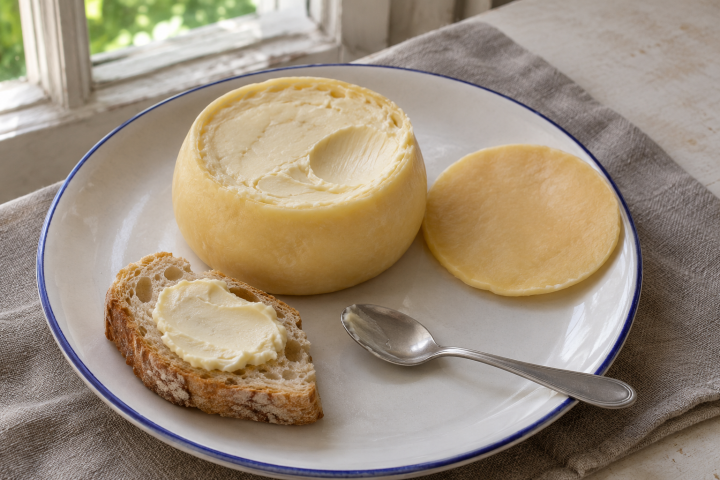
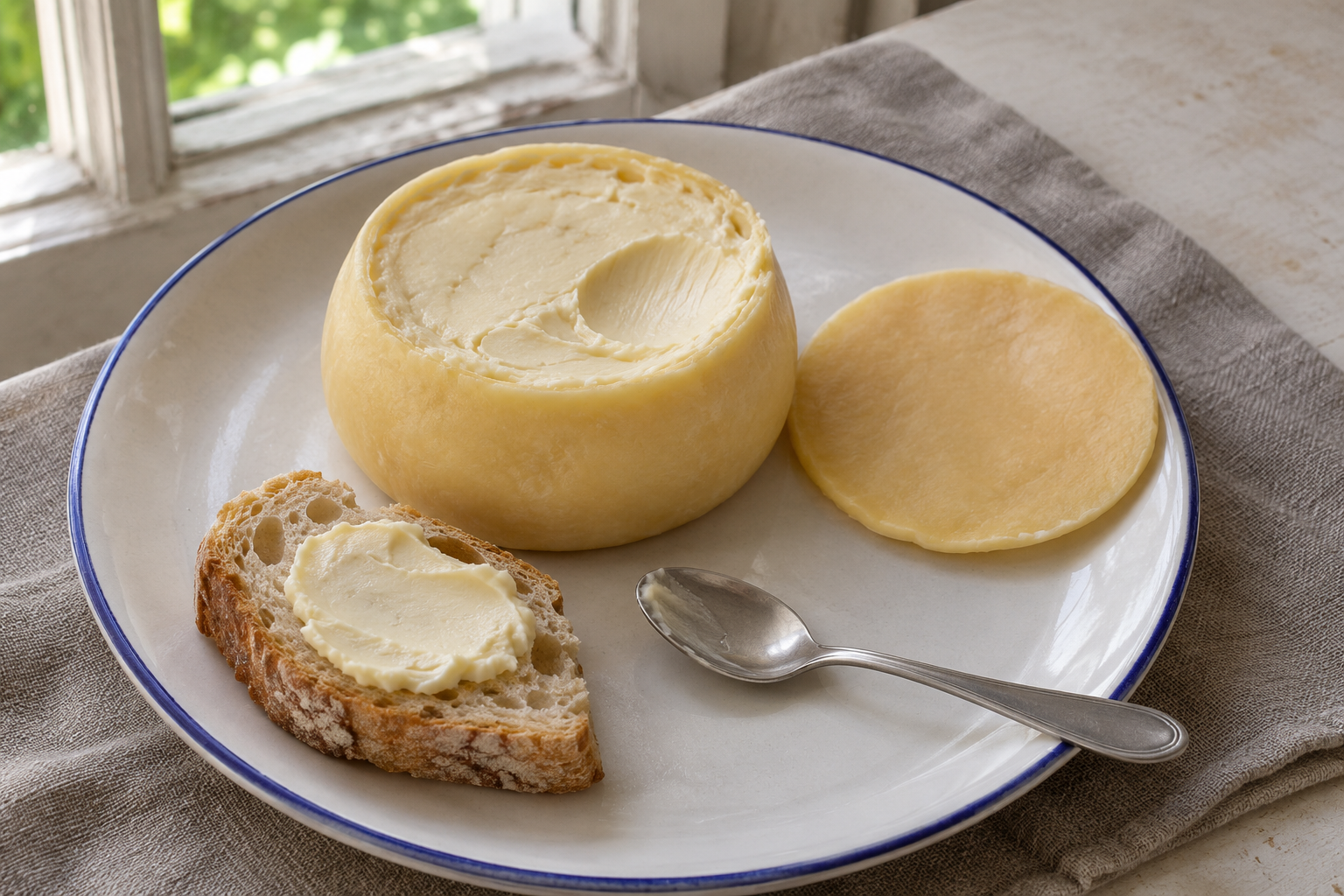
The finished wheels weigh about 100 or 250 grams. The rind bends easily, and the white to pale-yellow interior has few or no holes. Despite its mild aroma, the cheese tastes tangy and salty, with a slightly piquant finish. A soft wheel can be opened at the top and its centre spread on bread. It is served as a starter or as a cheese course before dessert.
At the Festival Queijo, Pão e Vinho in Quinta do Anjo, visitors can taste Azeitão cheese alongside local bread and wines from the Setúbal Peninsula. The festival has also offered milking and cheesemaking sessions, giving visitors a chance to handle the curd themselves and see how its texture changes as the whey drains.
References
Associação Regional de Criadores de Ovinos Leiteiros da Serra da Arrábida. (n.d.). Caderno de especificações do Queijo de Azeitão. https://tradicional.dgadr.gov.pt/images/prod_imagens/queijos/docs/CE_QAZETAO_maio_2021.pdf; Carvalho, M. (2018). Os queijos tradicionais de Portugal: História e sabores. Editorial Verbo; Donnelly, C. (Ed.). (2016). The Oxford companion to cheese. Oxford University Press; Mayson, R. (2020). The wines of Portugal. Infinite Ideas.
See Also:
See Also
Map