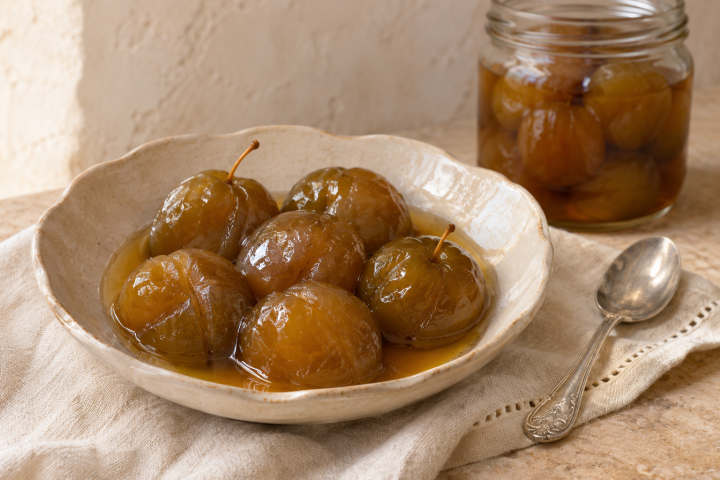
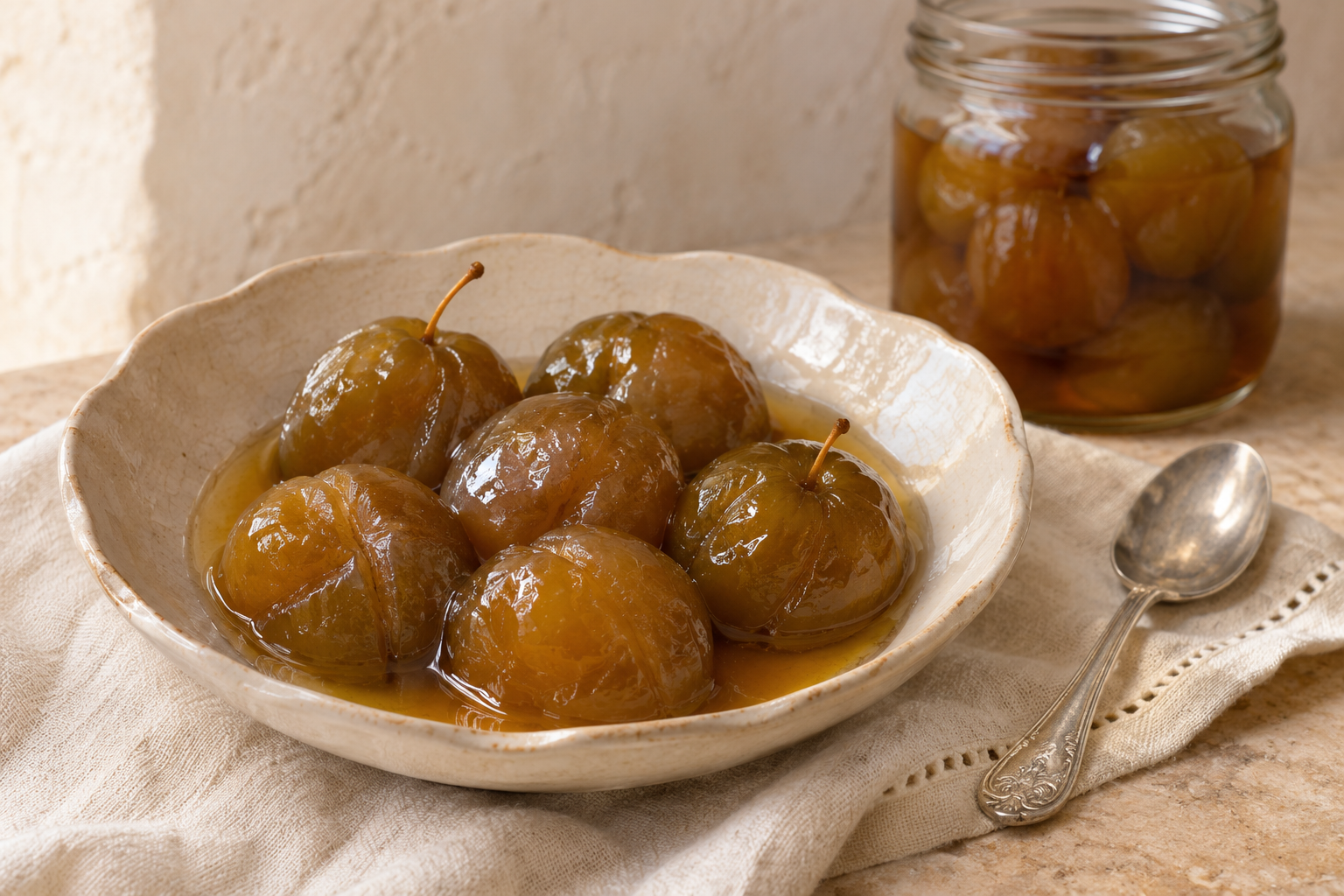
Ameixas de Elvas (Elvas, Alentejo, Portugal)
Traditional Food Resources COUNTRIES AND TERRITORIES Portugal
Elvas, Alentejo, Portugal
-
2026

These preserved fruits are a recognised speciality of Elvas, a fortified border city in eastern Portugal. They are prepared from Rainha Cláudia Verde, a greengage variety of Prunus domestica, cultivated within a wider area of the Alto Alentejo. Although the culinary name commonly evokes sweet preserves, the protected designation Ameixa d’Elvas also encompasses qualifying fresh and dried plums.
Local accounts connect the confectionery tradition with religious communities, particularly the Convent of Nossa Senhora da Consolação, also known as the convent of the Dominican nuns. The precise beginnings of the preparation are less securely established than its subsequent commercial development. In 1834, José da Conceição Guerra established a business producing preserved plums in Elvas. During the nineteenth century, the industry developed national and overseas markets, and its products received recognition at international exhibitions, including Paris in 1855.
The fruit’s aromatic flesh and balance of sweetness and acidity contribute to the finished product. Regional summer warmth favours sugar accumulation, but fruit intended for preserving must retain sufficient firmness to withstand cooking. Plums selected for candying are therefore harvested before becoming excessively soft. The basic preparation uses fruit, water and sugar; sucrose and glucose are specified for the protected candied product. Lemon and vanilla should not be presented as defining ingredients of the certified preparation.
Traditional processing involves an initial cooking in water, followed by immersion in sugar syrup. Subsequent heating and resting stages allow sugar to penetrate the fruit while the syrup becomes more concentrated. Careful handling helps preserve the whole plum’s shape. Ethnographic documentation records the use of copper pans, skimmers, draining vessels and large containers in which the fruit rests between stages. The process depends on judging fruit firmness and syrup consistency rather than applying one universal cooking time.
Several distinct presentations result. Ameixas em calda remain in syrup and have a soft, succulent texture. Drained candied plums are sold without the surrounding liquid, while ameixas cobertas receive a sugar coating. Drying may form part of a particular finishing method, but prior sun-drying is not a necessary stage for every preserved version. Separately, ameixas em passa are produced through dehydration and should not be confused with sugar-impregnated fruit.
The best-known local serving combination is with sericaia, a baked dessert made with eggs, milk, sugar and flour, topped with cinnamon. A plum and some of its syrup accompany the dessert, adding concentrated fruit flavour and a contrasting texture. Preserved plums are also eaten independently as confectionery and exchanged as gifts. Historical presentation practices included wooden or cardboard boxes decorated with cut-paper lace, linking the product with local packaging crafts as well as cooking skills.
The name Ameixa d’Elvas was registered as a European Protected Designation of Origin in 1996 under Commission Regulation (EC) No. 1107/96. Its delimited production area extends across designated parts of the municipalities of Elvas, Campo Maior, Monforte, Sousel, Alandroal, Borba, Estremoz and Vila Viçosa. Protection depends on compliance with the relevant geographical, production and certification requirements; association with Elvas alone does not establish a product’s certified status.
These preserves connect orchard cultivation, confectionery manufacture, domestic knowledge and the commercial history of the city. Restaurant desserts, regional retail sales and heritage displays introduce them to visitors. Their significance for gastronomic tourism lies both in tasting the fruit and in understanding the labour, preservation techniques and trading networks that established its reputation.
See Also
Almeida, M. (2015). Doçaria tradicional do Alentejo: História e receitas. Edições Alentejanas; Câmara Municipal de Elvas. (2019). Elvas: Património mundial, história e gastronomia; Direção-Geral de Agricultura e Desenvolvimento Rural. (2020). Produtos tradicionais com DOP: Ameixas de Elvas; Silva, J. (2018). Tesouros gastronómicos de Portugal. Âmbar.
See Also:
See Also
Map