Arroz-doce (Portugal)
Traditional Food Resources FOODS AND BEVERAGES Foods Desserts and Bakery Products COUNTRIES AND TERRITORIES Portugal CULINARY ARTS AND GASTRONOMY
Portugal
-
2026

Arroz-doce is a widely prepared Portuguese dessert whose name literally means “sweet rice.” Common versions combine rice, milk, sugar, lemon peel, and cinnamon, sometimes enriched with egg yolks and butter. Its consistency ranges from a soft, creamy pudding to a firmer preparation that can be divided into portions. Recipes vary among households and communities, and neither milk nor egg yolks are universal ingredients. The dish forms part of everyday domestic cooking as well as the food traditions surrounding weddings, baptisms, Christmas, Easter, and local religious celebrations.
Its precise origins are uncertain, but written sources document its place in early modern cookery. Francisco Martínez Montiño’s Spanish cookbook of 1611 includes a preparation identified as arroz a la portuguesa, incorporating egg yolks and cinnamon. Domingos Rodrigues’s Arte de Cozinha, first published in 1680, records sweet rice prepared with milk, sugar, flower water, and cinnamon. These references demonstrate an established culinary tradition while also revealing differences from present-day recipes. They do not establish a single place of invention or a moment when the modern preparation became standardized.
Carolino rice is commonly used in contemporary Portuguese preparations. Associated with japonica rice varieties, it is valued in dishes requiring tender grains and a creamy consistency. Milk contributes richness, while lemon peel and cinnamon provide characteristic aromas. Egg yolks, where included, deepen the yellow color and enrich the texture. Their use varies considerably, reflecting local recipes and household preferences.
A common method begins by cooking the rice in water with salt and aromatics before gradually adding warm milk. The mixture is stirred regularly until the grains become tender, after which sugar is incorporated. In versions containing yolks, these are first mixed with a little warm rice mixture and then returned to the saucepan for controlled heating. The recipe published by Turismo de Portugal, supplied by the Lisbon School of Hospitality and Tourism, specifies a final temperature of 82–85°C after adding the yolks. Cooking time depends on the rice, liquid proportions, heat, and quantity prepared.
Documented local preparations illustrate the diversity concealed by the general name. In Vagos and neighboring communities, a version recorded by Portugal’s Directorate-General for Agriculture and Rural Development uses water, rice, sugar, egg yolks, butter, and lemon peel, without milk. Alcochete’s arroz-doce branco omits eggs and is traditionally cooked to a sufficiently firm consistency to be cut into slices or squares. Such examples show that differences in color, richness, and texture cannot be reduced to a uniform division between northern and central Portugal.
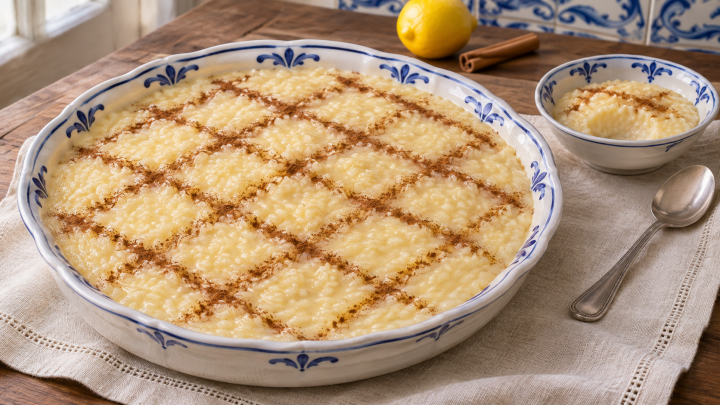
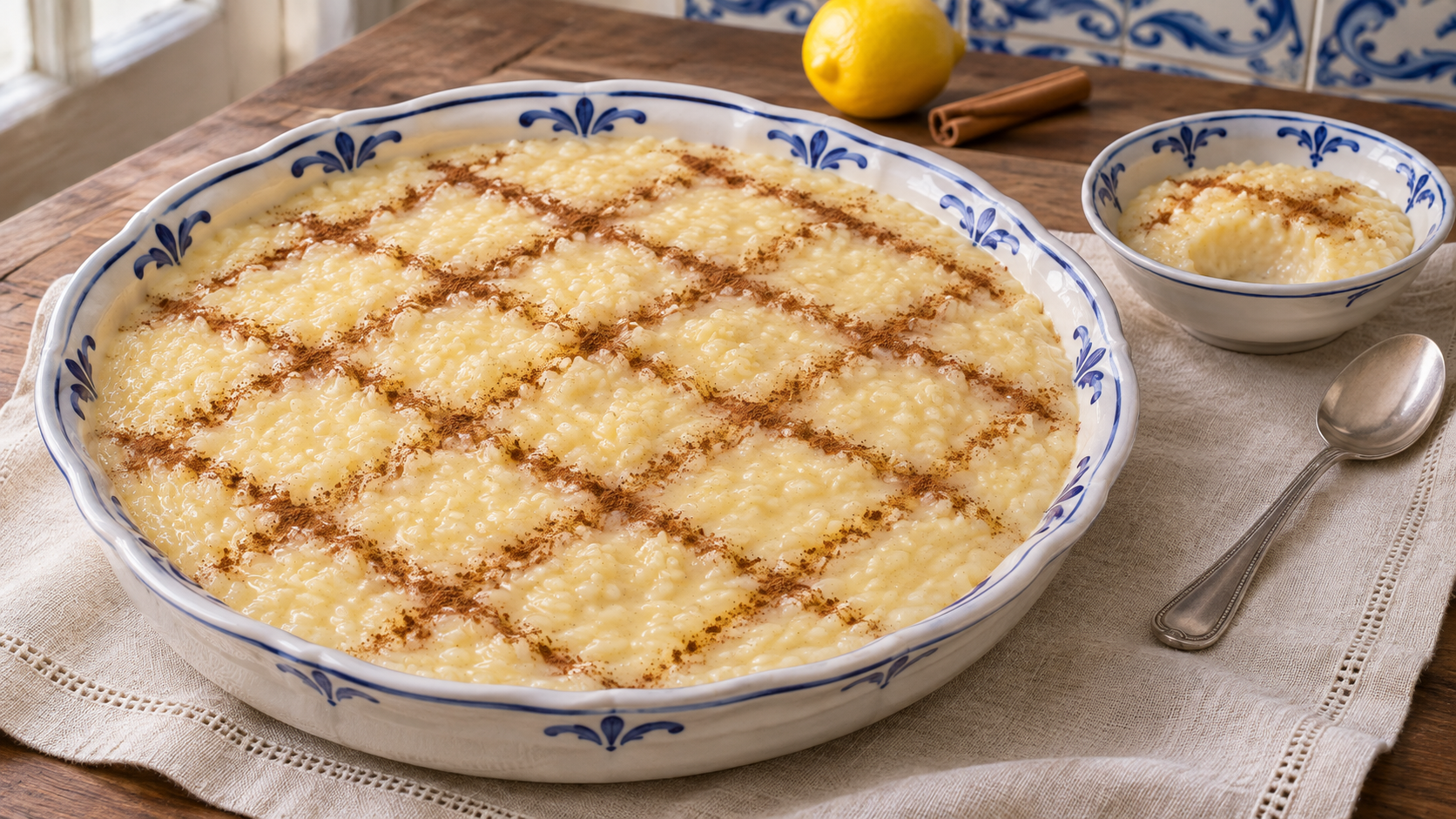
The dessert is commonly transferred to serving platters, shallow dishes, or individual bowls and allowed to cool before decoration. Ground cinnamon provides both flavor and visual ornament. Decorative patterns may include intersecting lines, floral designs, crosses, or initials associated with a celebration. Ethnographic documentation from Idanha-a-Nova records the importance of elaborate decoration in wedding preparations, where the presentation of the dessert expressed care and ceremonial significance.
Its social role also extends beyond the wedding meal. In Eira Pedrinha, in the municipality of Condeixa-a-Nova, couples distribute arroz-doce before their marriage to announce the occasion and share their celebration with neighbors, including people who will not attend the ceremony. A municipal documentary presented in 2026 records this continuing practice. Comparable customs are documented elsewhere, including Alcochete and Idanha-a-Nova, linking the dessert with gift exchange, neighborhood relationships, and collective participation in family events.
Arroz-doce is commercially available in restaurants and as a packaged dessert. Its nutritional composition varies with the recipe and portion size, particularly the quantities of sugar, milk, butter, and eggs. A single nutritional profile therefore cannot represent all traditional and commercial preparations. Its presence in regional restaurants and culinary training also connects household knowledge with hospitality and gastronomic tourism; Turismo de Portugal has offered training specifically addressing wedding arroz-doce and the traditions of Eira Pedrinha.
Regional documentation in traditional-food inventories is distinct from European quality certification. The protected geographical indication Arroz Carolino das Lezírias Ribatejanas, registered in 2008, applies to rice produced under its specification. It does not confer protected status on arroz-doce prepared from that ingredient. The dessert’s cultural significance rests principally on its recipes, preparation skills, decorative practices, and continuing place in communal celebrations.
References
Cantinho, M. J. (2018). A doçaria conventual portuguesa: História e receitas. Edições Colibri; Fernandes, D. (2016). A cozinha tradicional portuguesa. Editorial Verbo; Leite, A. S. (2019). Etnografia e gastronomia regional em Portugal. Âncora Editora; Modesto, M. L. (2012). Cozinha tradicional portuguesa. Verbo. (Original work published 1982); Sobral, J. M. (2007). Nacionalismo, gastronomia e identidade nacional em Portugal. Etnográfica, 11(1), 193–216. https://doi.org/10.4000/etnografica.1002; Sobral, V. (2015). Receitas de arroz de Portugal. Quetzal Editores.
See Also