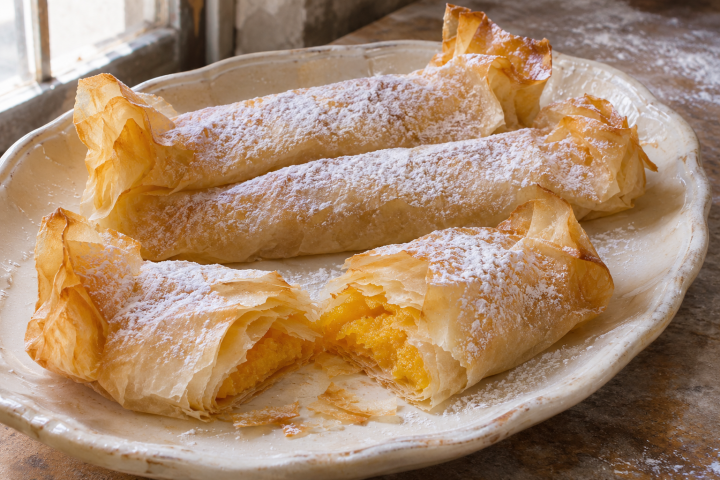
Pastéis de Tentúgal (Tentúgal, Montemor-o-Velho, Portugal)
Traditional Food Resources COUNTRIES AND TERRITORIES Portugal
Tentúgal, Montemor-o-Velho, Portugal
-
2026

The pastry originated at the Convent of Nossa Senhora da Natividade in Tentúgal, in the lower Mondego valley, where Carmelite nuns lived from 1565 until 1898. Its reputation had reached nearby Coimbra well before the convent closed. In Velharias de Coimbra, Augusto Fonseca records that a woman named Rosa sold the pastries beneath the city’s Arco do Bispo before 1860.
The dough contains only wheat flour and water. Bakers spread it over a white sheet on a low wooden platform, pulling it by hand until it is almost transparent, just 0.06–0.15 mm thick. The valley’s humid air helps the dough stretch without tearing. Once the sheet has dried enough to handle, the bakers cut it into pieces and fold several layers around a filling made from egg yolks, whole eggs and sugar syrup. In the oven, the layers turn crisp while the filling stays soft.
The slender palito has crimped ends; the pleated meia-lua, or half-moon, has toasted almonds in its filling. Both come in miniature versions. Under the European Union’s Protected Geographical Indication (PGI), bakers must make the dough and filling and shape the pastries in Tentúgal, although they may bake them elsewhere. For visitors, local pastry-making demonstrations offer a chance to see the most demanding part of the craft: stretching a single sheet evenly without breaking it. cm-montemorvelho.pt
References
Associação dos Pasteleiros de Tentúgal. (2024). Caderno de especificações do Pastel de Tentúgal – Indicação Geográfica Protegida. https://tradicional.dgadr.gov.pt/images/prod_imagens/doces/docs/CE_Pastel_Tentugal.pdf; Carvalho, M. (2018). A doçaria conventual em Portugal: História e receitas. Editorial Verbo; Davidson, A. (2006). The Oxford companion to food (T. Jaine, Ed.; 2nd ed.). Oxford University Press. https://doi.org/10.1093/acref/9780192806819.001.0001; Freitas, J. (2015). Tesouros da pastelaria do centro de Portugal. Verbo.
See Also:
See Also
Map