Ovos Moles de Aveiro (Portugal)
Traditional Food Resources COUNTRIES AND TERRITORIES Portugal CULINARY ARTS AND GASTRONOMY Culinary Culture
Aveiro, Portugal
-
2026

Ovos Moles de Aveiro belong to the Portuguese tradition of doçaria conventual, or convent confectionery. Their history is closely associated with Aveiro’s Dominican Convent of Jesus. In 1502, King Manuel I granted the convent an annual allowance of sugar from Madeira for making sweets. The grant documents confectionery at the convent, although the recipe’s precise origins remain uncertain. The name Ovos Moles de Aveiro appeared in the Portuguese culinary periodical Annona ou Mixto-curioso in 1836–1837. Women educated in convents passed on the method, and commercial producers were registered in Aveiro by 1856, before the Convent of Jesus itself closed in 1874.
Confectioners heat refined white cane sugar and water to 110 °C, then work fresh egg yolks into the syrup. They continue cooking and stirring until each stroke briefly exposes the bottom of the pan. The result is a smooth cream, yellow to orange in color, that holds its shape. Traditionally, it cools and rests for 24 hours; controlled rapid cooling can shorten this stage. The product specification gives a typical composition of about 41 percent sugar and 17 percent fat by weight.
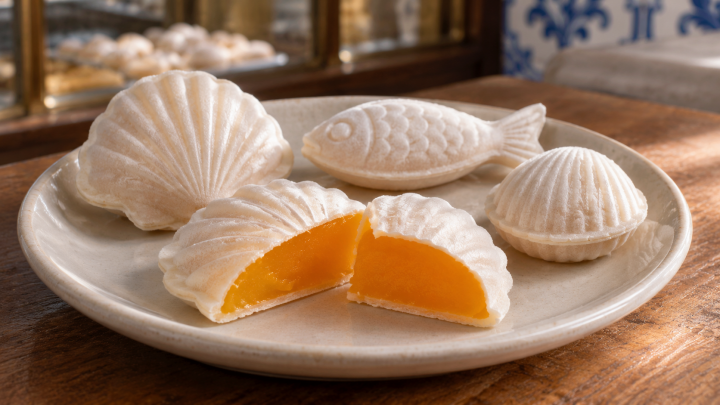
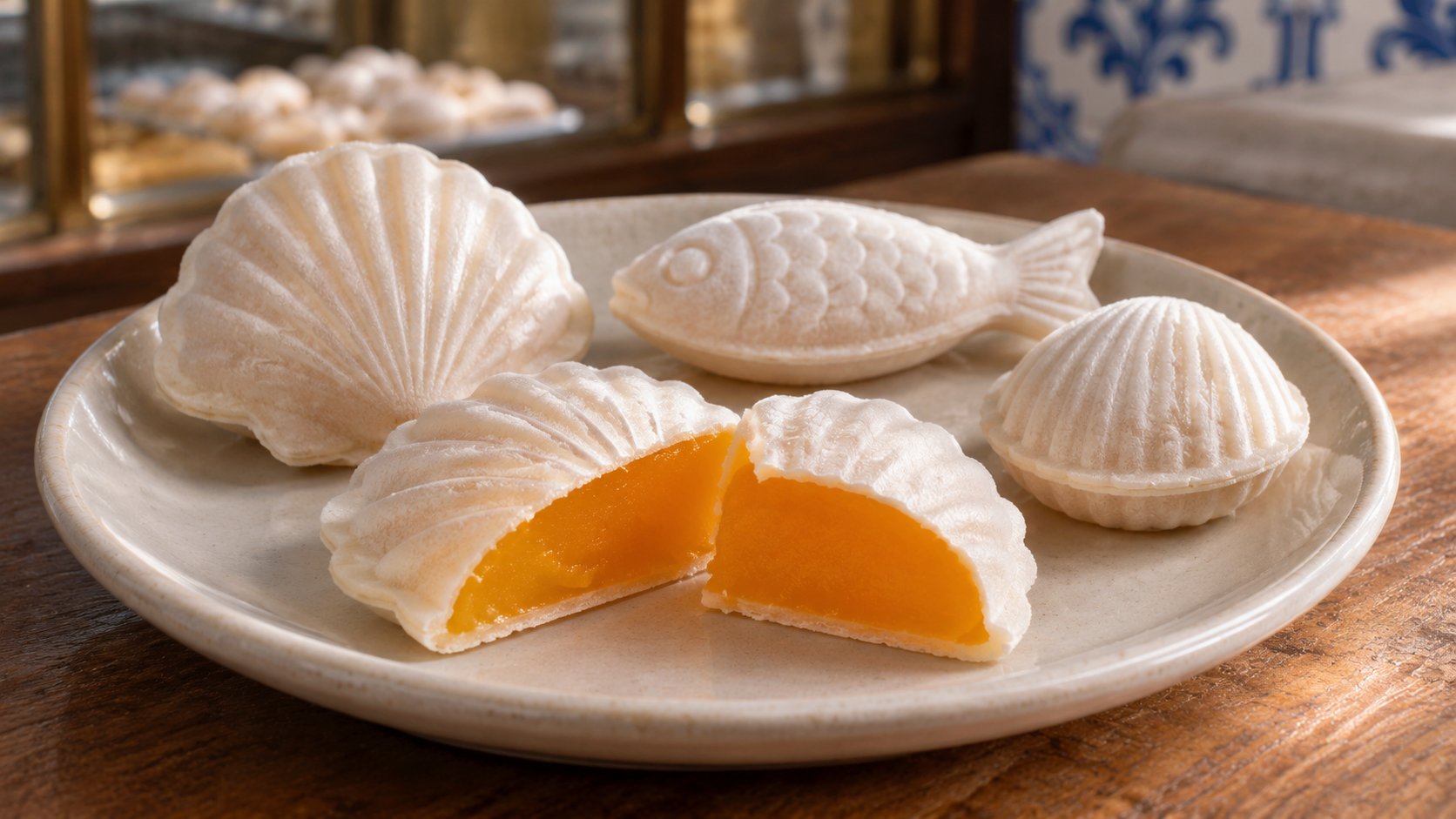
The two customary presentations evoke different aspects of the lagoon. For individual sweets, confectioners fill molded wafer halves, press them together, and trim the edges to form fish, cockles, mussels, or whelks. The pale wafer may be left plain or finished with a thin coating of sugar syrup or chocolate. Alternatively, the cream is packed directly into small wooden or porcelain barrels called barricas. These often bear painted scenes of salt pans and moliceiros, the traditional boats of the Ria de Aveiro.
The European Union registered the name as a Protected Geographical Indication (PGI; Portuguese: Indicação Geográfica Protegida, IGP) in 2009 under Commission Regulation (EC) No 286/2009. The specification distinguishes where the sweet is made from where its eggs may come from. Preparation and packaging are restricted to ten municipalities in and around the lagoon: Águeda, Albergaria-a-Velha, Aveiro, Estarreja, Ílhavo, Mira, Murtosa, Ovar, Sever do Vouga, and Vagos. The permitted area for egg production includes four additional municipalities. The regional producers’ association is the Associação de Produtores de Ovos Moles de Aveiro (APOMA).
Travel helped establish the sweet’s reputation beyond Aveiro. Women sold it to passengers when trains on the Lisbon–Porto line stopped at the city’s station. Its familiarity as a gift is evident in Eça de Queirós’s novel Os Maias (1888), in which Dâmaso brings six little barrels as a present. Today, the old railway station presents and sells the confection alongside local salt and Bairrada wines. At Aveiro’s Oficina do Doce, visitors can take part in filling the wafers and taste the finished sweets.
References
Associação de Produtores de Ovos Moles de Aveiro. (n.d.). Caderno de especificações da indicação geográfica protegida: Ovos Moles de Aveiro; European Commission. (2009). Commission Regulation (EC) No 286/2009 of 7 April 2009 entering certain names in the register of protected designations of origin and protected geographical indications (Melva de Andalucía (PGI), Caballa de Andalucía (PGI), Ovos Moles de Aveiro (PGI), Castagna di Vallerano (PDO)). Official Journal of the European Union, L 94, 15–16. https://eur-lex.europa.eu/eli/reg/2009/286/oj; Fernandes, D. (2016). A doçaria conventual portuguesa: História e receitas. Edições Colibri; Queiroz, E. de. (1888). Os Maias: Episodios da vida romantica (Vols. 1–2). Livraria Internacional de Ernesto Chardron.
See Also:
See Also
Map