London–Calcutta Bus Route
Events by Spatial Format Route-Based Event
(1957 - 1976)
-
2026

London–Calcutta Bus Route was one of the longest international overland passenger transport services in the world, operating between London in the United Kingdom and Calcutta (now Kolkata) in India between 1957 and 1976. Traversing Europe, Türkiye, the Middle East, and South Asia, the route became closely associated with the famous Hippie Trail and played a significant role in the development of long-distance overland tourism during the second half of the twentieth century.
Origins and Development
The London–Calcutta bus service was inaugurated in 1957, at a time when international air travel remained expensive and inaccessible to many young travelers. The route offered an alternative means of reaching South Asia by land and quickly became popular among adventure travelers, students, backpackers, and later members of the hippie movement.
Departing from Victoria Coach Station in London, the service connected Western Europe with the Indian subcontinent through a continuous overland journey. During its years of operation, it represented one of the most ambitious passenger transportation ventures ever undertaken.
In addition to services terminating in Calcutta, some companies also operated routes extending to Kathmandu, Nepal, another major destination on the Hippie Trail.
Route and Geography
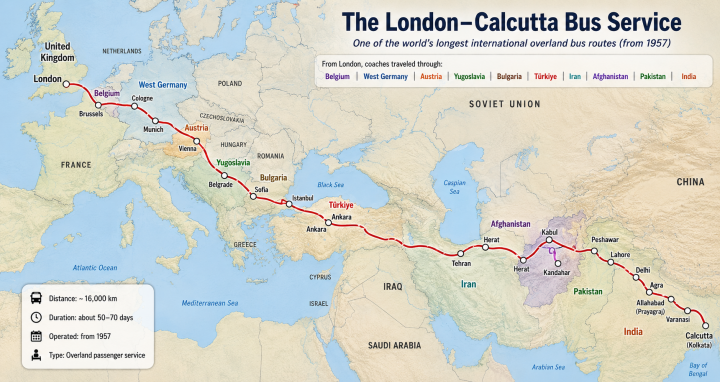
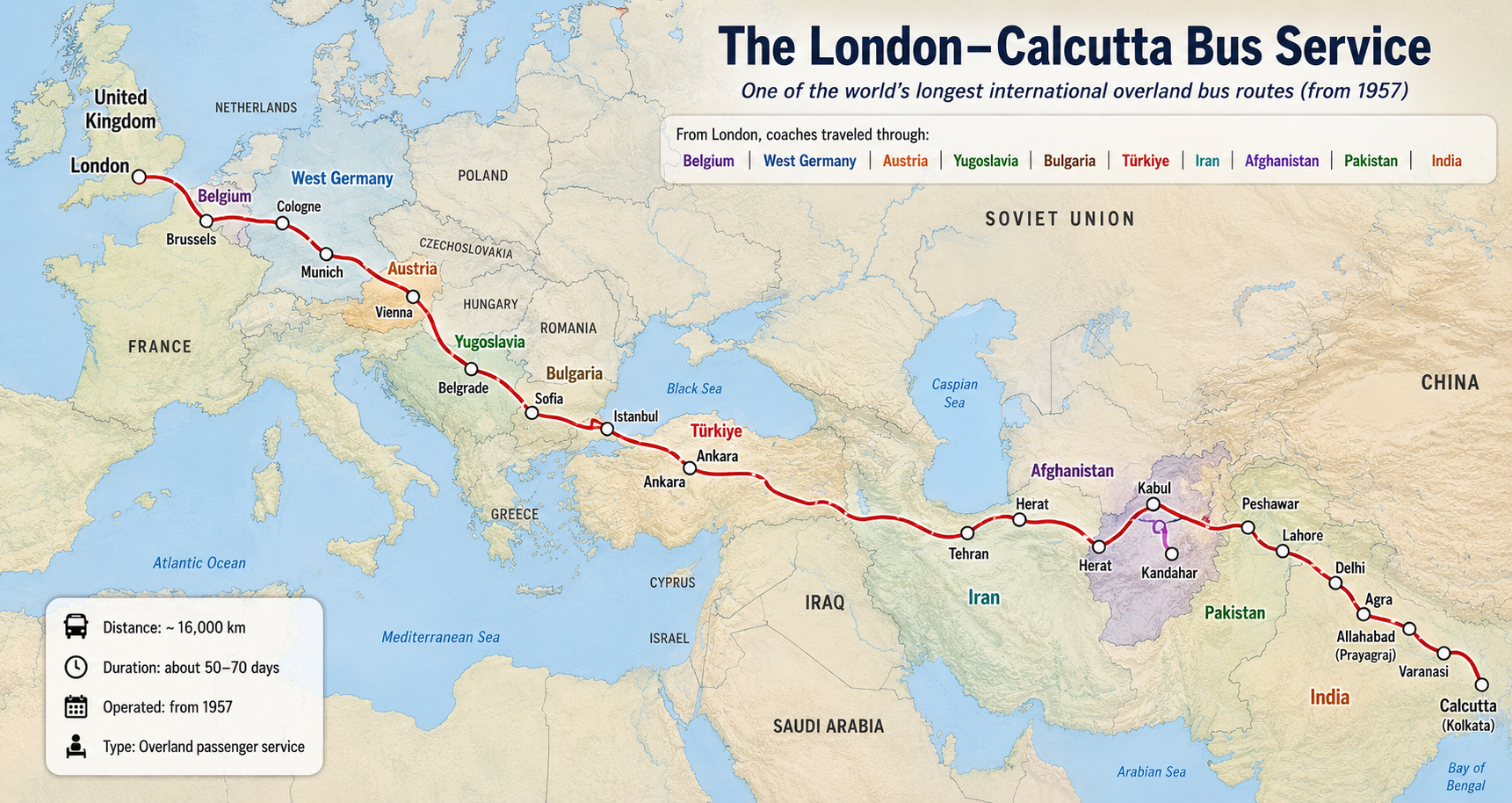
The standard route crossed a wide range of countries and cultural regions. From London, coaches traveled through: Belgium, West Germany, Austria, Yugoslavia, Bulgaria, Türkiye, Iran, Afghanistan, Pakistan, India.
The journey covered approximately 10,000 miles (16,000 kilometers) one way and more than 20,000 miles (32,000 kilometers) for a round trip. Travel time between London and Calcutta generally lasted around fifty days, depending on border procedures, weather conditions, and scheduled stops.
Türkiye occupied a strategic position along the route. Entering from Bulgaria and continuing toward Iran, coaches crossed the country through major transportation corridors linking Europe and Asia. Istanbul became one of the most important stopover points on the journey, serving both logistical and touristic functions. For many travelers, the city represented the symbolic gateway between Europe and the East.
Besides Istanbul, passengers frequently spent time visiting other destinations within Türkiye before continuing toward Iran and South Asia. Consequently, the route contributed to the international visibility of several Turkish destinations during the formative years of modern tourism in the country.
Travel Experience
The London–Calcutta route offered far more than simple transportation. Contemporary accounts often describe the journey as a moving international tour rather than a conventional bus trip.
Ticket prices varied over time. A one-way fare was approximately £85 in 1957 and increased to around £145 by 1973. The fare generally included accommodation and meals, making the service comparatively affordable for long-distance travelers.
The coaches were equipped with facilities designed to support extended travel. Typical amenities included:
- Sleeping bunks for passengers
- Electric heating systems
- Onboard kitchens
- Observation lounges
- Radio and music systems
Many vehicles also hosted social activities during the journey. Passengers from different countries shared meals, exchanged travel information, and participated in informal gatherings, creating a unique international travel culture.
The route therefore became not only a transportation service but also a social space where travelers formed friendships and shared experiences across national and cultural boundaries.
Relationship with the Hippie Trail
During the 1960s and 1970s, the London–Calcutta route became closely linked with the Hippie Trail, the informal network of overland routes connecting Western Europe with destinations in South Asia.
Young travelers seeking alternative lifestyles, spiritual experiences, cultural exploration, and inexpensive travel frequently used the service. The route provided access to major destinations associated with the countercultural movement, including Istanbul, Tehran, Kabul, Lahore, Delhi, Kathmandu, and Calcutta.
Because of its popularity among these travelers, the route is often referred to as part of the Classic Hippie Route. It played an important role in facilitating the movement of thousands of young people between Europe and Asia during the peak years of the hippie era.
For Türkiye, the route had particular significance because it brought large numbers of international travelers through Istanbul and other destinations, contributing to the early growth of independent tourism and backpacker travel.
Operators
Several companies operated long-distance services along the route during different periods. Among the best-known operators were:
- Treasure Tours Overland Coaches,
- Penn Overland,
- Top Decks,
- Spike Cawthorn,
- Sundowners,
- Contiki Intertrek,
- Encounter Overland,
- Exodus.
These companies competed by offering varying levels of comfort, itinerary flexibility, and additional sightseeing opportunities.
Decline and Closure
The route began to face increasing challenges during the mid-1970s. Political instability across parts of the Middle East and South Asia complicated overland travel. Rising tensions between India and Pakistan, together with the deteriorating political situation in Iran and Afghanistan, created growing uncertainty for operators and passengers.
As geopolitical conditions worsened, maintaining regular and safe service became increasingly difficult. The route was ultimately discontinued in 1976, shortly before the Iranian Revolution of 1979 effectively ended the traditional overland Hippie Trail.
Legacy
The London–Calcutta Bus Route occupies a distinctive place in the history of tourism and transportation. As one of the world's longest scheduled overland passenger services, it symbolized a period when international travel was increasingly accessible yet still characterized by adventure and exploration.
The route contributed significantly to the development of overland tourism between Europe and Asia and played a central role in the cultural exchanges associated with the Hippie Trail. For Türkiye, its importance lies in the country's function as a major transit corridor and cultural gateway between continents, reinforcing its historical role as a bridge connecting Europe and Asia within the global tourism system.
References
Gemie, S. ve Ireland, B. (2017). The Hippie Trail: A History, 1957–1978. İngiltere: Manchester University Press; MacLean, R. (2007). Magic Bus: On the Hippie Trail from İstanbul to India (2. baskı). ABD: Penguin Books; Facebook Grubu. https://www.facebook.com/groups/1702950456599867 (Erişim tarihi: 08.12.2024); Facebook Grubu. https://www.facebook.com/groups/283021612689600?hoisted_section_header_type=recently_seen&multi_permalinks=1221808332144252 (Erişim tarihi: 08.12.2024); India Historical Moments. https://www.facebook.com/IndiaHistoricalMoments (Erişim tarihi: 08.12.2024).
See Also:
See Also