The Hippie Trail
Events by Spatial Format
(1960s - 1979)
-
2026

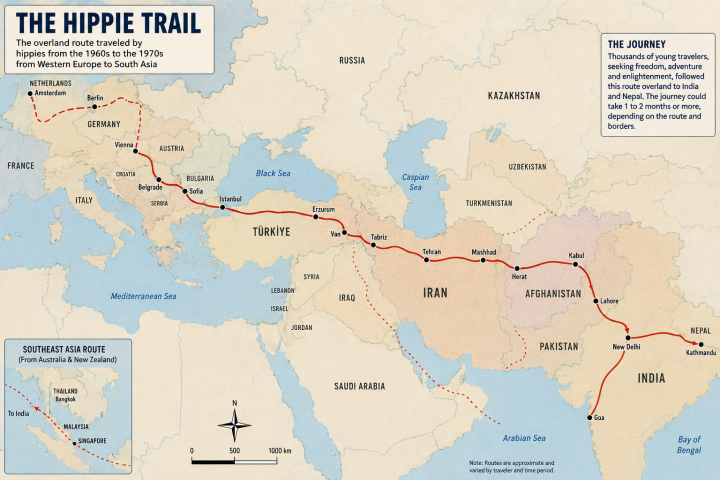
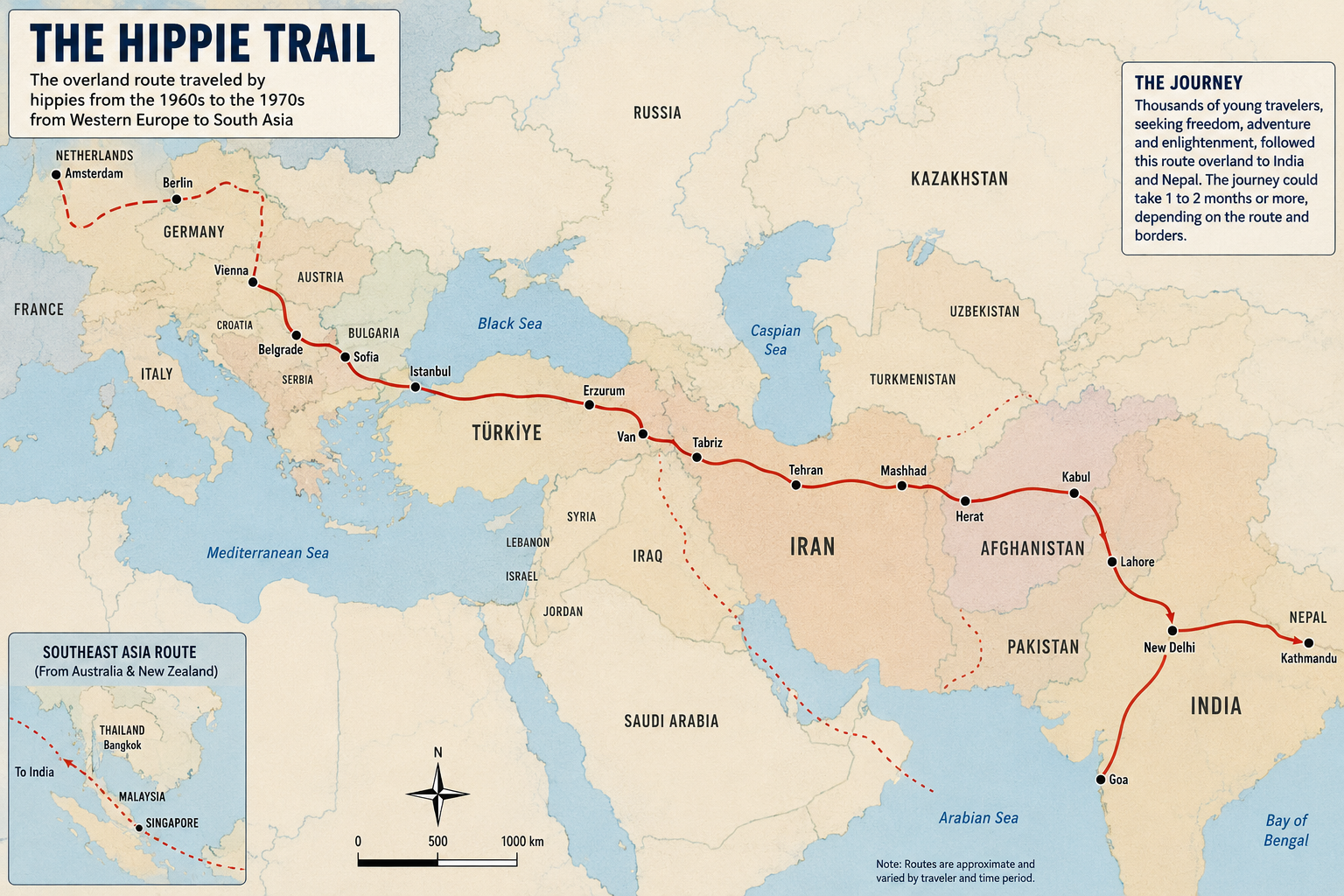
The Hippie Trail was the most widely used overland travel route followed by members of the international hippie movement between the mid-1960s and 1979. Extending from Western Europe through Türkiye, Iran, Afghanistan, Pakistan, and ultimately India or Nepal, the route became one of the most significant independent travel corridors of the twentieth century. Istanbul, particularly the Sultanahmet district, served as the principal gateway linking Europe and Asia along this route.
Definition and Historical Background
The Hippie Trail emerged during the 1960s as a result of the countercultural movement that developed primarily in the United States and Western Europe. Seeking alternatives to consumer society, conventional lifestyles, and political conflict, many young travelers embarked on long overland journeys to South Asia in search of spiritual experiences, personal freedom, and cultural discovery.
Although several routes connected Europe with Asia, the most frequently used itinerary became known as the Hippie Trail. The period between approximately 1965 and 1979 represented the peak years of the route's popularity. Interest increased significantly after members of The Beatles visited India in 1967, an event that attracted worldwide attention to South Asian spirituality and travel.
Türkiye as the Gateway to Asia
The Republic of Türkiye occupied a strategic position within the Hippie Trail network. Istanbul represented the primary meeting point where travelers arriving from Europe prepared for their journeys to Asia.
Most travelers from North America and Western Europe first gathered in major European cities such as London, Amsterdam, Paris, or Berlin before continuing overland through Austria, the former Yugoslavia, and Bulgaria to Istanbul. Amsterdam's Dam Square became one of the most important gathering places for hippies planning the journey eastward. Specialized transportation companies, including Magic Bus and Budget Bus, offered low-cost travel services connecting Western Europe with Istanbul.
Within Istanbul, Sultanahmet developed into the principal staging area for overland travel to South Asia. The district contained budget accommodations, restaurants, travel agencies, ticket vendors, and informal information networks serving international backpackers and hippie travelers.
Route and Itinerary
The Hippie Trail generally began in Istanbul and continued through Türkiye, Iran, Afghanistan, Pakistan, India, and Nepal.
One of the most common itineraries included the following sequence of destinations: Istanbul – Ankara – Sivas – Erzurum – Tabriz – Tehran – Mashhad – Herat – Kabul – Lahore – New Delhi – Kathmandu.
Alternative variations of the route also existed. Some travelers passed through Lebanon, Jordan, Iraq, or additional destinations within Iran and Pakistan. Separate routes were used by travelers originating from Australia and New Zealand, who typically traveled through Southeast Asia before reaching India and Nepal.
Although the exact itineraries varied, Istanbul remained the most important western gateway to the Asian section of the route.
Sultanahmet and the Travel Infrastructure
The success of the Hippie Trail depended upon an informal tourism infrastructure concentrated in Istanbul's Sultanahmet district. Student organizations, travel agents, independent operators, and local businesses provided transportation information, ticket sales, accommodation assistance, and travel advice.
Among the institutions reported to have assisted travelers at various times were the Turkish National Youth Organization (Türkiye Milli Gençlik Teşkilatı – TMGT) and the Turkish National Student Federation (Türkiye Milli Talebe Federasyonu – TMTF), both of which facilitated ticket sales and travel arrangements for individuals continuing to India, Nepal, and Tibet. Private operators and local businesses such as the famous Pudding Shop also played an important role in organizing transportation and disseminating travel information.
Because transportation regulations were relatively limited during the period, a variety of private operators entered the market, including bus owners from Pakistan and Afghanistan who transported travelers eastward from Istanbul.
Travel Experience
Journeys along the Hippie Trail typically lasted between forty-five and sixty days, depending on traveler preferences and local conditions. Unlike organized package tours, itineraries were flexible and often allowed travelers to remain in particular destinations for extended periods.
Many travelers viewed the route itself as an essential part of the experience. Historical cities, archaeological sites, mountain landscapes, and encounters with local cultures formed an integral component of the journey. Some itineraries included additional stops such as Cappadocia in central Türkiye.
Destinations Beyond India
Although Kathmandu in Nepal became the most iconic destination of the Hippie Trail, travelers frequently continued beyond India to other locations. After reaching New Delhi, travelers often dispersed to destinations such as Kathmandu, Goa, Kashmir, Manali, Chitral, Tibet, Bangkok, Dhaka, and Sri Lanka.
Among these destinations, Kathmandu emerged as the symbolic endpoint of the trail. The city's famous Freak Street (Jhochhen Tole) became one of the most important international gathering places for hippies, playing a role comparable to that of Sultanahmet in Istanbul.
Decline of the Route
The popularity of the Hippie Trail began to decline during the mid-1970s. However, the decisive turning point occurred in 1979 following the Iranian Revolution. Political changes in Iran, combined with growing instability in Afghanistan and changes in regional border controls, made overland travel increasingly difficult.
As a result, the traditional route through Türkiye, Iran, Afghanistan, Pakistan, and India effectively ceased to function as an accessible international travel corridor. By the early 1980s, the Hippie Trail had largely disappeared as a major tourism phenomenon.
Significance and Legacy
The Hippie Trail represents one of the most influential long-distance travel routes in the history of modern tourism. It contributed to the growth of independent travel, backpacker tourism, intercultural exchange, and alternative forms of mobility outside conventional mass tourism systems.
For Türkiye, the route holds particular significance because Istanbul and Sultanahmet served as the principal bridge between Europe and Asia. The infrastructure, businesses, and social networks that developed to support Hippie Trail travelers contributed to the emergence of backpacker tourism in Türkiye and helped establish Istanbul as a major international travel hub during the second half of the twentieth century.
References
Aksak, M. (2019). Mahmut Aksak. (Görüşen: Nazmi Kozak). İçinde; Kozak, N. (Editör), Türkiye Turizmi Sözlü Tarih Araştırması Görüşme Metinleri Cilt - IX: Turizm Bakanlığı, TURBAN, TURİNG, TMGT, TMTF, Hippiler, Turizm Yatırımcılığı, Diğer Alanlar (ss. 568-581). İstanbul: Yılmazlar Matbaası; Çolpan, N. (2018). Namık Çolpan. (Görüşen: Nazmi Kozak). İçinde; Kozak, N. (Editör), Türkiye Turizmi Sözlü Tarih Araştırması Görüşme Metinleri Cilt - IX: Turizm Bakanlığı, TURBAN, TURİNG, TMGT, TMTF, Hippiler, Turizm Yatırımcılığı, Diğer Alanlar (ss. 582-587). İstanbul: Yılmazlar Matbaası; Kozak, N. (Editör) (2019). Türkiye’de Hippiler (1965 – 1979). İçinde; N. Kozak (Editör), Dünden Bugüne Türkiye’de Turizm Kurumlar, Kuruluşlar, Turizm Bölgeleri ve Meslekler (ss. 859-908). İstanbul: Yılmazlar Matbaası.
See Also:
See Also