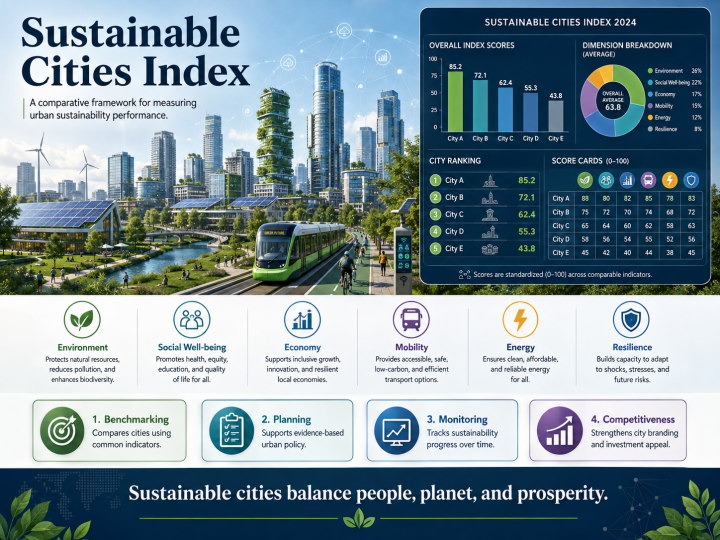
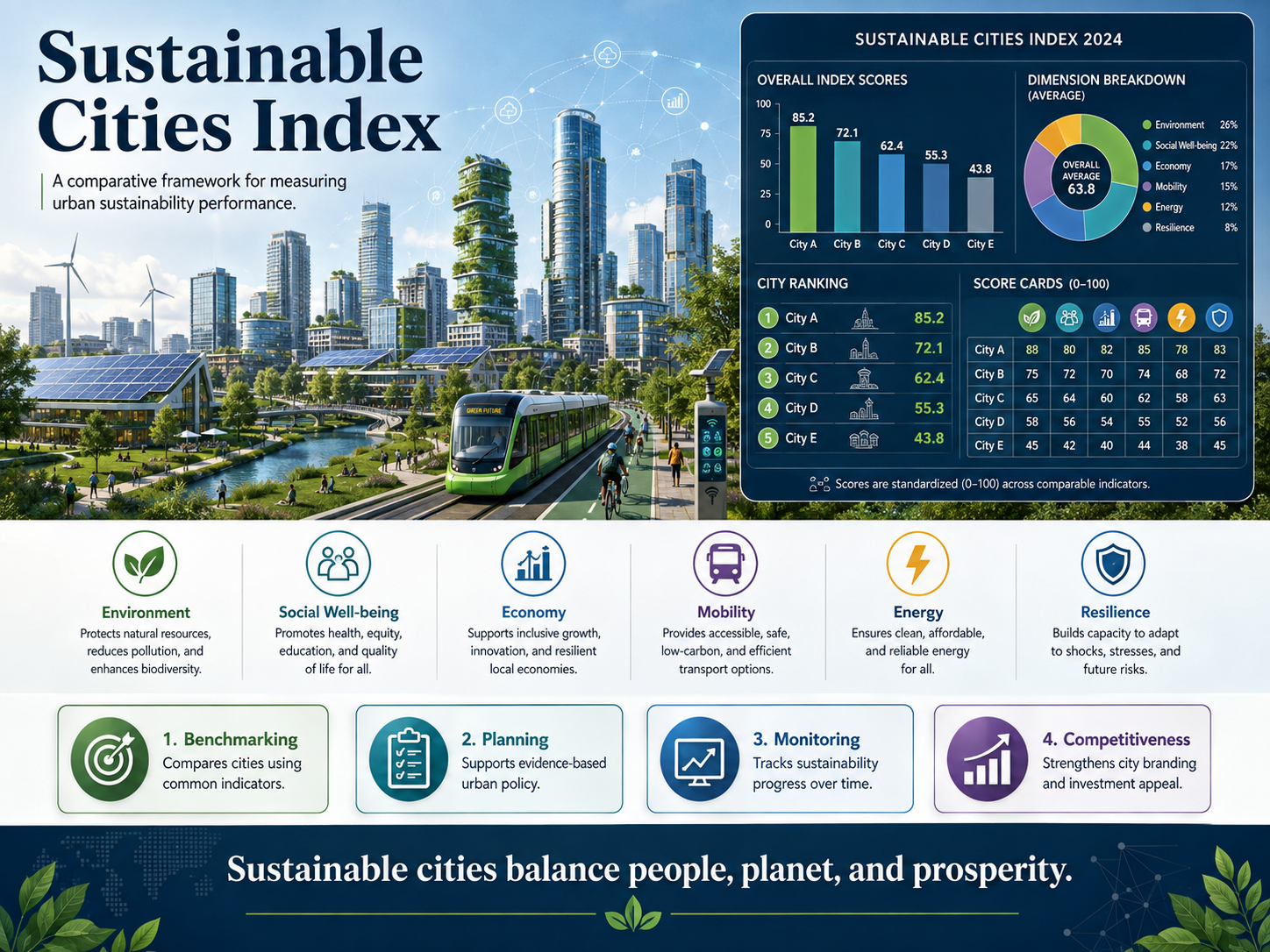
Sustainable Cities Index
Sustainability Studies Urban and Regional Planning
-
2026

The concept of sustainability, which gained prominence as rapid urbanization after World War II triggered severe environmental problems, entered the agenda of international organizations in the 1970s. The UN’s 1972 Human and Environment Conference laid the groundwork, and the 1987 Our Common Future report conceptualized sustainable development as a universal policy framework. In the subsequent period, the recognition that cities play a pivotal role in advancing sustainable development and that the prospects for a sustainable future are largely contingent upon urban sustainability performance became widely accepted. This is because cities, home to more than half of the world’s population, consume a substantial share of natural resources, while unplanned urbanization continues to constitute a primary source of environmental problems.
Sustainable cities are urban areas that are planned and managed with regard to their social, economic, and environmental impacts, offering resilient living environments for present populations while safeguarding the capacity of future generations to enjoy comparable conditions. With the growing significance of sustainable cities, the necessity of measuring and monitoring sustainability has come to the fore. Indices have become useful tools for evaluating and tracking cities. Moreover, within the competitive processes of globalization, they are also regarded as effective instruments of city marketing strategies. Indeed, positive recognition is of great importance for cities seeking to attract new investors, residents, and tourists.
Sustainable city indices are constructed using a set of indicators that reflect the three core dimensions of urban sustainability: environment, society, and economy. Indicators of environmental sustainability generally address planetary health. For instance, the Arcadis Sustainable Cities Index, which encompasses a broad range of indicators, includes environmental indicators such as air pollution, drinking water and sanitation, energy, resilience to natural disasters, green spaces, greenhouse gas emissions, green policy, sustainable transport, and waste management. Indicators associated with social sustainability include issues such as affordability, education, health, income inequality, work–life balance, cultural offerings, public transport services, and crime. Indicators used to assess economic sustainability include economic development, employment, income and living standards, ease of doing business, transport infrastructure, access to reliable electricity, internet quality, governance, and digital services.
According to the Arcadis 2024 Sustainable Cities Index, which evaluates cities using environmental, social, and economic indicators, Amsterdam ranks first, followed by Rotterdam, Copenhagen, Frankfurt, Munich, Oslo, Hamburg, Berlin, Warsaw, and London. All of the top ten cities are located in Europe, while the highest-ranking city from any other continent is Seoul, in 11th place. The index categorizes cities into four groups: cities with sustainable momentum, which combine high current sustainability with significant progress over the past decade; cities with declining momentum, such as Oslo, Toronto, and Hong Kong, which score highly but have made slower progress over the last ten years; cities with early momentum, such as Jakarta, which have made notable advances but still remain in the bottom third of the index; and cities losing momentum, which are positioned at the lower end of the rankings.
Today, different sustainable city indices are prepared by organizations such as Arcadis and the Sustainable Society Foundation. These indices serve as useful tools for reporting on local systems and guiding their improvement toward sustainable development. However, research has indicated that some indices suffer from methodological weaknesses, neglect complex causal relationships such as international spillover effects, and lack transparency in data collection and weighting processes. Moreover, they tend to reinforce stereotypes of top-ranked cities while disregarding those at the lower end of the rankings. The lack of clarity regarding city-selection criteria is another point of debate. Consequently, policymakers and users should not overlook the limitations of sustainable city indices and should exercise caution when engaging with those that fail to provide sufficient information regarding their methodology and results.
References
Arcadis. (2018). Citizen centric cities: The Sustainable Cities Index 2018. https://www.arcadis.com/campaigns/citizencentriccities/images/%7b1d5ae7e2-a348-4b6e-b1d7-6d94fa7d7567%7dsustainable_cities_index_2018_arcadis.pdf; Arcadis. (2024). The Arcadis Sustainable Cities Index 2024: 2,000 days to achieve a sustainable future. https://images.connect.arcadis.com/Web/Arcadis/%7B8dc89ba8-072e-4571-b752-3228076e5b4c%7D_The-Arcadis-Sustainable-Cities-Index-2024.pdf; Cömertler, S. (2020). Sustainable Cities Index / Sürdürülebilir Şehirler Endeksi. In N. Kozak (Ed.), Online Türkiye Turizm Ansiklopedisi. https://turkiyeturizmansiklopedisi.com/sustainable-cities-index-surdurulebilir-sehirler-endeksi; Giffinger, R., Haindlmaier, G., & Kramar, H. (2010). The role of rankings in growing city competition. Urban Research & Practice, 3(3), 299–312. https://doi.org/10.1080/17535069.2010.524420; Karakurt Tosun, E. (2019). Sürdürülebilir kentleşme. Dora Basım-Yayın; Sáez, L., Heras-Saizarbitoria, I., & Rodríguez-Núñez, E. (2020). Sustainable city rankings, benchmarking and indexes: Looking into the black box. Sustainable Cities and Society, 53, Article 101938. https://doi.org/10.1016/j.scs.2019.101938; United Nations. (1987). Report of the World Commission on Environment and Development: Our common future.
See Also