Cooking Techniques
Culinary Arts and Gastronomy Gastronomy
-
2026

Cooking techniques are methods of applying heat to food to modify its physical, chemical, and sensory properties. They influence flavor, aroma, color, texture, digestibility, and food safety and constitute a fundamental component of culinary knowledge. The use of fire and the development of cooking vessels, utensils, and ovens expanded the ways in which ingredients could be prepared. Contemporary practice encompasses both established methods, such as roasting and boiling, and technologies that enable precise control of cooking conditions. In tourism and hospitality, these techniques underpin food production in restaurants, hotels, and other food-service establishments.
Heat transfer is central to understanding cooking techniques. In conventional cooking, heat reaches and moves through food by conduction, convection, and radiation, often operating simultaneously. Conduction transfers heat through direct contact and within materials, including from a heated pan to food and from warmer to cooler regions within the food itself. Convection involves heat transfer through the movement of liquids or gases, while thermal radiation transfers energy through electromagnetic waves, particularly infrared radiation emitted by hot surfaces and flames. The combined effects of the heat source, cooking medium, temperature, duration, and food composition determine the rate and distribution of heating.
Cooking methods are commonly classified as dry-heat, moist-heat, or combination methods. This framework is widely used in culinary education, although classifications vary, particularly in the treatment of methods involving fat. Method selection depends on the ingredient’s structure, tenderness, connective tissue, moisture content, size, and shape, together with the desired characteristics of the finished dish. Equipment availability and service requirements also influence the choice of technique.
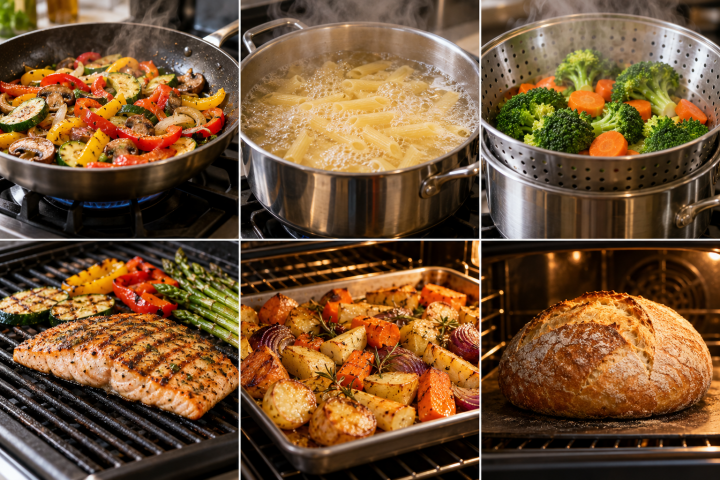
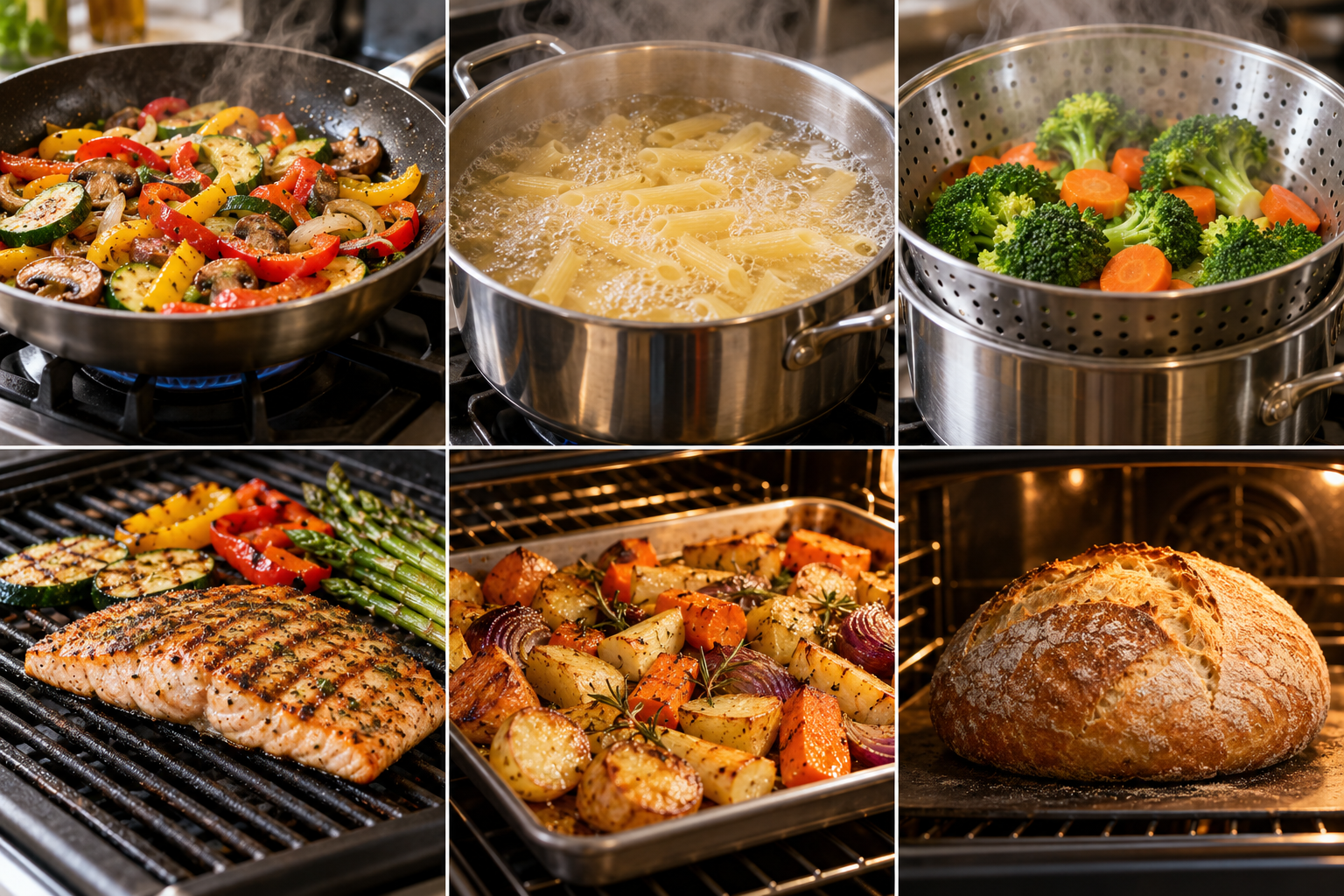
Dry-heat methods use hot air, heated surfaces, radiant heat, or hot fat without water or a water-based liquid serving as the principal cooking medium. Examples include roasting, baking, grilling, broiling, sautéing, pan-frying, and deep-frying. Roasting and baking commonly take place in an oven, where circulating air and radiant heat cook the food, with additional conduction through trays or other cooking vessels. Roasting is conventionally associated with meat, poultry, and vegetables, whereas baking is particularly associated with bread, pastries, and cakes, although usage overlaps. Both methods can produce surface browning and characteristic flavors and textures.
Grilling and broiling expose food to relatively intense radiant heat and are frequently used for tender ingredients or portions that cook quickly. In American English, grilling generally refers to cooking over a heat source, whereas broiling refers to cooking beneath one. In British English, grilling can describe the latter arrangement. Contact with a heated grill surface also contributes to heat transfer and surface browning. These terminology differences are relevant when interpreting recipes and culinary literature across national contexts.
Sautéing cooks relatively small or thin pieces of food rapidly with a small quantity of fat. Pan-frying generally uses more fat, with the food partly immersed and usually turned during cooking. Deep-frying involves full immersion in hot fat. These methods are commonly included in the dry-heat category because fat, rather than water, serves as the cooking medium. Their outcomes depend on fat temperature, cooking time, food size, and any coating applied to the ingredient.
Moist-heat methods use water, another water-based liquid, or steam as the principal cooking medium. Poaching involves gentle cooking in liquid below a simmer and is particularly suitable for delicate ingredients. Simmering involves gentle bubbling, whereas boiling produces more vigorous movement as the liquid reaches its boiling point under the prevailing pressure conditions. Steaming cooks food without immersing it in liquid; steam transfers energy to the food, including through condensation on its surface. Differences in temperature and liquid movement affect the suitability of these methods for particular ingredients and textures.
Combination methods bring together dry- and moist-heat stages. Braising typically involves browning food before cooking it gently in a covered vessel with a limited quantity of liquid. Stewing generally uses smaller pieces and often a greater proportion of liquid, although practices vary among dishes and culinary traditions. Preliminary browning is common but is not required in every braise or stew. Prolonged cooking can tenderize connective-tissue-rich cuts of meat, while fish and vegetables require adjustments to cooking time and temperature. The cooking liquid also contributes to flavor and may form part of the finished sauce.
Microwave cooking uses electromagnetic energy absorbed by food to generate heat within it. It is used for cooking, reheating, and defrosting, although heating may be uneven and depends on the food’s composition, dimensions, and arrangement. Sous-vide, French for “under vacuum,” typically involves vacuum-sealing food in heat-stable, food-grade packaging and cooking it in a precisely controlled water bath or steam environment. It commonly uses temperatures below the boiling point of water and permits close control of doneness and texture. Safe application requires appropriate combinations of time and temperature, together with rapid chilling and controlled refrigerated storage when cooked food is retained for later service.
Smoking has a distinct place among culinary processes because it combines exposure to smoke with varying degrees of heat. Hot smoking cooks food while developing characteristic flavors, whereas cold smoking does not itself constitute cooking. Infrared heating, meanwhile, is a form of radiant heat transfer used in both conventional and specialized equipment. Molecular gastronomy is a scientific field concerned with the physical and chemical phenomena involved in culinary preparation; its findings can inform cooking practices, but it is not itself a cooking method.
Cooking techniques also influence resource use. Equipment efficiency, cooking duration, production volume, and operating practices affect energy and water consumption. Appropriate equipment selection and control of preheating, idle operation, and cooking cycles can improve efficiency in professional kitchens. Matching preparation quantities to demand and controlling cooking processes can also help limit avoidable food waste. Resource efficiency therefore forms part of the assessment of cooking practices alongside sensory quality, consistency, and safety.
Within tourism and hospitality, cooking techniques have both operational and cultural significance. They shape menu development, production scheduling, product consistency, and the dining experience. Techniques associated with regional cuisines also form part of culinary heritage and may be communicated through restaurant meals, cooking demonstrations, and participatory tourism activities. Their study consequently connects food science and professional kitchen management with the preparation, presentation, and transmission of gastronomic traditions.
References
Aktaş, A., & Özdemir, B. (2012). Otel işletmelerinde mutfak yönetimi [Kitchen management in hotel enterprises] (3rd ed.). Detay Publishing; Canbolat, C. (2021). Pişirme teknikleri [Cooking techniques]. In Y. Seçim & S. Bayrakcı (Eds.), Temel mutfak bilimleri [Basic culinary sciences] (pp. 215–228). Detay Publishing; Gisslen, W. (2021). Profesyonel aşçılık [Professional cooking] (E. Denizci, Trans. Ed.; translated from the 8th ed.). Nobel Yaşam; McGee, H. (2004). On food and cooking: The science and lore of the kitchen (Rev. ed.). Scribner; Sabuncular, G., & Çelik, Z. M. (2022). Mutfakta sürdürülebilir pişirme [Sustainable cooking in the kitchen]. In Y. B. Saygı & Ş. Tavman (Eds.), Sürdürülebilir mutfak [Sustainable kitchen] (pp. 302–320). Detay Publishing; Yeşilyurt, C. (2021). Uluslararası pişirme yöntemleri [International cooking methods]. In E. Geçgin & M. Baltacı (Eds.), Temel mutfak teknikleri ve yönetimi [Basic kitchen techniques and management] (pp. 96–116). Detay Publishing.
See Also:
See Also