Leitão Assado da Bairrada (Bairrada, Portugal)
Traditional Food Resources COUNTRIES AND TERRITORIES Portugal
Bairrada, Portugal
-
2026

Leitão Assado da Bairrada, also known as leitão assado à Bairrada, is associated with the Bairrada region of central Portugal, particularly Mealhada, Anadia, Cantanhede, and Oliveira do Bairro. It forms part of a regional food culture linking livestock farming, specialist roasting skills, breadmaking, and wine production. Mealhada is especially associated with restaurants specializing in the dish, while its preparation and consumption extend throughout the surrounding region.
The precise origins of the dish remain uncertain. Portugal’s official inventory of traditional foods cites a conventual manuscript dated 1743, entitled Caderno Refeitório, containing a roast suckling pig recipe resembling the modern preparation. Its commercial development involved several cooks and entrepreneurs rather than a single documented inventor. A significant expansion occurred during the twentieth century alongside road travel. Álvaro Pedro began selling suckling pig sandwiches to motorists on the EN1 in 1941 and opened a restaurant in Sernadelo, Mealhada, in 1949. His establishment became an influential example of the specialized restaurants associated with the region.
Traditional preparation favors a young, milk-fed piglet with limited excess fat. The Confraria Gastronómica do Leitão da Bairrada identifies Bísaro and Malhado de Alcobaça among suitable breeds and recommends animals approximately one to one and a half months old. Published descriptions differ in their preferred weights and seasoning proportions. The principal seasoning combines garlic, salt, pepper, and pork fat; some recipes also include bay leaf, parsley, and olive oil. After cleaning and draining, the piglet is mounted lengthwise on a spit, seasoned, and sewn closed with cotton or linen thread.
Roasting traditionally takes place in a brick oven of the type also used for baking broa, or maize bread. Vine prunings or eucalyptus fuel heat the oven, after which the embers are moved to the sides and managed throughout cooking. The piglet is rotated manually to achieve an even roast, with cooking commonly taking approximately two hours, depending on its size and the oven conditions. Some traditional methods involve briefly withdrawing it and sprinkling the skin with Bairrada white wine using a bay branch. Near the end of roasting, the accumulated liquid is drained from the cavity before a short final period in the oven. The experience of the assador, or specialist roaster, is central to controlling browning and achieving crisp skin.
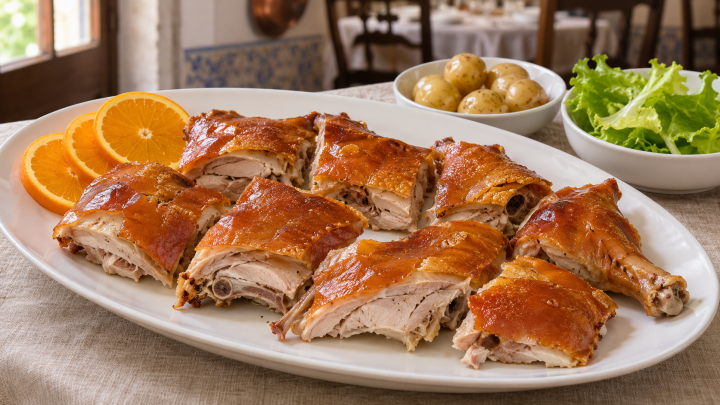
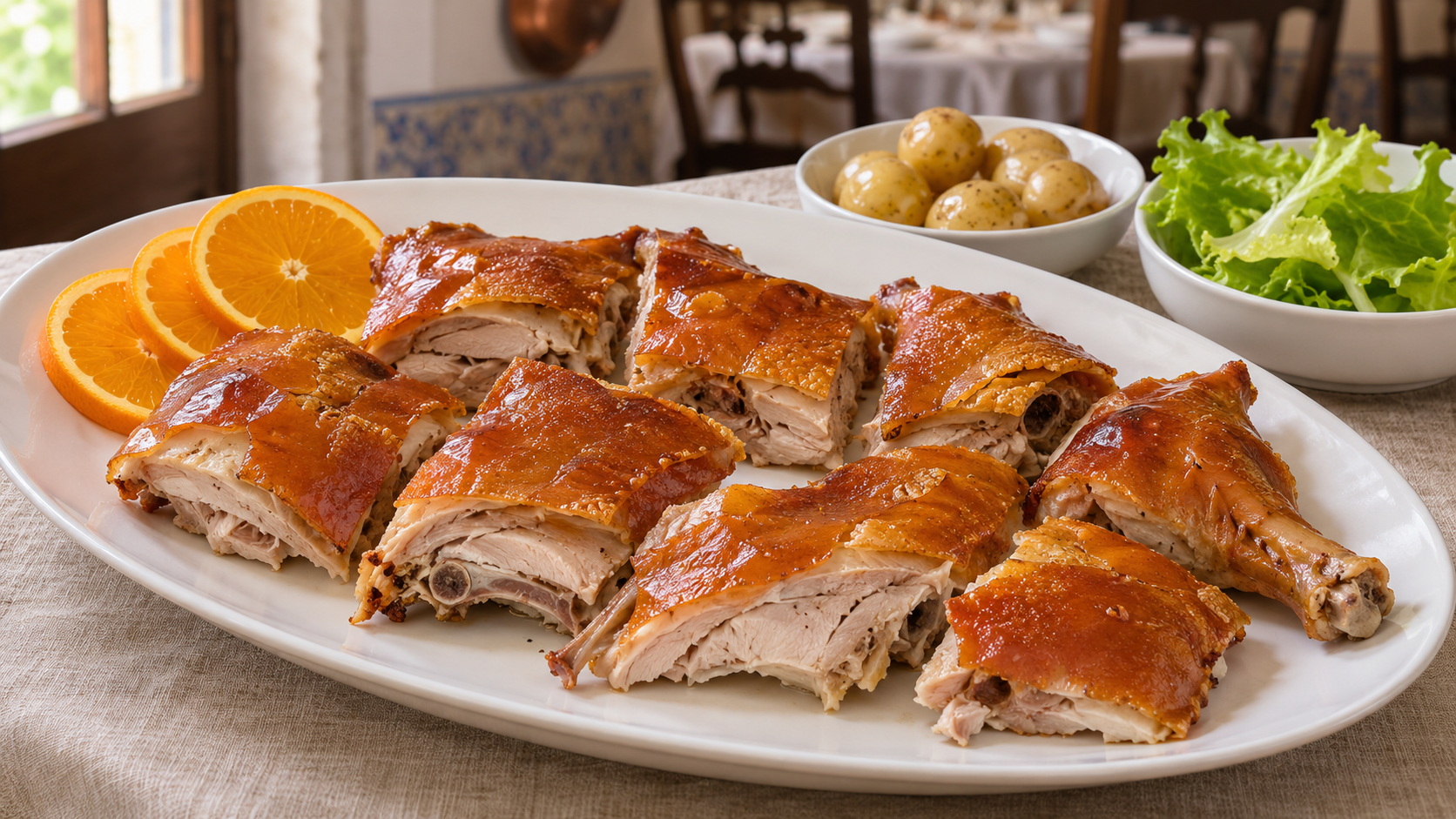
The finished piglet is carved into small portions, traditionally with shears, and arranged skin-side upward without stacking the pieces. Common accompaniments include sliced oranges, lettuce salad, and thinly sliced fried potatoes; boiled potatoes in their skins also belong to the documented serving tradition. The meat may be served warm or cold, according to preference. Bairrada sparkling wine, particularly dry styles, is a customary pairing, although regional red wines are also documented. These accompaniments and serving practices vary among households and restaurants.
The dish retains a place at weddings, baptisms, fairs, religious festivities, and family gatherings, while specialized restaurants make it available throughout the year. Related regional preparations include cabidela de leitão, made with the animal’s blood and offal, and feijoada de leitão, which incorporates parts of the roasted pig into a bean dish. Together, these preparations demonstrate the broader culinary practices surrounding suckling pig in Bairrada.
In 2011, Leitão da Bairrada was selected by public vote as one of the Seven Wonders of Portuguese Gastronomy. It is also promoted through Mealhada’s Água, Pão, Vinho, Leitão: As 4 Maravilhas da Mesa da Mealhada initiative, created in 2007 to support four characteristic local products. Separately, the Associação Rota da Bairrada has pursued qualification and legal protection for the dish. These promotional distinctions and protection initiatives should not be presented as evidence of an approved European geographical indication.
Its role in tourism extends from restaurant meals to organized wine-and-food experiences. Regional offerings combine cellar visits and wine tastings with suckling pig sandwiches, connecting the dish to Bairrada’s wine tourism. Such activities make its preparation, presentation, and regional associations part of the visitor experience.
References
Modesto, M. L. (2012). Cozinha tradicional portuguesa. Verbo; Moura, A. (2017). Gastronomia e turismo no Centro de Portugal. Edições Almedina; Rocha, J. (2019). O leitão da Bairrada: História, tradição e segredos da assadura. Rota da Bairrada Editores; Sobral, V. (2018). Petiscos e pratos típicos de Portugal. Quetzal Editores.
See Also