Broa de Avintes (Avintes, Vila Nova de Gaia, Portugal)
Traditional Food Resources COUNTRIES AND TERRITORIES Portugal
Avintes, Vila Nova de Gaia, Portugal
-
2026

Associated with Avintes, a parish in Vila Nova de Gaia on the southern side of the Douro, this bread reflects the connections between cereal cultivation, milling, domestic baking and trade with Porto. The nearby Febros valley supported watermills that supplied flour to local bakers. Women known as padeiras de Avintes played a central role in production and distribution, carrying bread across the Douro for sale in Porto’s markets.
Although local breadmaking traditions have older roots, the present maize-based preparation cannot be confidently described as medieval. Earlier references to milho may denote millet rather than American maize. Historical research connects the development of the modern bread with the expansion of maize cultivation locally during the late seventeenth and eighteenth centuries. Its subsequent commercial importance generated disputes over bread weights, prices and sales practices.
The principal ingredients are maize flour, rye flour, water, salt and a fermenting starter. The Portuguese traditional-products inventory specifically describes white maize flour, so yellow cornmeal should not be treated as a defining requirement. Traditional fermentation may employ isco or massa velha, a portion of dough retained from an earlier batch. Flour proportions and fermentation practices vary between producers.
Preparation involves working the flours with hot water, with scalding forming part of documented traditional methods. Where a starter is used, the mixture must cool sufficiently before its incorporation. After kneading and fermentation, portions are shaped using bowls called tigelas or escudelas. The loaves are placed close together in a wood-fired oven, which helps explain their flattened sides and limited lateral crust.
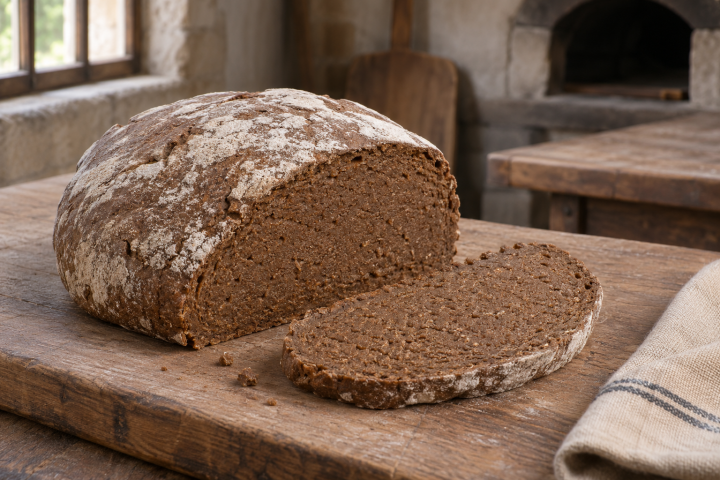
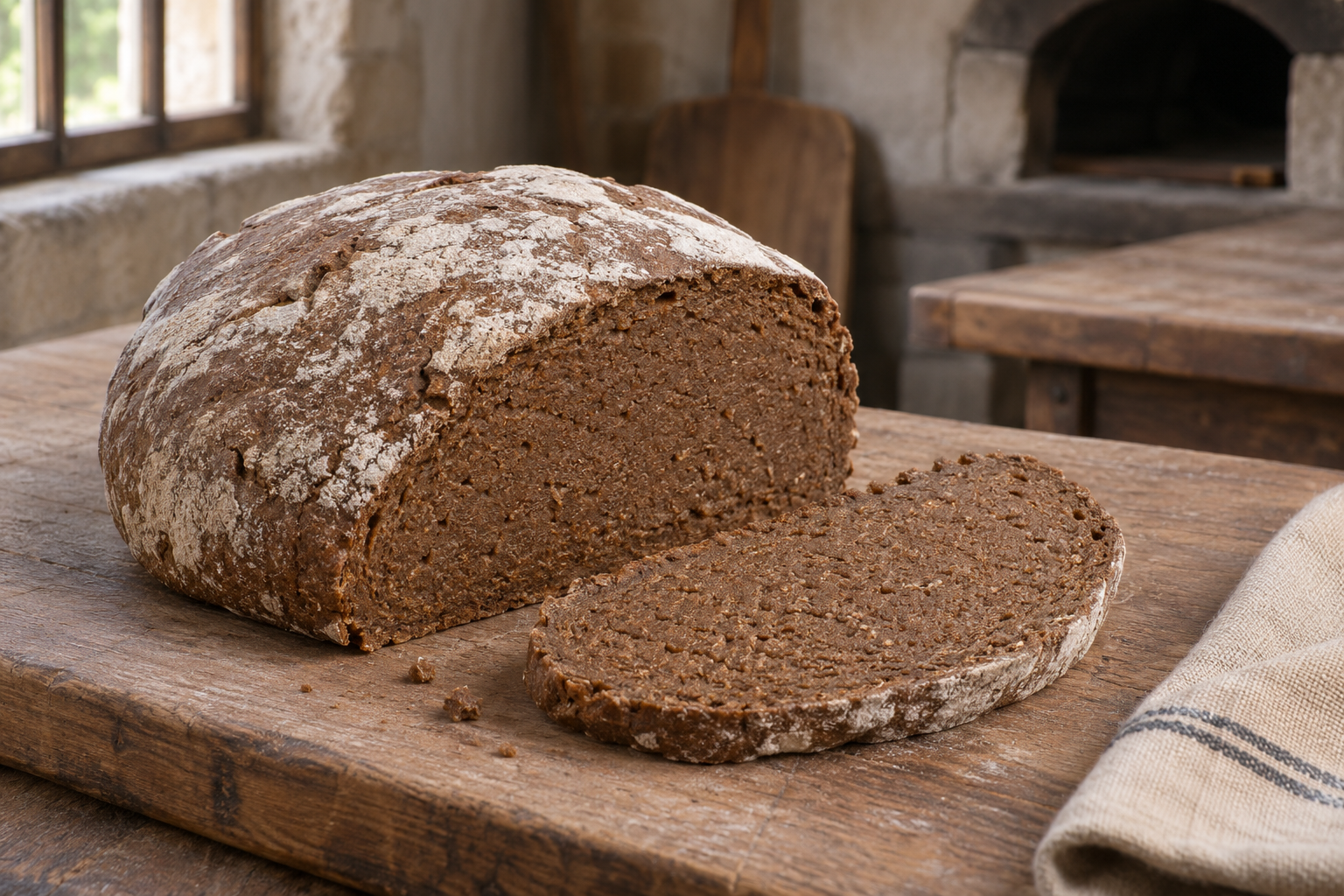
Baking takes several hours, although duration depends on loaf size, oven conditions and the producer’s method. Traditional accounts describe approximately three to four hours; a universal four-to-six-hour rule is therefore inappropriate. The finished loaf is heavy and compact, with a moist brown or yellowish-brown crumb and an often rounded, cracked, flour-dusted upper surface. Its characteristic flavour combines cereal sweetness with the acidity and aromatic complexity of fermentation and prolonged baking.
Common accompaniments include caldo verde, grilled sardines, chouriça and linguiça. Served in slices or portions, it belongs to everyday meals as well as communal celebrations and regional food events. Allowing the loaf to cool helps it slice cleanly. Keeping quality depends on production and storage conditions, rather than a guaranteed period of several weeks. Nutritionally, it supplies carbohydrates, with fibre content varying according to the flours used.
The bread’s cultural significance rests particularly on the knowledge transmitted through baking families and the historical contribution of women to the local economy. The Festa da Broa de Avintes brings together food stalls, cultural associations, music and activities centred on local traditions. The Confraria da Broa de Avintes also contributes to its public recognition.
Local bakeries, regional retailers and restaurants connect this living baking tradition with gastronomic tourism in Vila Nova de Gaia. Its inclusion in the DGADR inventory documents its importance as a traditional Portuguese food; this should not be presented as evidence of a particular geographical-indication registration. Written accounts include José Vaz’s História da Broa de Avintes and studies of regional breadmaking and milling.
References
Câmara Municipal de Vila Nova de Gaia. (2020). O património gastronómico de Gaia: A broa de Avintes; Carvalho, M. (2018). Os pães tradicionais de Portugal. Editorial Verbo; Freitas, J. (2015). A cozinha tradicional do norte. Verbo; Rodrigues, A. (2018). Tesouros da pastelaria e padaria portuguesa. QuidNovi.
See Also:
See Also
Map