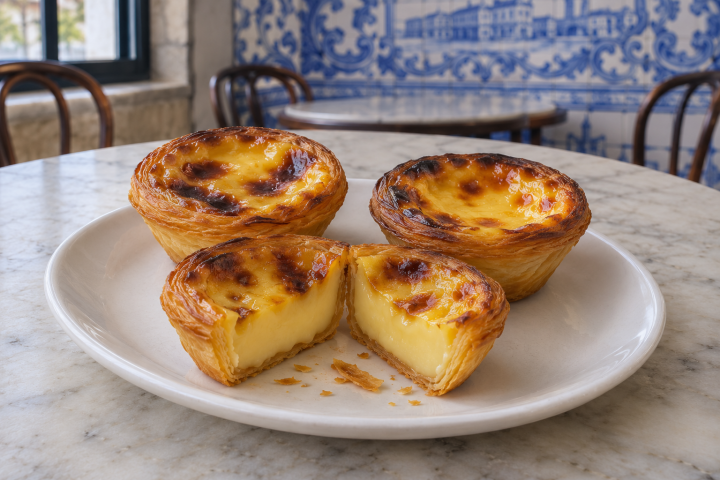
Pastéis de Belém (Belém, Lisbon, Portugal)
Traditional Food Resources COUNTRIES AND TERRITORIES Portugal
Belém, Lisbon, Portugal
-
2026

The Antiga Confeitaria de Belém traces its recipe to the neighbouring monastery. According to the bakery’s account, after the monastery closed in 1834, someone from its community began selling pastries at a small shop attached to a cane sugar refinery. In 1837, baking began in buildings adjoining the refinery. At the time, visitors from central Lisbon often reached Belém by steamboat to see the monastery and Belém Tower. Stopping for a tart became part of the outing.
The bakery still makes the tarts by hand. Its master pastry chefs pass on the recipe in a private workroom known as the Oficina do Segredo. The exact ingredients, proportions and baking conditions are not public. The name Pastéis de Belém identifies the bakery’s own tarts; elsewhere in Portugal, customers generally ask for a pastel de nata, or pastéis de nata in the plural.
In the bakery’s tiled rooms, the tarts are served warm, often with an espresso. Diners can add ground cinnamon or icing sugar to taste. For Lisbon families, a tart after a Sunday walk through the gardens of Belém is a familiar custom. Those taking pastries home can buy them in the shop’s distinctive long, six-sided box, which holds six tarts.
Pastel de nata, Jerónimos Monastery, Portuguese convent sweets, Lisbon café culture.
References
Antiga Confeitaria de Belém. (2020). A história do verdadeiro pastel de Belém: 1837. Pastéis de Belém; Carvalho, M. (2018). A doçaria conventual em Portugal. Editorial Verbo; Davidson, A. (2006). The Oxford companion to food (T. Jaine, Ed.; 2nd ed.). Oxford University Press. https://doi.org/10.1093/acref/9780192806819.001.0001; Freitas, J. (2015). Tesouros da pastelaria de Lisboa. Verbo.
See Also:
See Also
Map