Espumante da Bairrada / DOC Bairrada Sparkling Wine (Bairrada, Portugal)
Alcoholic Beverages COUNTRIES AND TERRITORIES Portugal
Bairrada, Portugal
-
2026

Bairrada lies between Aveiro and Coimbra, where Atlantic winds moderate summer temperatures and help grapes retain the acidity needed for sparkling wine. Its vineyards grow on clay and limestone as well as sandier soils. The grape most closely associated with the region is Baga, a dark-skinned variety that can produce all three colours of sparkling wine. To make a white blanc de noirs, winemakers press the grapes gently and separate the pale juice from the skins before they release much colour. White grapes used in the region include Maria Gomes, the local name for Fernão Pires, as well as Bical, Arinto, and Cercial. Chardonnay and Pinot Noir are also permitted under the Bairrada Protected Designation of Origin.
The region’s documented sparkling wine tradition began at the Escola Prática de Viticultura e Pomologia da Bairrada in Anadia. Founded in 1887, the school gave its first director, the agronomist José Maria Tavares da Silva, a place to experiment with fermenting local wines in the bottle. He produced Bairrada’s first natural sparkling wine there in 1890. The industry expanded in the 1920s as specialist cellars opened across the region. Portugal formally demarcated Bairrada in 1979 and extended its designation of origin to sparkling wines in 1991.
The appellation requires the método clássico. After the first fermentation, the winemaker bottles the base wine with yeast and sugar. A second fermentation in the sealed bottle produces the bubbles. The wine then rests on the spent yeast, or lees, which can give it aromas of bread and toast. Before corking, the producer gradually turns and tilts each bottle to collect the sediment in its neck, then expels it. Bairrada sparkling wine must remain at the producer’s premises for at least nine months after bottling. Portuguese label terms distinguish longer periods before sediment removal: Reserva denotes 12–24 months, Super Reserva or Extra Reserva 24–36 months, and Grande Reserva or Velha Reserva more than 36 months. A separate term, such as bruto (brut), indicates sweetness.
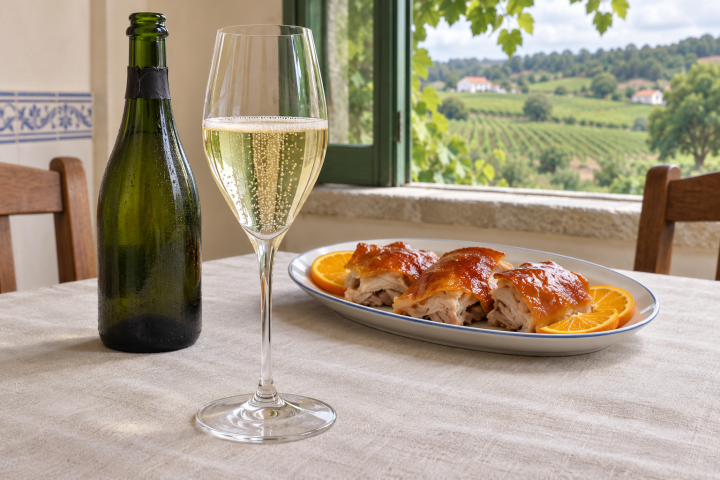
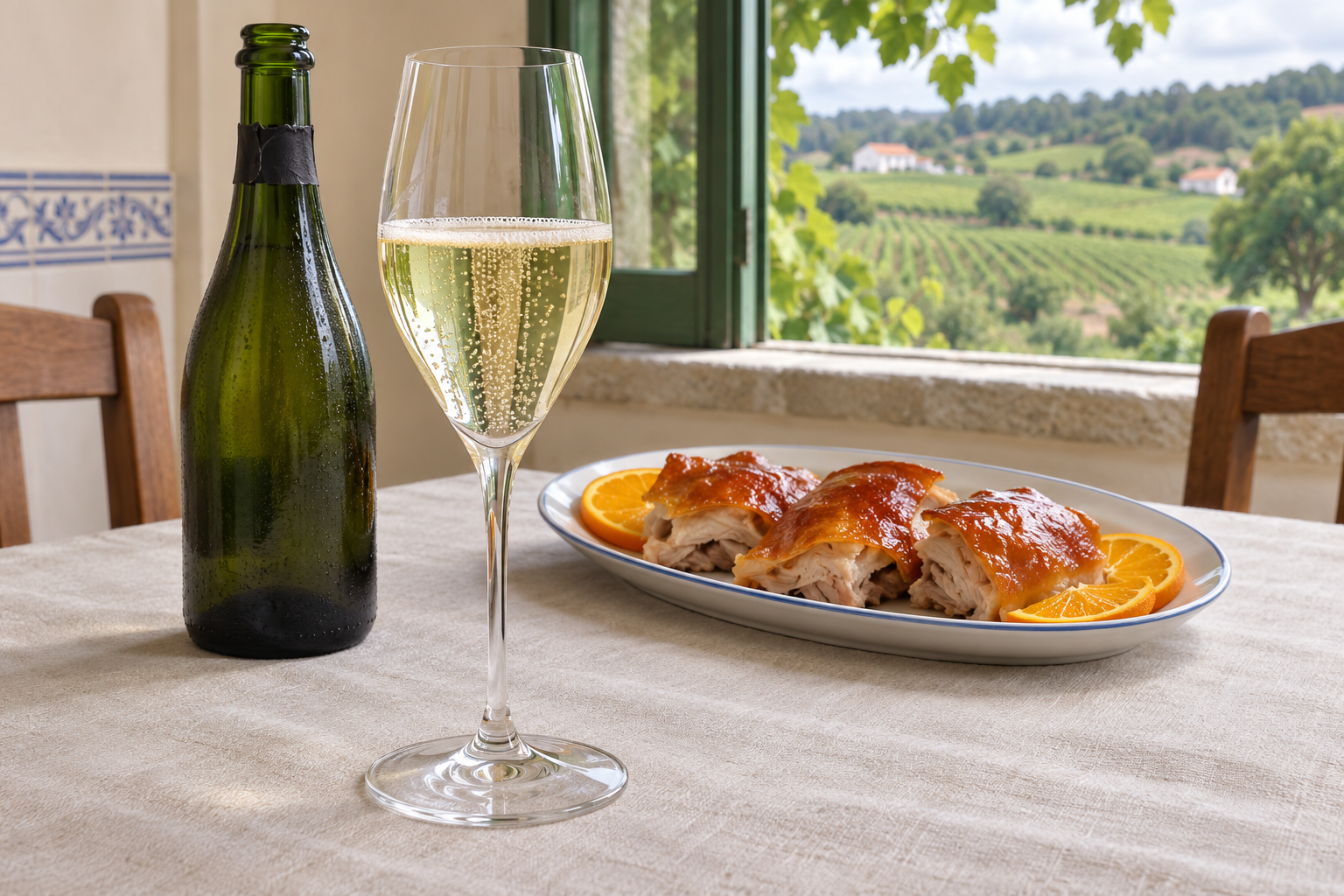
In the restaurants of Mealhada, a dry espumante traditionally accompanies leitão assado à Bairrada, wood-roasted suckling pig. The wine’s acidity and bubbles refresh the palate between bites of crisp skin and pepper-seasoned meat. Visitors can explore this pairing along the Rota da Bairrada: in Ferreiros, for example, cellar tastings pair local sparkling wine with roast suckling pig served on regional bread. In nearby Anadia, the Museu do Vinho Bairrada overlooks the experimental vineyards where the region’s sparkling wine tradition began.
References
Comissão Vitivinícola da Bairrada. (2022). Caderno de especificações: DO “Bairrada” (PDO-PT-A1537-AM01). https://www.ivv.gov.pt/wp-content/uploads/2026/02/DO_Bairrada.pdf; Mayson, R. (2020). The wines of Portugal. Infinite Ideas; Reis, M. S. (2012). A história do espumante na Bairrada e a Estação Vitivinícola de Anadia. Edições Almedina; Robinson, J. (Ed.). (2006). The Oxford companion to wine (3rd ed.). Oxford University Press.
See Also:
See Also
Map