Madeira Wine / Vinho da Madeira (Madeira and Porto Santo, Portugal)
Alcoholic Beverages COUNTRIES AND TERRITORIES Portugal
Madeira Island, Portugal
-
2026

The Madeira Protected Designation of Origin covers vineyards on the islands of Madeira and Porto Santo. On Madeira’s steep slopes, growers tend vines by hand on narrow terraces called poios, held in place by stone walls. Porto Santo has a different vineyard landscape: vines traditionally grow close to the ground, sheltered from the wind by low stone walls known as muros de croché. The regional wine institute, the Instituto do Vinho, do Bordado e do Artesanato da Madeira (IVBAM), certifies the fortified wine produced under the designation.
Portuguese settlers planted vines on Madeira in the fifteenth century, and Funchal became a port of supply for ships crossing the Atlantic and sailing to the East Indies. The wine was familiar enough in Elizabethan England for Poins to tease Falstaff about trading his soul for a cup of Madeira in Shakespeare’s Henry IV, Part 1. Merchants later found that casks returning from tropical voyages fetched higher prices than wines that had stayed ashore. Known as vinho da roda, this round-trip wine encouraged producers in the eighteenth century to experiment with warming their wines on land.
Winemakers add neutral grape spirit during or after fermentation, depending on the style. Earlier fortification leaves more of the grapes’ sugar in the wine; longer fermentation produces a drier Madeira. Most bottlings contain 17–22% alcohol by volume. Four white grape names traditionally signal a progression in sweetness: Sercial is dry, Verdelho medium-dry, Boal or Bual medium-rich, and Malvasia or Malmsey rich. Tinta Negra, the most widely grown variety, is red-skinned and can produce wines across the sweetness range. Terrantez is a rarer white variety. Pronounced acidity gives even the sweetest Madeiras a fresh finish.
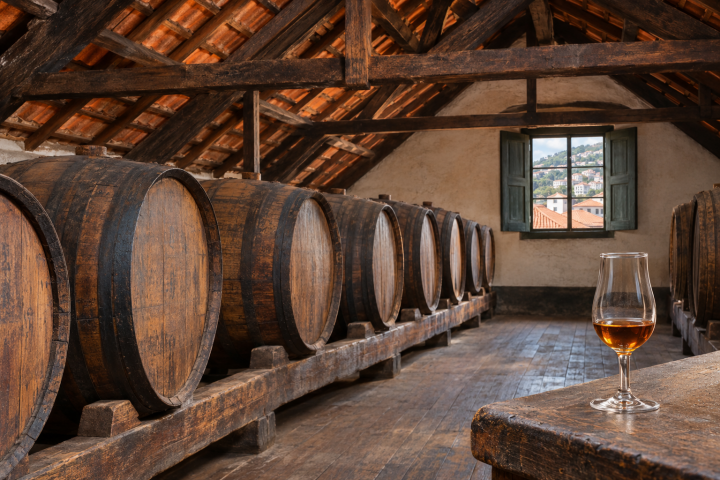
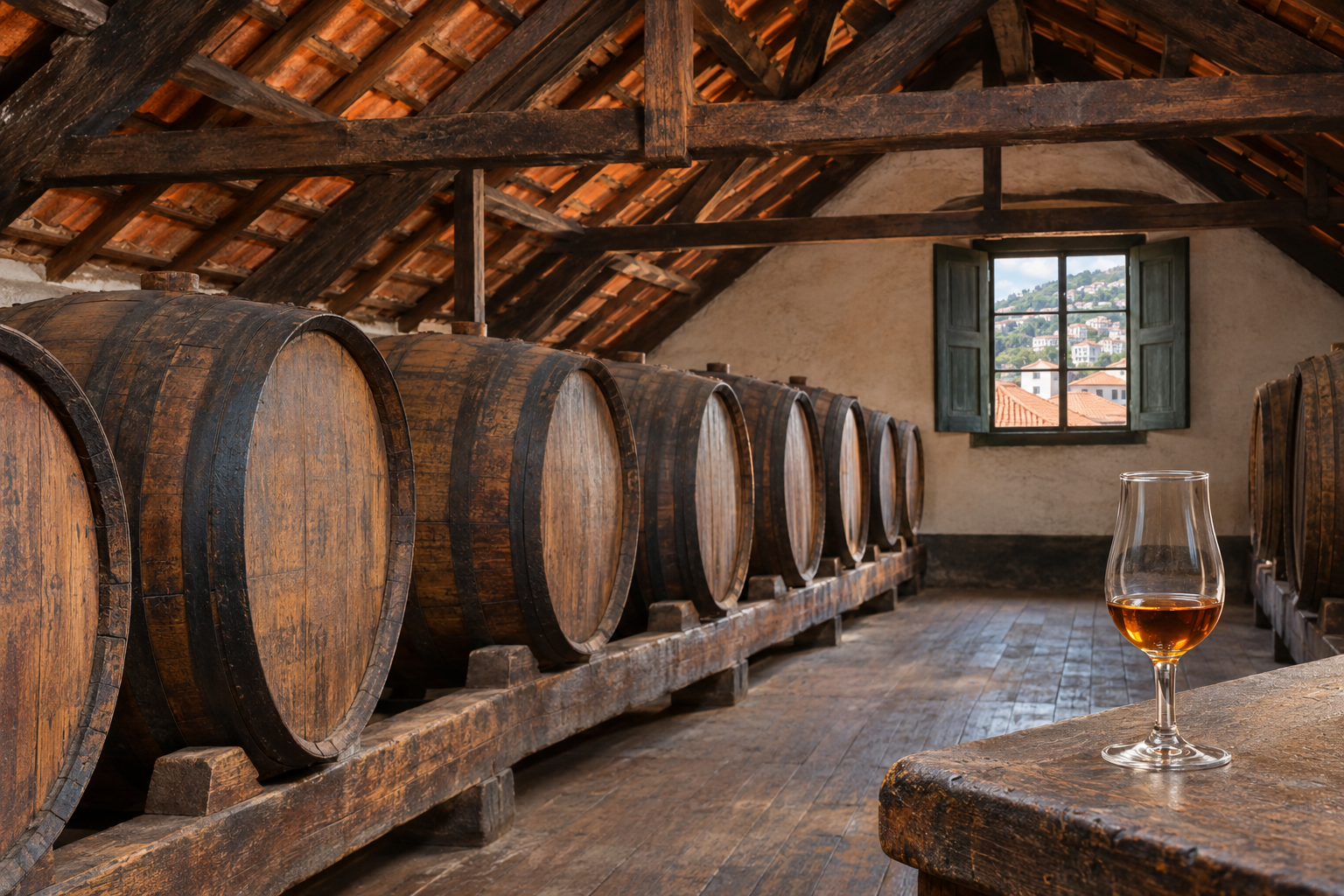
Producers use two ageing methods. In estufagem, hot water circulates through coils to warm the wine in tanks for at least 90 days, at a temperature no higher than 50°C. In canteiro, wooden casks rest on timber supports, often on the warm upper floors of a wine lodge. Over years or decades, evaporation and slow exposure to oxygen concentrate the wine and develop aromas of citrus peel, roasted nuts, and spice. Labels distinguish blends bearing an age indication, such as ten years, from wines of a single harvest. A Colheita spends at least five continuous years in wood; a Frasqueira, also called Garrafeira, requires at least twenty continuous years in wood under the canteiro method. A recorked bottle kept upright, cool, and away from light can remain enjoyable for months after opening.
In Funchal, visitors to Blandy’s Wine Lodge can see the canteiro ageing rooms and compare styles in a tasting. Dry Sercial is served lightly chilled as an aperitif, while Malmsey accompanies bolo de mel, Madeira’s spiced Christmas cake made with sugarcane syrup. During the annual Festa do Vinho Madeira, tastings in Funchal complement the harvest celebration in Estreito de Câmara de Lobos, where grape picking and treading bring visitors into the vineyards.
References
Blandy, A. (2017). The wines of Madeira. Infinite Ideas; Instituto da Vinha e do Vinho, I.P. (n.d.). Caderno de especificações: DO “Madeira” (PDO-PT-A0038). https://www.ivv.gov.pt/wp-content/uploads/2026/02/DO_Madeira.pdf; Mayson, R. (2003). The wines and vineyards of Portugal. Mitchell Beazley; Robinson, J. (Ed.). (2006). The Oxford companion to wine (3rd ed.). Oxford University Press.
See Also:
See Also
Map