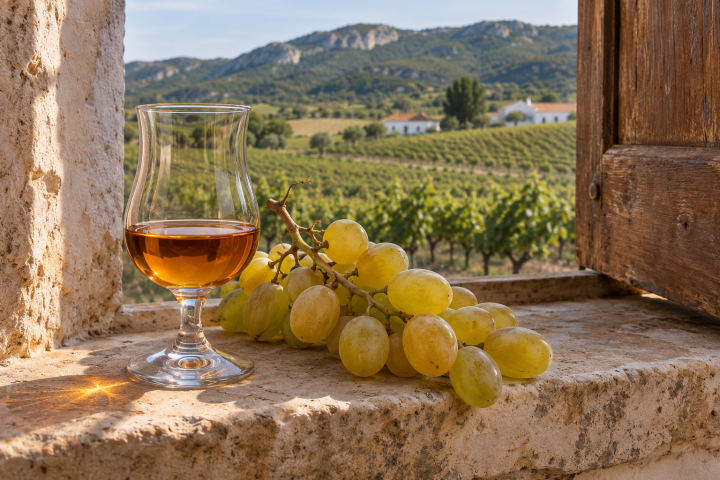
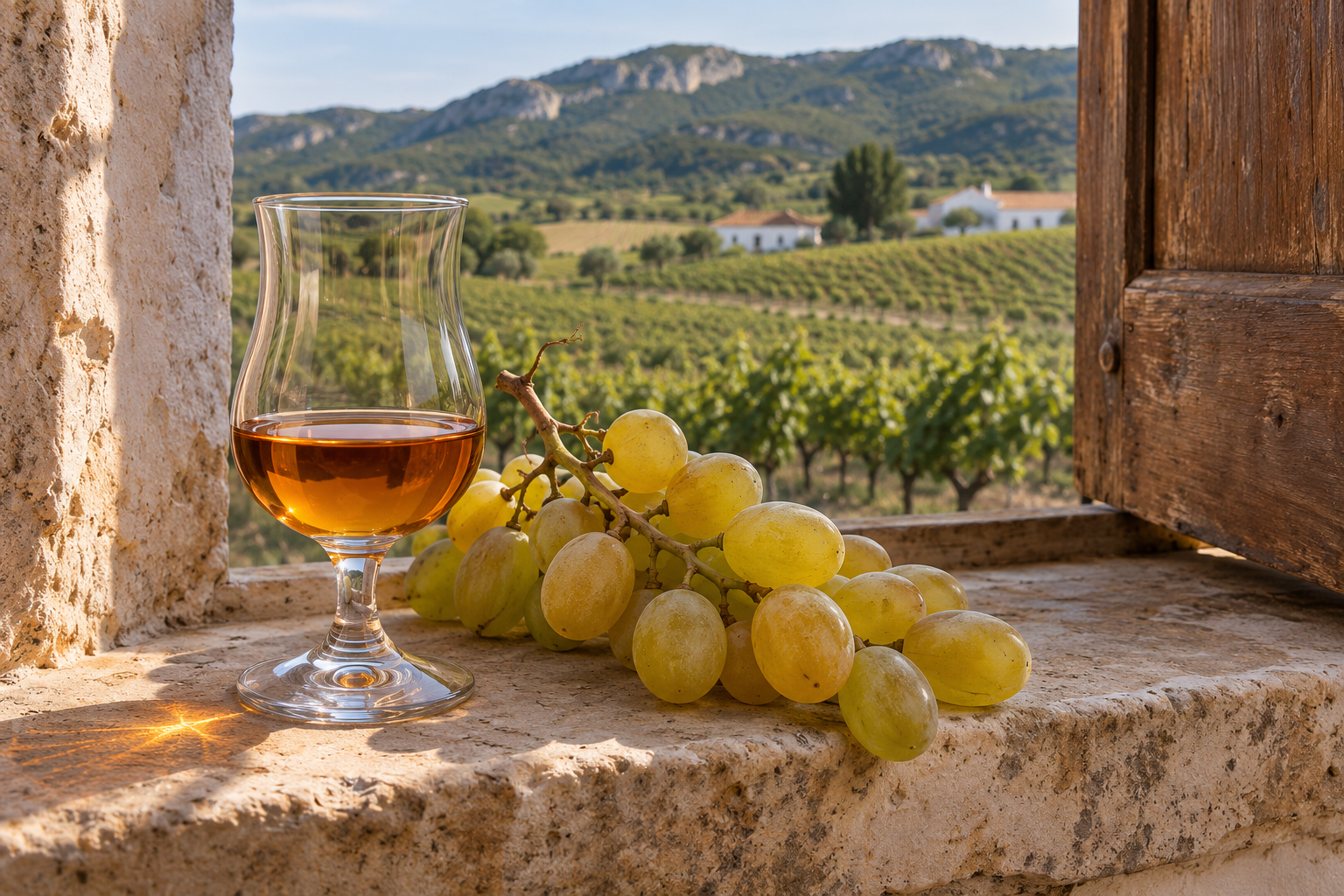
Moscatel de Setúbal (Setúbal Peninsula, Portugal)
Alcoholic Beverages COUNTRIES AND TERRITORIES Portugal
Setúbal Peninsula, Portugal
-
2026

Setúbal’s wine trade dates back several centuries. A record from 1675 mentions the export of 350 casks of Moscatel. In the nineteenth century, the Azeitão wine house José Maria da Fonseca, founded in 1834, brought the wine to a wider audience. Its Moscatel won a gold medal at the Paris Universal Exhibition in 1855. Portugal formally demarcated the production area in 1907 and confirmed its boundaries by decree in 1908.
Maritime trade also gave rise to torna-viagem, or “return voyage,” wines. In the nineteenth century, captains carried casks of Moscatel on consignment to markets including Brazil. Unsold casks returned to Portugal after a second passage through the tropics. Merchants came to value the distinctive character the wines acquired at sea, where temperatures and humidity differed from those in the cellars at Azeitão. In 2000, José Maria da Fonseca revived the practice by sending casks aboard the Portuguese naval training ship Sagres.
The protected designation of origin, Setúbal, covers the municipalities of Montijo, Palmela, and Setúbal, together with the parish of Castelo in Sesimbra. Vineyards occupy both the limestone slopes of the Serra da Arrábida and the sandy plains around Palmela. Two distinct Muscat grapes are central to the appellation. The white Muscat of Alexandria, locally called Moscatel Graúdo, supplies at least 85% of the must in wines labelled Moscatel de Setúbal. The same threshold applies to the rarer, pink-skinned Moscatel Galego Roxo when the label reads Moscatel Roxo de Setúbal. For wines bearing the Setúbal designation alone, the minimum proportion of the corresponding grape is 67%.
Winemakers add grape spirit partway through fermentation, preserving some of the grapes’ natural sugar. The skins traditionally remain in the fortified wine through the winter. For its Alambre, José Maria da Fonseca leaves them in contact for five months, then presses them and blends the pressed wine with the wine drained from the vat. Maturation in used oak casks gradually deepens the colour from gold to amber. Orange blossom and fresh citrus are characteristic of younger wines; older examples can develop aromas of dried apricot, honey, and walnut. The minimum ageing period before bottling is 18 months for the white wine and 36 months for Roxo. An age statement on a blend refers to its youngest component. Since 2025, certified wines at least a century old may carry the designation 100 anos.
On the Setúbal Peninsula Wine Route, visitors can taste Moscatel at the José Maria da Fonseca and Bacalhôa wineries in Azeitão. The Casa Mãe da Rota de Vinhos, housed in a former winery in Palmela, offers tastings with regional sweets. A local pairing is torta de Azeitão, a soft sponge cake rolled around an egg-yolk filling. Younger Moscatel is also served chilled as an aperitif. Palmela’s annual Festa das Vindimas in September gives visitors another occasion to encounter the wine in the region where its grapes are grown.
References
Comissão Vitivinícola Regional da Península de Setúbal. (t.y.). Caderno de especificações da denominação de origem protegida Setúbal. https://www.ivv.gov.pt/np4/%7B%24clientServletPath%7D/?fileName=CE_DO_Set_bal.pdf&newsId=8617; Mayson, R. (2020). The wines of Portugal. Infinite Ideas; Menezes, F. (2016). O Moscatel de Setúbal: História, vinha e vinho. Editorial Verbo; Robinson, J. (Ed.). (2006). The Oxford companion to wine (3rd ed.). Oxford University Press.
See Also:
See Also
Map