Espumante Murganheira (Távora-Varosa, Portugal)
Alcoholic Beverages COUNTRIES AND TERRITORIES Portugal
Távora-Varosa, Portugal
-
2026

Murganheira is the sparkling wine brand of Sociedade Agrícola e Comercial do Varosa, whose winery is at Abadia Velha in Ucanha, in the municipality of Tarouca. Its founder, Acácio da Fonseca Laranjo, was a Porto textile manufacturer from the nearby village of Murganheira. He established the business in the 1940s. Winemaker Orlando Lourenço and his partners acquired it in the 1980s. Lourenço subsequently studied sparkling winemaking in Champagne with Georges Hardy, who joined him for two harvests at Murganheira.
The Távora-Varosa wine region lies in the foothills of the Serra da Nave, between the Douro and Dão wine regions. Its vineyards grow predominantly on granite soils. At higher elevations, cooler conditions help grapes retain the acidity needed for sparkling base wines. Viticulture here has medieval roots: Cistercian communities associated with the monasteries of São João de Tarouca and Santa Maria de Salzedas cultivated vines as part of their agricultural estates. The modern appellation dates to 1999, when Távora-Varosa replaced the earlier geographical names Varosa and Encostas da Nave. It covers white, red, and rosé wines, both still and sparkling.
The winery uses hand-picked grapes from its own vineyards and those of local growers. Its Reserva Bruto blends Malvasia Fina, Cerceal, Gouveio Real, and Touriga Franca. Other bottlings show how the same grape can yield wines of different colours. The 2015 Vintage Bruto was a white sparkling wine made from Pinot Noir; for the 2018 Czar Grand Cuvée Rosé, brief contact with the skins gave the Pinot Noir juice a pink tint. The winery also uses Touriga Nacional to make a blanc de noirs, a white wine from dark-skinned grapes.
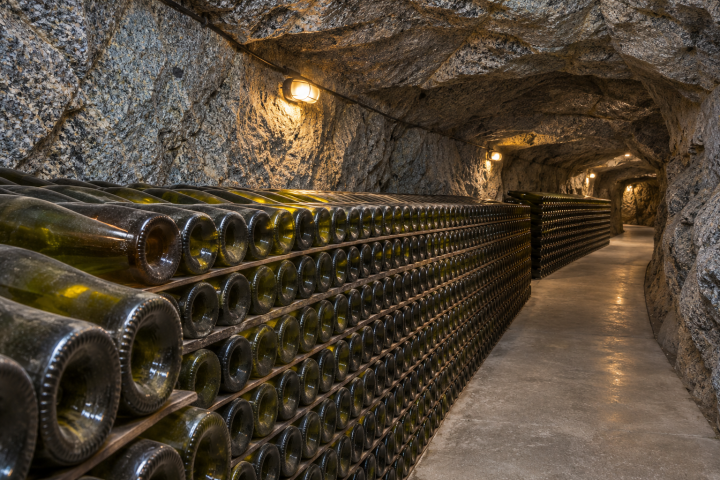
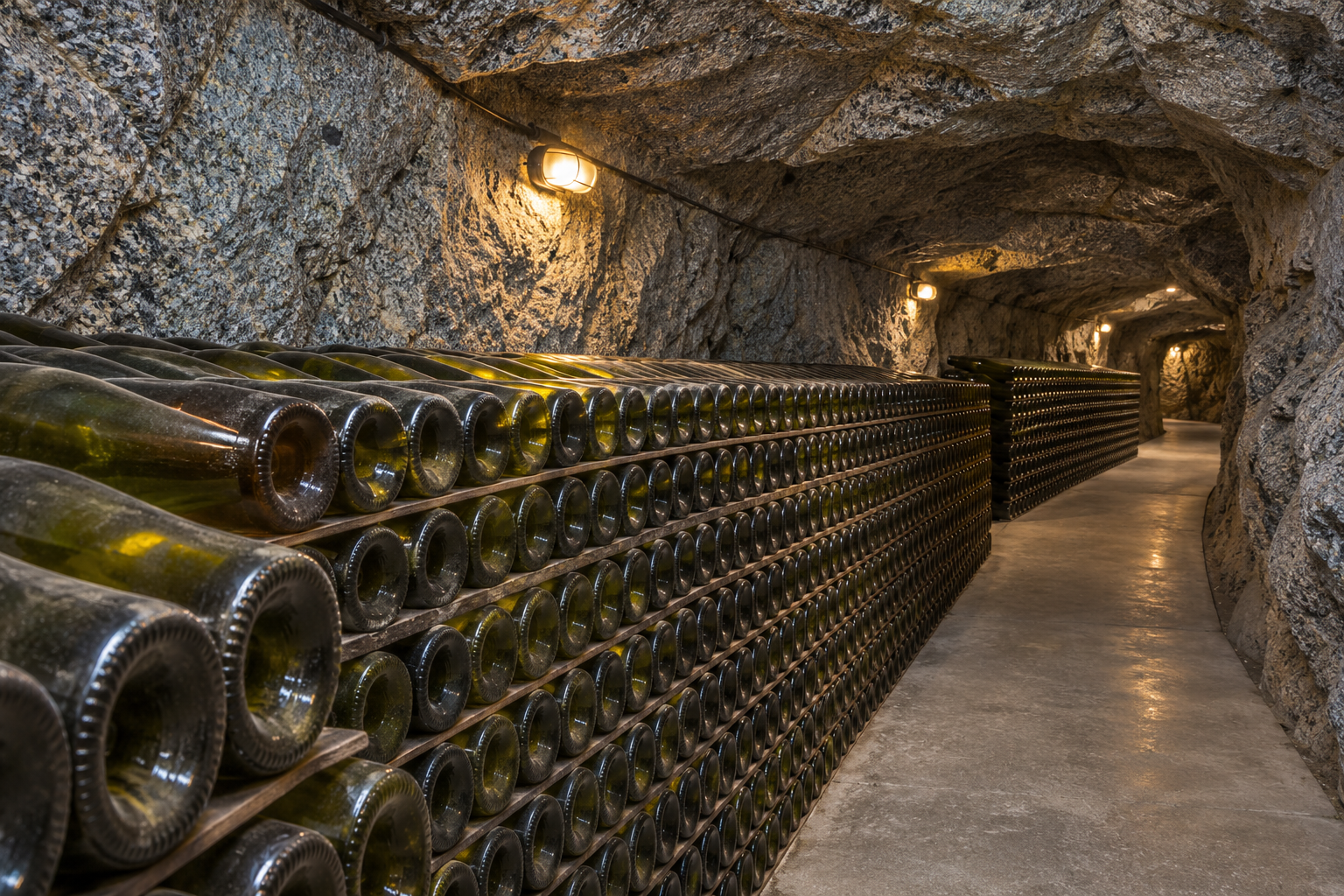
In the traditional method (método clássico), the winemaker bottles the base wine with yeast and sugar. As the yeast ferments the sugar, carbon dioxide dissolves in the wine and gives it its sparkle. The bottles then rest on the spent yeast, or lees, in the cool granite galleries. The 2018 Czar Rosé matured for six years and the 2015 Vintage Bruto for nine. During this time, contact with the lees can give the wine aromas of bread or brioche. A distinctive cellar practice is dégorgement à la volée: once the sediment has collected in the neck, a worker opens the bottle by hand and lets its internal pressure expel the deposit before final corking.
The cellars are a stop on the Rota das Vinhas de Cister, a wine route that also takes visitors to Ucanha’s fortified bridge and the monasteries of the Varosa Valley. Guided visits and tastings introduce visitors to the underground galleries and to styles ranging from dry bruto to sweet doce. At the table, the producer recommends its Super Reserva Bruto with roast fish or shellfish and its sweeter meio seco with desserts.
References
Comissão Vitivinícola Regional Távora-Varosa. (t.y.). Caderno de especificações da denominação de origem Távora-Varosa. https://www.ivv.gov.pt/wp-content/uploads/2026/02/DO_Tavora-Varosa.pdf; Mayson, R. (2020). The wines of Portugal. Infinite Ideas; Ramos, E. (2015). Murganheira e a epopeia do espumante em Távora-Varosa. Edições Murganheira; Robinson, J. (Ed.). (2006). The Oxford companion to wine (3rd ed.). Oxford University Press.
See Also:
See Also
Map