Monastery of Batalha / Mosteiro de Santa Maria da Vitória (Batalha, Portugal)
UNESCO World Heritage Destination RELIGION AND BELIEF SYSTEMS Religious Rituals and Sacred Spaces Monastery NATURAL AND CULTURAL HERITAGE Religious Architecture and Sacred Heritage Monastery COUNTRIES AND TERRITORIES Portugal UNESCO World Heritage
Batalha, Portugal
-
2026

King John I commissioned the monastery to fulfill a vow to the Virgin Mary following the Portuguese victory over Castilian forces at the Battle of Aljubarrota on 14 August 1385. The victory strengthened the independence of the kingdom and the position of the newly established Avis dynasty. Construction began in the late 1380s, and the king entrusted the foundation to the Dominican Order in 1388. Successive monarchs financed additions, making Batalha an important center of architectural and artistic production into the sixteenth century.
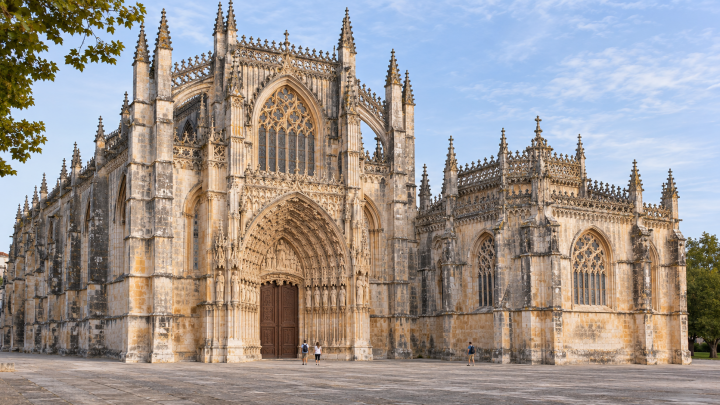
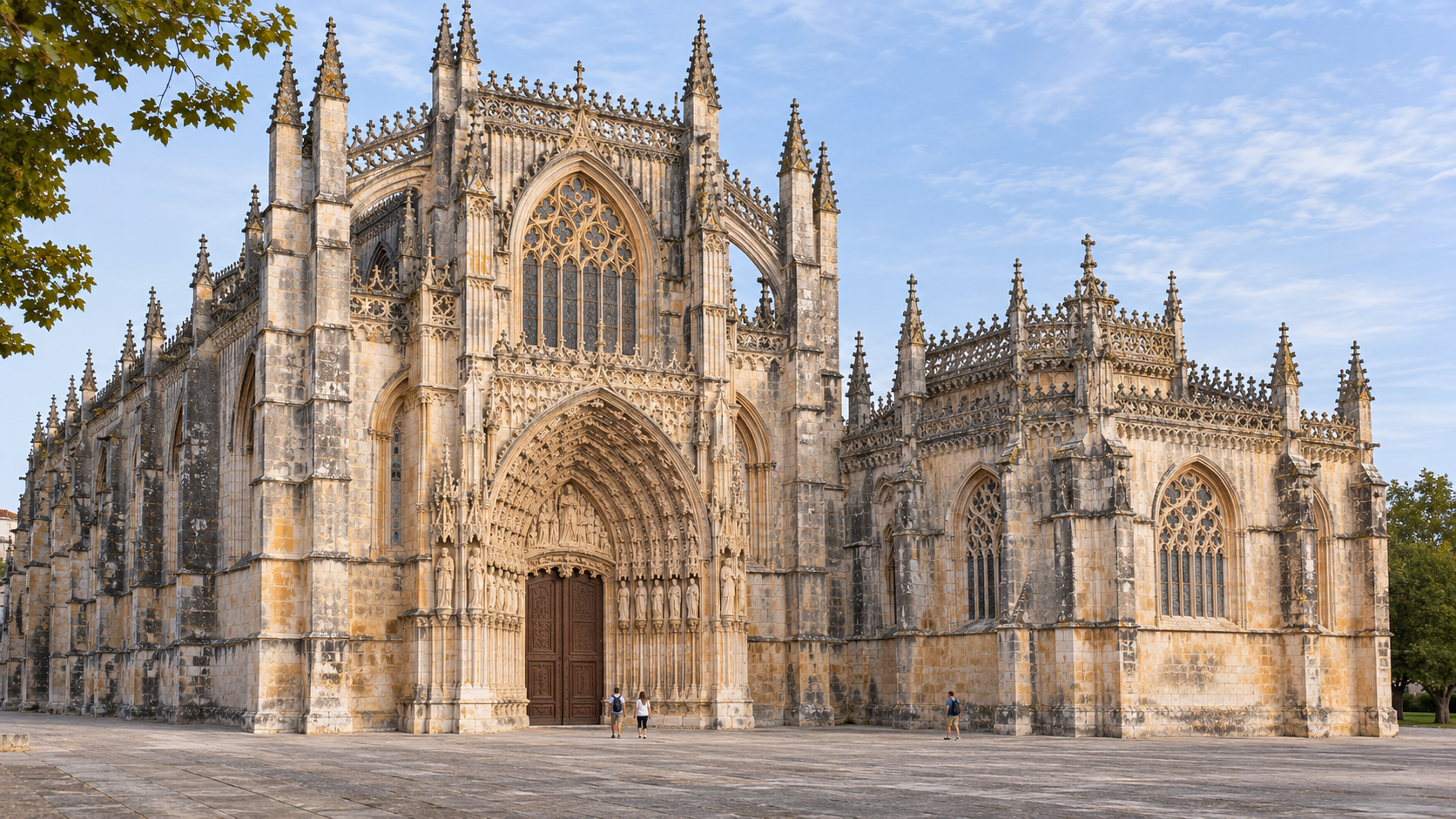
Afonso Domingues directed the initial building campaign, establishing the layout of the church and adjoining conventual spaces. His successor, Huguet, developed the complex’s Flamboyant Gothic architecture and designed the Founder’s Chapel. Later master builders included Martim Vasques, Fernão de Évora, Mateus Fernandes, and João de Castilho. Constructed predominantly from local limestone, the church has a Latin cross plan, a high central nave, and two lower aisles. Its west portal contains an extensive sculptural program of apostles, prophets, angels, and biblical rulers surrounding Christ in Majesty. Surviving sixteenth-century stained glass illuminates the chancel and chapter house.
The Founder’s Chapel (Capela do Fundador) was conceived as a dynastic burial space. An octagonal central structure rises within its square plan, sheltering the joint tomb of John I and Philippa of Lancaster. Their recumbent effigies hold hands, while tombs along the southern wall commemorate their sons, including Henry the Navigator. The chapel’s arrangement brings architecture, sculpture, and heraldry together to express the legitimacy and continuity of the royal family.
The Royal Cloister (Claustro Real), also called the Cloister of John I, connected the church with rooms used for meetings, meals, and other communal activities. Its Gothic arcades received elaborate Manueline tracery under Mateus Fernandes. The more restrained, two-story Cloister of Afonso V is associated with Fernão de Évora. Beyond the church’s eastern end, King Edward commissioned a separate burial complex in 1437. Known as the Unfinished Chapels (Capelas Imperfeitas), it contains an elaborate Manueline entrance portal by Mateus Fernandes. Work continued intermittently until 1533, but the central octagonal space remained without its intended roof.
The chapter house is distinguished by a broad stone vault without a central supporting pier. Since April 1921, it has housed the Tomb of the Unknown Soldier, containing the remains of two Portuguese servicemen from the First World War, one brought from Flanders and the other from Mozambique. A military honor guard, the Chama da Pátria memorial flame, and the damaged crucifix known as the Christ of the Trenches form part of this commemorative setting. The former refectory houses the Museum of Offerings to the Unknown Soldier.
The earthquake of 1755 damaged the monastery, including the spire above the Founder’s Chapel and numerous stained-glass windows. French troops inflicted further destruction in 1810, burning the library. The Dominican community departed following the suppression of religious orders in 1834. A major restoration campaign began in 1840 under Luís Mouzinho de Albuquerque, supported by King Ferdinand II. The monastery received National Monument status in 1907, reaffirmed in 1910, and UNESCO World Heritage recognition in 1983. Conservation continues under Museus e Monumentos de Portugal; restoration of the chancel and chapter-house stained glass was completed in 2026.
Today, Batalha combines heritage visits, religious ceremonies, educational activities, and military commemoration. The monument normally opens daily, except on specified holidays, with a ticketed circuit encompassing its principal chapels, cloisters, and former communal rooms. Ramps serve much of the route, although the Founder’s Chapel and upper cloister present access limitations. Together with Alcobaça and the Convent of Christ in Tomar, it forms an established cultural itinerary through central Portugal. The nearby Aljubarrota Interpretation Centre at São Jorge provides a complementary account of the battle that prompted its foundation.
References
Cocheril, M. (1984). Le monastère de Batalha: Histoire et architecture. Fondation Calouste Gulbenkian; Dias, P. (2002). O Mosteiro da Batalha. Scala Publishers; IPPAR; Redondo, J. M. (2015). A arquitectura do Mosteiro de Santa Maria da Vitória. Imprensa da Universidade de Coimbra; UNESCO World Heritage Centre. (1983). Monastery of Batalha. World Heritage List. https://whc.unesco.org/en/list/264
See Also:
See Also
Map