Prehistoric Rock Art Sites in the Côa Valley (Vila Nova de Foz Côa, Portugal)
UNESCO World Heritage Destination COUNTRIES AND TERRITORIES Portugal UNESCO World Heritage
Vila Nova de Foz Côa, Portugal
-
2026

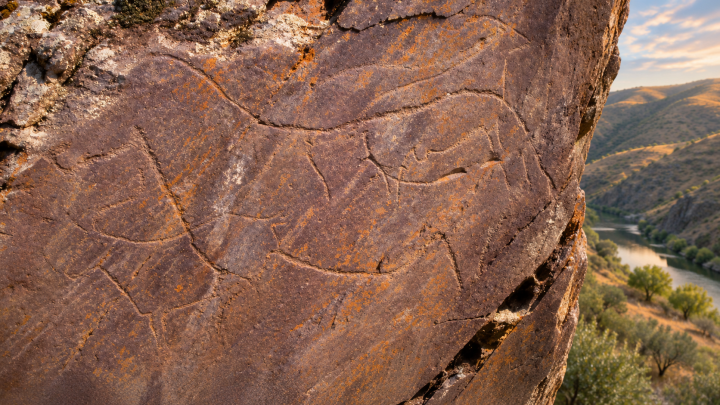
The prehistoric rock art of the Côa Valley extends along the lower Côa River and adjoining stretches of the Douro, encompassing parts of Vila Nova de Foz Côa, Figueira de Castelo Rodrigo, Pinhel, and Mêda. The archaeological park covers a broader landscape of approximately 200 square kilometers. By August 2026, official records identified more than 1,600 decorated rocks distributed across 104 archaeological sites, representing several periods of artistic activity. Continued discoveries have expanded both the inventory and understanding of the landscape.
The principal prehistoric engravings were produced by Upper Paleolithic hunter-gatherer communities. UNESCO describes the prehistoric sequence represented by the Côa Valley and Siega Verde property as extending approximately from 22,000 to 8,000 BCE. Dating individual compositions involves stylistic comparison, the sequence of overlapping figures, and archaeological evidence. At Fariseu, excavations revealed engraved surfaces buried beneath deposits containing evidence of human occupation; dating these deposits provided chronological limits for the engravings. Later prehistoric, Iron Age, and historical images document recurrent artistic activity, including engravings associated with millers working along the river.
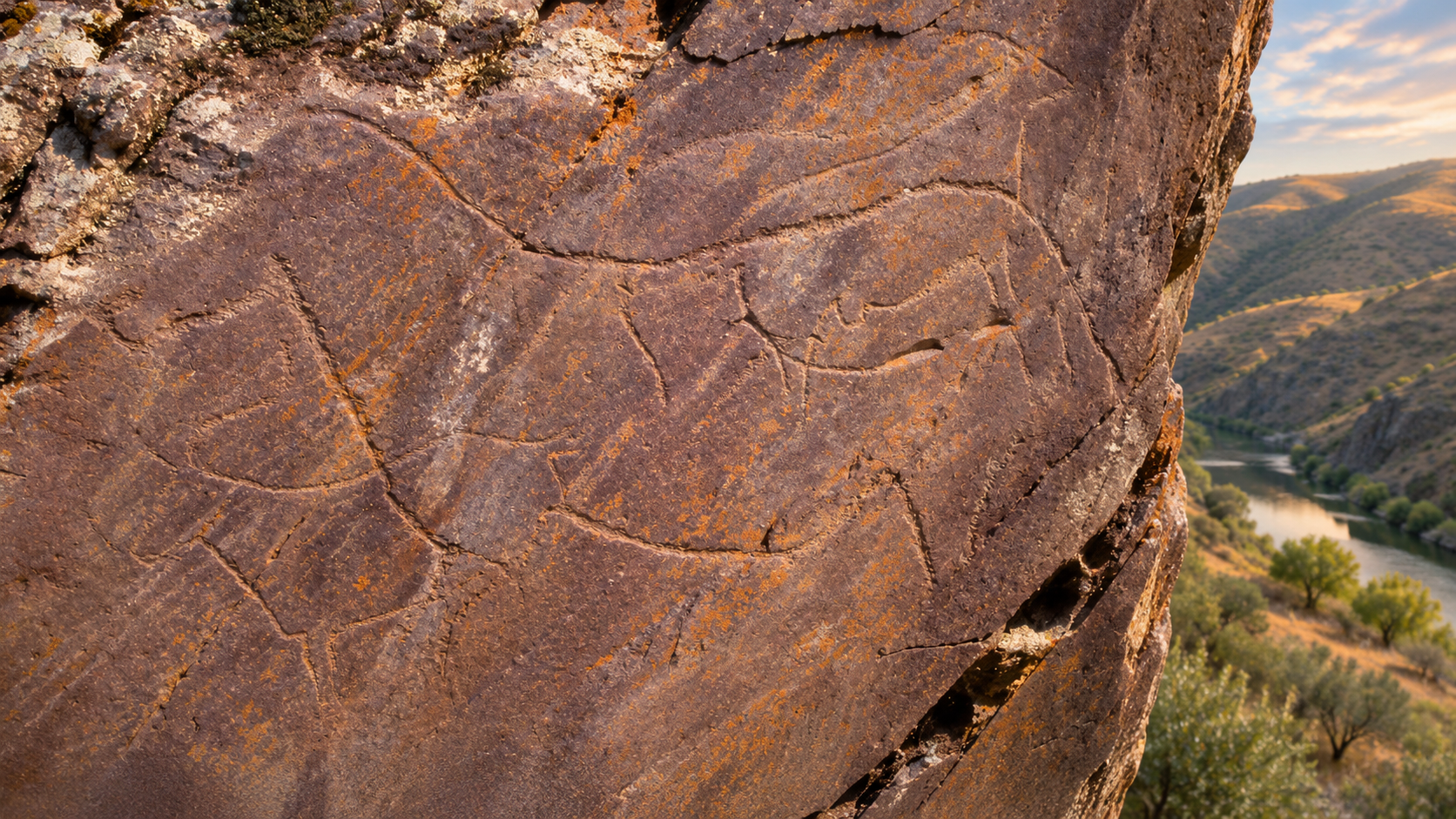
Most images occur on exposed schist surfaces, often using naturally smooth vertical panels. Engravers employed pecking, fine-line incision, and abrasion, sometimes combining techniques. Horses, aurochs, ibex, and deer dominate the Paleolithic imagery. Figures frequently overlap, while some animals have multiple heads or repeated outlines interpreted as representations of movement. Human figures are uncommon; a notable example is the “Man of Piscos” at Ribeira de Piscos. Although engravings predominate, painted images also survive, particularly in the granite shelters at Faia. Their social and symbolic meanings remain subjects of archaeological interpretation.
The recognition of this extensive outdoor ensemble broadened interpretations of European Paleolithic art, whose best-known examples had largely been preserved in caves. The Côa Valley provides evidence that related artistic conventions also operated across exposed river landscapes. Its importance lies in the relationship between images, archaeological occupation sites, and the surrounding terrain, as well as in the artistic qualities of individual figures.
Modern archaeological recognition developed during preparations for a hydroelectric dam. Archaeologist Nelson Rebanda identified an engraved rock at Canada do Inferno in 1991, and the discoveries became public in 1994. The threatened inundation prompted scientific debate and a public campaign for preservation. Dam construction was suspended in January 1996, and the Côa Valley Archaeological Park opened on 10 August that year to protect, investigate, and present the sites. The Portuguese archaeological ensemble received National Monument classification in 1997.
UNESCO inscribed the Côa Valley sites on the World Heritage List in 1998 under criteria (i) and (iii), recognizing their artistic significance and testimony to prehistoric societies. In 2010, the property was extended to include Siega Verde, on Spain’s Águeda River. Its official name consequently became Prehistoric Rock Art Sites in the Côa Valley and Siega Verde. Conservation work includes monitoring rock surfaces and environmental conditions, maintaining detailed photographic and graphic records, and applying three-dimensional documentation techniques. Visitor limits also help protect the engravings and their setting.
The Côa Museum, designed by Camilo Rebelo and Tiago Pimentel, opened on 30 July 2010 above the confluence of the Côa and Douro rivers. It provides an introduction to the archaeological landscape and supports exhibitions, educational activities, and site visits. Standard guided excursions serve Canada do Inferno, Penascosa, and Ribeira de Piscos, using all-terrain vehicles and walking routes. Advance booking is recommended because daily visitor numbers are limited. Night visits at Penascosa use oblique lighting to reveal engraved lines and overlapping figures; a separate boat excursion provides access to Fariseu.
These visitor experiences connect archaeological interpretation with the Douro landscape, including vineyards, olive groves, almond cultivation, riverside habitats, and traditional mills. The park thus supports cultural and educational tourism while making the preservation of prehistoric art central to the region’s visitor experience.
References
Aubry, T. (2009). 200 000 anos de ocupação humana no Vale do Côa. IGESPAR; Baptista, A. M. (2009). A arte paleolítica do Vale do Côa. Parque Arqueológico do Vale do Côa; UNESCO. (1998). Prehistoric rock art sites in the Côa Valley and Siega Verde. World Heritage Centre. https://whc.unesco.org/en/list/866; Zilhão, J. (Ed.). (1997). Arte paleolítica da Beira Interior: As gravuras do Vale do Côa. Ministério da Cultura.
See Also:
See Also
Map