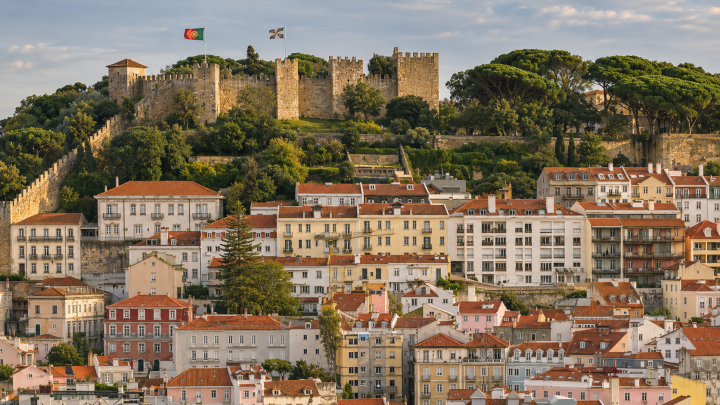
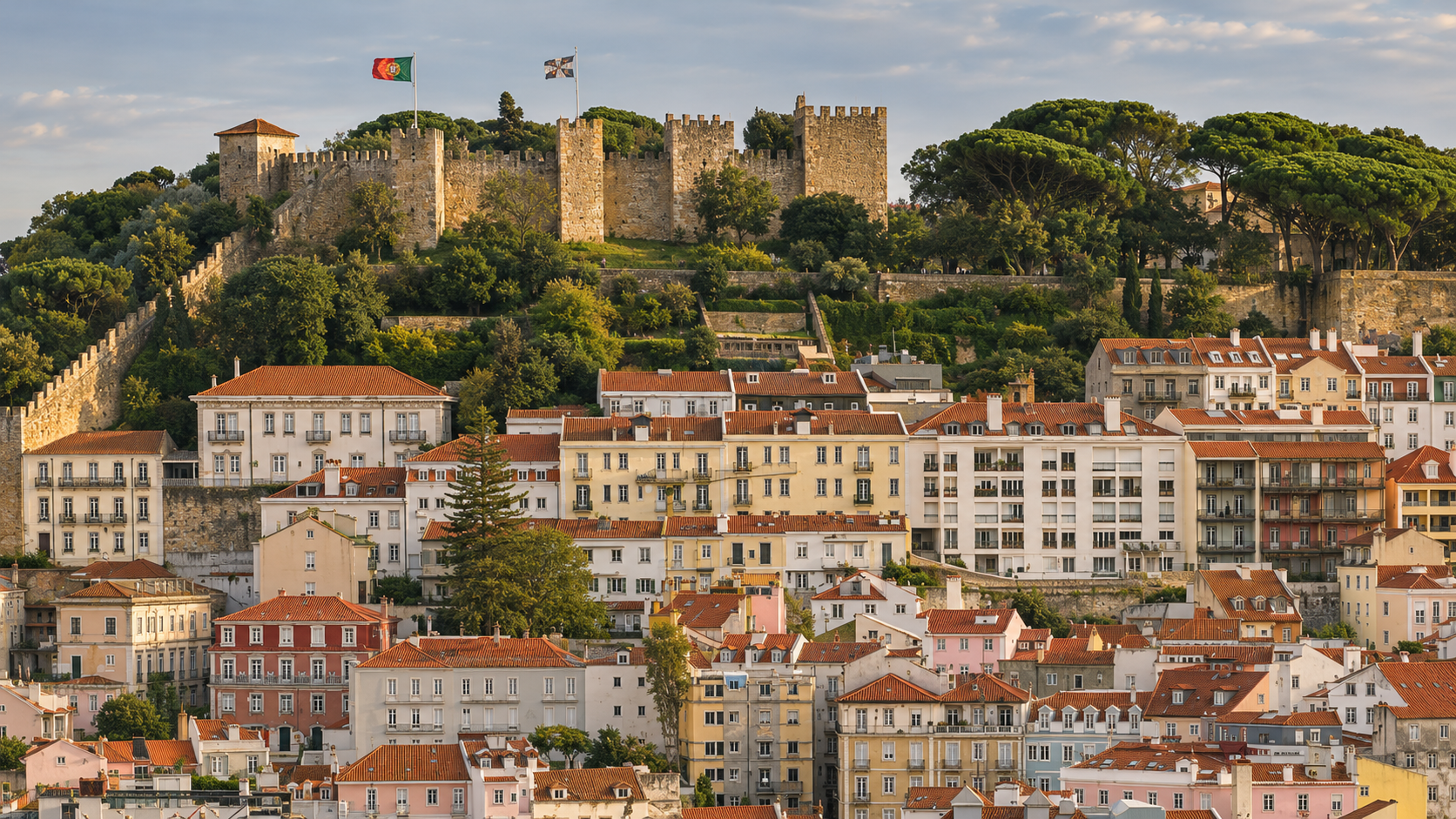
Castle of São Jorge / Castelo de São Jorge (Lisbon, Portugal)
Cultural Heritage Destination COUNTRIES AND TERRITORIES Portugal Visitor Attractions, Culture and Heritage
Lisbon, Portugal
-
2026

The Castle of São Jorge stands above the Alfama district on a hill that afforded a clear view of the river and its approaches. The monument occupies about four hectares of the former alcáçova, or fortified upper town. Within this enclosure, the castle served as a military stronghold, while neighbouring buildings housed residents of the citadel and, later, the Portuguese royal court. The distinction remains visible today: the castle walls enclose two courtyards, while the ruins of the royal palace lie beside the fortress.
Archaeological evidence places a settlement on the hill by the seventh century BCE. At Praça Nova, excavators identified a rectangular room with a hearth and ceramic vessels, probably a kitchen. Imported pottery provides evidence of trade with Mediterranean communities through Phoenician merchants. The settlement may have been fortified, although no defensive wall from this period has been securely identified. Roman Lisbon, known as Olisipo, had walls extending towards the waterfront, but their course near the summit remains uncertain.
Under Islamic rule, a wall separated the hilltop citadel from the medina, the city that extended down the slope towards the Tagus. An Arabic inscription dated 985 records repairs to Lisbon’s defences. By the second half of the eleventh century, a residential quarter occupied the northern part of the citadel. Two excavated houses illustrate how its inhabitants lived: each had rooms opening onto a courtyard that provided light and ventilation, as well as a kitchen and storage space. Fragments of painted plaster preserve geometric decoration, and a drain beneath the cobbled street carried wastewater away from the houses.
In October 1147, King Afonso Henriques and crusaders from northern Europe captured Lisbon after a siege. Under Portuguese rule, the citadel became a royal residence and a centre of government. Documents from 1264 and 1277 identify the Paço da Alcáçova as the palace of King Afonso III. Successive monarchs enlarged it, linking the royal chambers, chapel, and great hall through courtyards, stairs, and balconies. At the southwest corner of the castle, the springing of an arch on the Palace Tower still marks the former connection between palace and fortress.
The castle acquired much of its present layout during the reigns of Afonso III (1248–1279) and his son Denis (1279–1325). Ten towers reinforce its roughly rectangular perimeter, and an eleventh stands on the wall dividing the two interior courtyards. The main entrance turns sharply beneath the Tower of Ulysses, preventing attackers from advancing directly into the courtyard. On the more exposed southern and eastern sides, a lower outer wall, or barbican, and a moat provided additional protection. The Tower of Ulysses later housed royal records and became known as the Torre do Tombo, a name that survives in the title of Portugal’s national archive.
In 1505, King Manuel I decided to move the principal royal residence to the Ribeira Palace on the waterfront. The hilltop palace nevertheless remained in use: King Sebastian favoured it and commissioned repairs after the earthquake of 1531. Following the union of the Portuguese and Spanish crowns in 1580, parts of the complex served as barracks, a prison, and a hospital. The earthquake of 1755 severely damaged both the castle and the palace. Further military construction covered much of the earlier site.
Portugal classified the castle and the surviving sections of Lisbon’s defensive walls as a National Monument in 1910. Between 1938 and 1940, the Estado Novo government removed barracks, rebuilt stretches of wall, and raised several towers. The stone bridge and entrance through the barbican date from this campaign, which drew on sixteenth-century depictions of the fortress. A later project at Praça Nova, completed in 2010 to a design by João Luís Carrilho da Graça, sheltered the excavated houses and used modern walls to show how their rooms once opened onto the courtyards.
Today, visitors can follow the ramparts and look across Lisbon’s lower town to the Tagus. The Tower of Ulysses houses a camera obscura that projects a live panoramic view of the city. Guided visits to the archaeological area offer a different perspective on the hill through the surviving rooms, courtyards, and household objects. The monument recorded approximately 1.74 million visits in 2025, about 95 per cent of them by visitors from abroad.
References
Alarcão, J. (2001). O Castelo de São Jorge: História e arqueologia. IPPAR; Boiça, J., & Carvalho, R. (2001). Lisboa militar: O Castelo de São Jorge e as fortificações de Lisboa. Quidnovi; Magalhães, J. R. (1997). O Castelo de São Jorge: Símbolo de Lisboa. Câmara Municipal de Lisboa; Mattoso, S. (1993). Lisboa medieval: O castelo e a cidade. Editorial Estampa.
See Also
Map