Historic Centre of Évora / Centro Histórico de Évora (Évora District, Alentejo, Portugal)
UNESCO World Heritage Destination COUNTRIES AND TERRITORIES Portugal UNESCO World Heritage
Évora District, Alentejo, Portugal
-
2026

Évora stands on a low hill in the Alentejo region of southern Portugal. Under Roman rule, the town was known as Ebora Liberalitas Iulia and held municipal status in the province of Lusitania. Its forum occupied the highest part of the hill, where fourteen columns of a first-century CE temple still stand. Their granite shafts rest on marble bases and carry Corinthian capitals. Although popularly called the Temple of Diana, the sanctuary was probably dedicated to the imperial cult. Its later use as a municipal butcher’s market helped preserve the columns within the walls of another building. In 1870–1871, Giuseppe Cinatti directed the removal of later masonry, exposing the temple much as it appears today. Remains of the Roman public baths also survive beneath the present town hall.
Under Islamic rule, the town was known as Yabura, and its inhabitants rebuilt the defences along the line of the late Roman walls. In 1165, Geraldo Sem Pavor (Gerald the Fearless) captured Évora for King Afonso Henriques, who granted it a municipal charter the following year. Work on the cathedral began in the late 12th century. Its twin façade towers, Gothic cloister and stone lantern above the crossing remain visible features of the upper town. As settlement spread beyond the older enclosure, a wider circuit of walls, the Cerca Nova, took shape in the 14th century.
Évora became a frequent residence of the Portuguese court in the 15th and 16th centuries. The kings of the House of Avis maintained a palace beside the Franciscan convent of São Francisco. Its surviving wing, the Galeria das Damas (Ladies’ Gallery), combines Portuguese late Gothic ornament with Mudéjar forms drawn from Iberian Islamic building traditions. It now houses the city’s interpretation centre. Another royal project changed everyday life more directly: the Água da Prata Aqueduct, built under the direction of Francisco de Arruda and inaugurated in 1537, carried water some 18 kilometres from springs at Divor. Along Rua do Cano, houses occupy the spaces beneath its arches.
In 1559, Cardinal Henrique founded Portugal’s second university at the Jesuit College of the Holy Spirit. The university closed in 1759 when the Portuguese Crown expelled the Jesuits. University education returned to the city in 1973 with the creation of the University Institute of Évora, which became the University of Évora in 1979. Another expression of the city’s religious history survives at São Francisco: in the 17th-century Chapel of Bones (Capela dos Ossos), human skulls and bones cover the walls and pillars as a reminder of mortality.
UNESCO inscribed the historic centre on the World Heritage List in 1986. The designation recognises the survival of a Portuguese royal city of the 15th and 16th centuries and the influence of its architecture on towns in Brazil, including Salvador da Bahia. Much of Évora escaped serious damage in the 1755 earthquake that devastated Lisbon. Its character owes as much to ordinary houses as to palaces and churches: narrow streets retain their medieval alignments, while whitewashed façades, wrought-iron balconies, glazed tiles and terracotta roofs largely date from the 16th to the 18th centuries. Keeping these houses in residential use remains a municipal conservation priority.
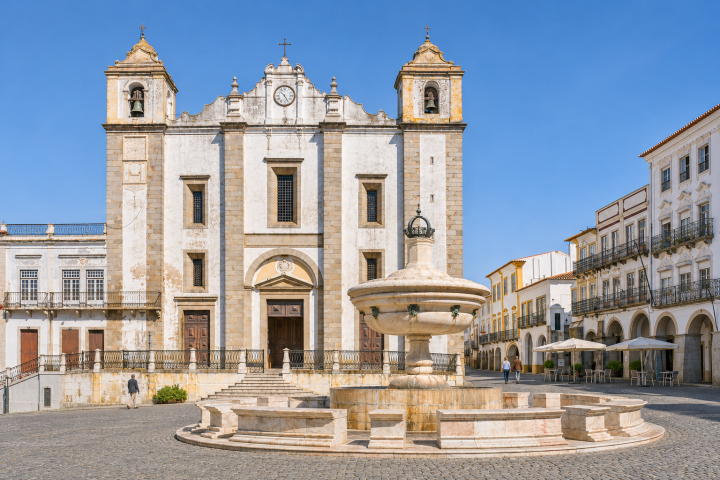
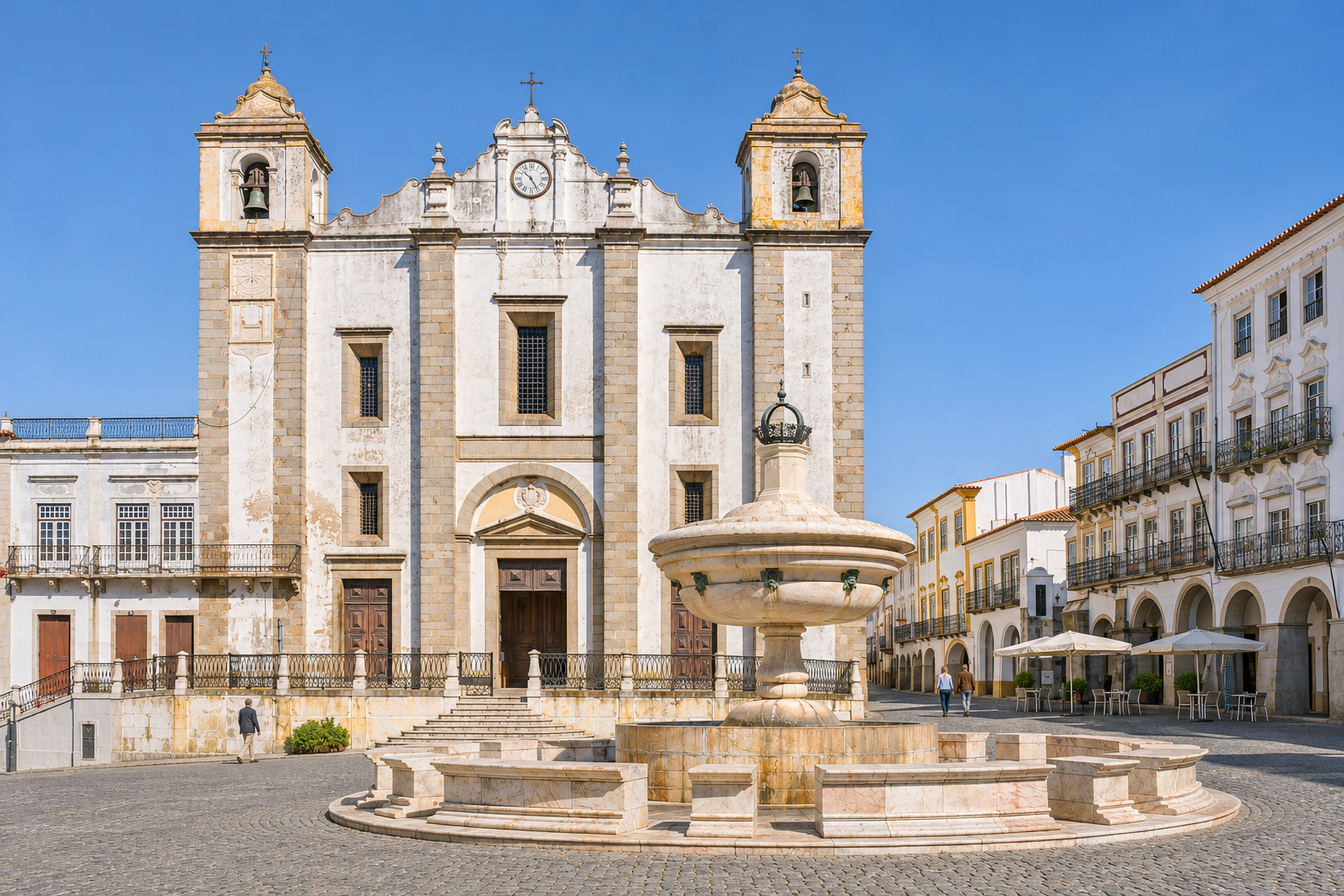
The arcaded Praça do Giraldo remains a meeting place and a starting point for exploring the centre on foot. Rua 5 de Outubro leads uphill from the square to the cathedral and the Roman temple. The temple can be viewed freely from the surrounding square; the cathedral cloister and roof terrace, the Chapel of Bones and the College of the Holy Spirit have separate visitor arrangements. Évora is also a starting point for the Alentejo Wine Route, and regional dishes such as açorda alentejana, a bread soup seasoned with garlic, coriander and olive oil, feature on local menus. The city was selected as a European Capital of Culture for 2027, with a programme extending across the Alentejo.
References
Espanca, T. (1966). Inventário artístico de Portugal: Vol. 7. Concelho de Évora. Academia Nacional de Belas-Artes; Malkiel-Jirmounsky, M. (1937). Évora: Cidade monumental. Edições Panorama; UNESCO World Heritage Centre. (t.y.). Historic Centre of Évora. World Heritage List. https://whc.unesco.org/en/list/361/; Vasconcelos, J. (2002). Évora: História, arte e património. Câmara Municipal de Évora.
See Also:
See Also
Map