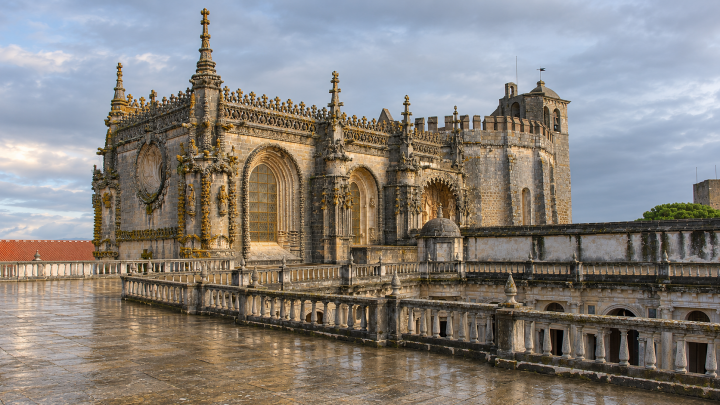
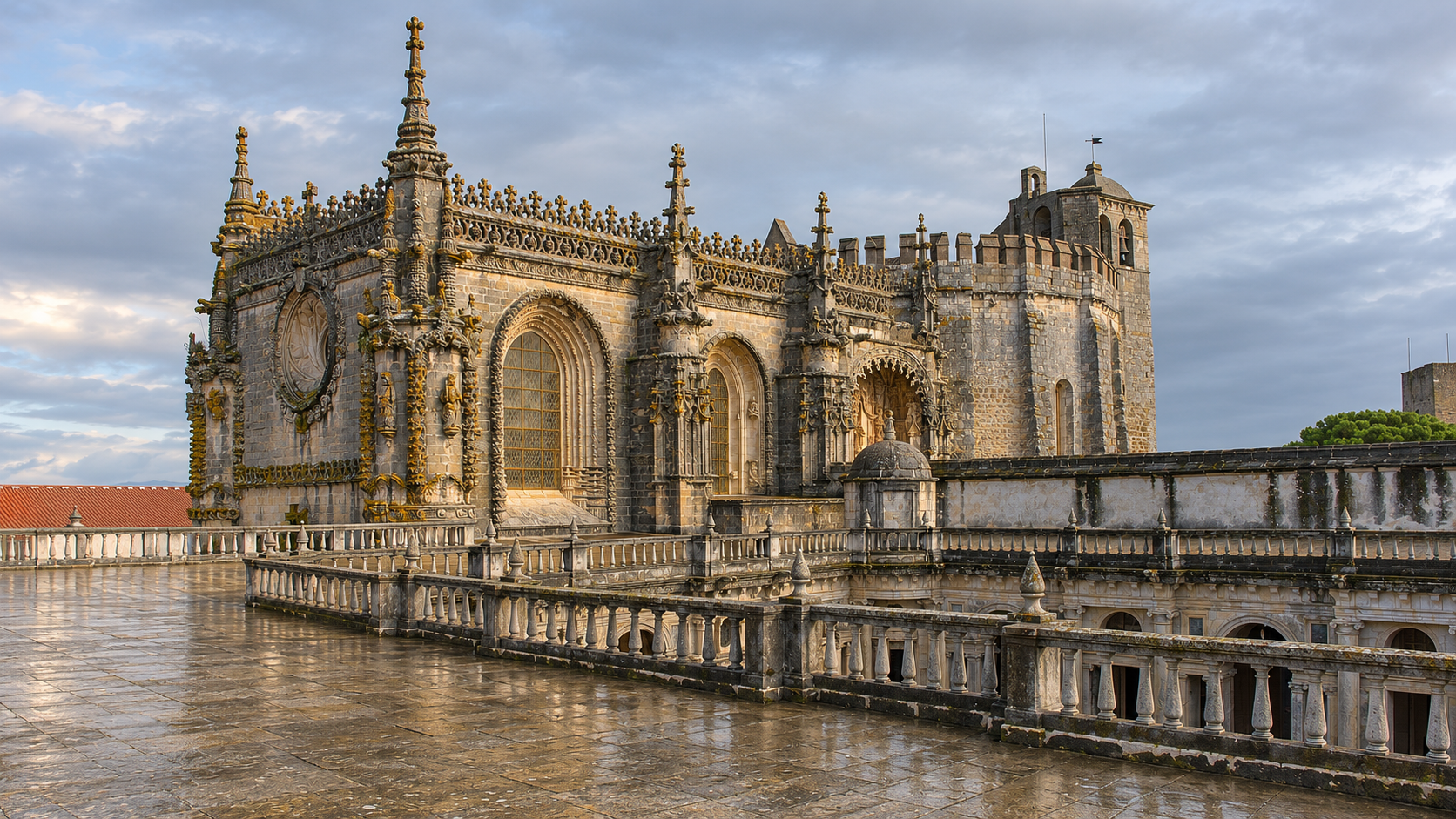
Convent of Christ / Convento de Cristo (Tomar, Portugal)
UNESCO World Heritage Destination COUNTRIES AND TERRITORIES Portugal UNESCO World Heritage
Tomar, Portugal
-
2026

On 1 March 1160, Gualdim Pais, master of the Knights Templar in Portugal, began building a castle at Tomar. An inscription in the keep records the event. The stronghold formed part of a chain of fortifications defending the Tagus frontier and withstood an Almohad attack in 1190. Its walls enclosed both the Templars’ quarters and the homes of Tomar’s early inhabitants. At the western end of the enclosure stands the Charola, the knights’ Romanesque church, dating from the late 12th century. Its plan recalls the rotunda of the Holy Sepulchre in Jerusalem: a passage encircles an octagonal sanctuary within a sixteen-sided outer wall.
The suppression of the Knights Templar in 1312 did not immediately make Tomar the headquarters of their successor. In 1319, at the request of King Dinis, Pope John XXII established the Order of Christ, which received the former Templar estates in Portugal. Its first seat was at Castro Marim in the Algarve; the order moved its headquarters to Tomar in the mid-14th century. Prince Henry the Navigator, its governor from 1420 until his death in 1460, sponsored voyages along the Atlantic coast of Africa. At Tomar, he commissioned residential quarters and two Gothic cloisters, known as the Cemetery Cloister and the Washing Cloister.
Under King Manuel I, builders extended the church westward. João de Castilho opened a broad arch between the new nave and the Charola, turning the former Templar sanctuary into the chancel of the enlarged church. Painted scenes from the life of Christ and gilded wooden figures of saints and prophets transformed its interior. On the west façade, Diogo de Arruda designed the Chapter House Window (Janela do Capítulo) around 1510. Carved ropes and knots frame the opening alongside the cross of the Order of Christ and Manuel’s personal emblem, the armillary sphere.
In the 16th century, King John III imposed a stricter rule of enclosure on the religious community. To accommodate this change, João de Castilho laid out dormitories, a refectory and additional cloisters. The Main Cloister, redesigned by Diogo de Torralva and completed by Filippo Terzi, provided a setting for processions and private prayer. Two storeys of classical columns and arches surround its courtyard. Water reached the central fountain in 1619 through the Pegões Aqueduct, which carried spring water approximately six kilometres to the convent. The complex also served as a setting for royal assemblies: in 1581, the Portuguese Cortes met here and recognised Philip II of Spain as Philip I of Portugal.
Monastic life ended in 1834 with the dissolution of Portugal’s religious orders. In 1838, António Bernardo da Costa Cabral, later Count of Tomar, acquired the convent’s enclosed estate. The state purchased the family’s holdings in 1936; the former convent grounds are now known as the Mata dos Sete Montes. Portugal first classified the convent as a National Monument in 1907 and reaffirmed its protection in 1910. UNESCO inscribed it on the World Heritage List in 1983.
Today, Museus e Monumentos de Portugal manages the convent as a cultural monument. The visitor route brings several periods of Portuguese architecture into view: from the nave, the open arch reveals the original Templar sanctuary, while the Cloister of Santa Bárbara offers a close view of the carved Chapter House Window. The convent recorded 350,813 visits in 2025 and features alongside the monasteries of Batalha and Alcobaça on cultural itineraries through central Portugal. Admission to the convent is ticketed; in 2026, conservation work temporarily restricted access to the Templar castle.
References
Conde, M. S. (1996). O Convento de Cristo em Tomar: História e arquitectura. IPPAR; Scala Publishers; Dias, P. (1992). A arquitectura do Convento de Cristo no século XVI. Universidade de Coimbra; Gomes, I. (2010). Tomar: A cidade templária e o Convento de Cristo. Editorial Estampa; UNESCO World Heritage Centre. (t.y.). Convent of Christ in Tomar. World Heritage List. https://whc.unesco.org/en/list/265/
See Also:
See Also
Map