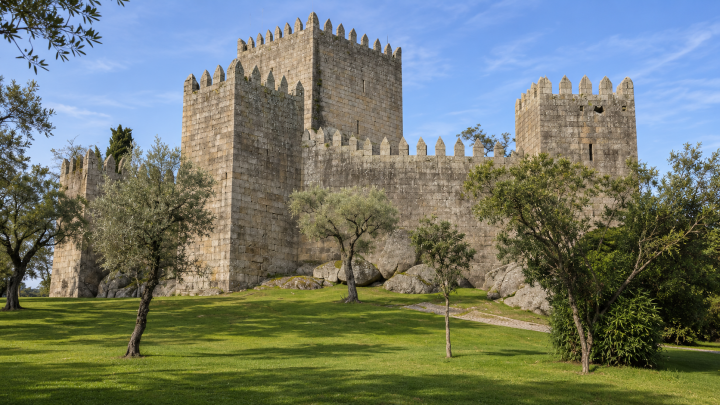
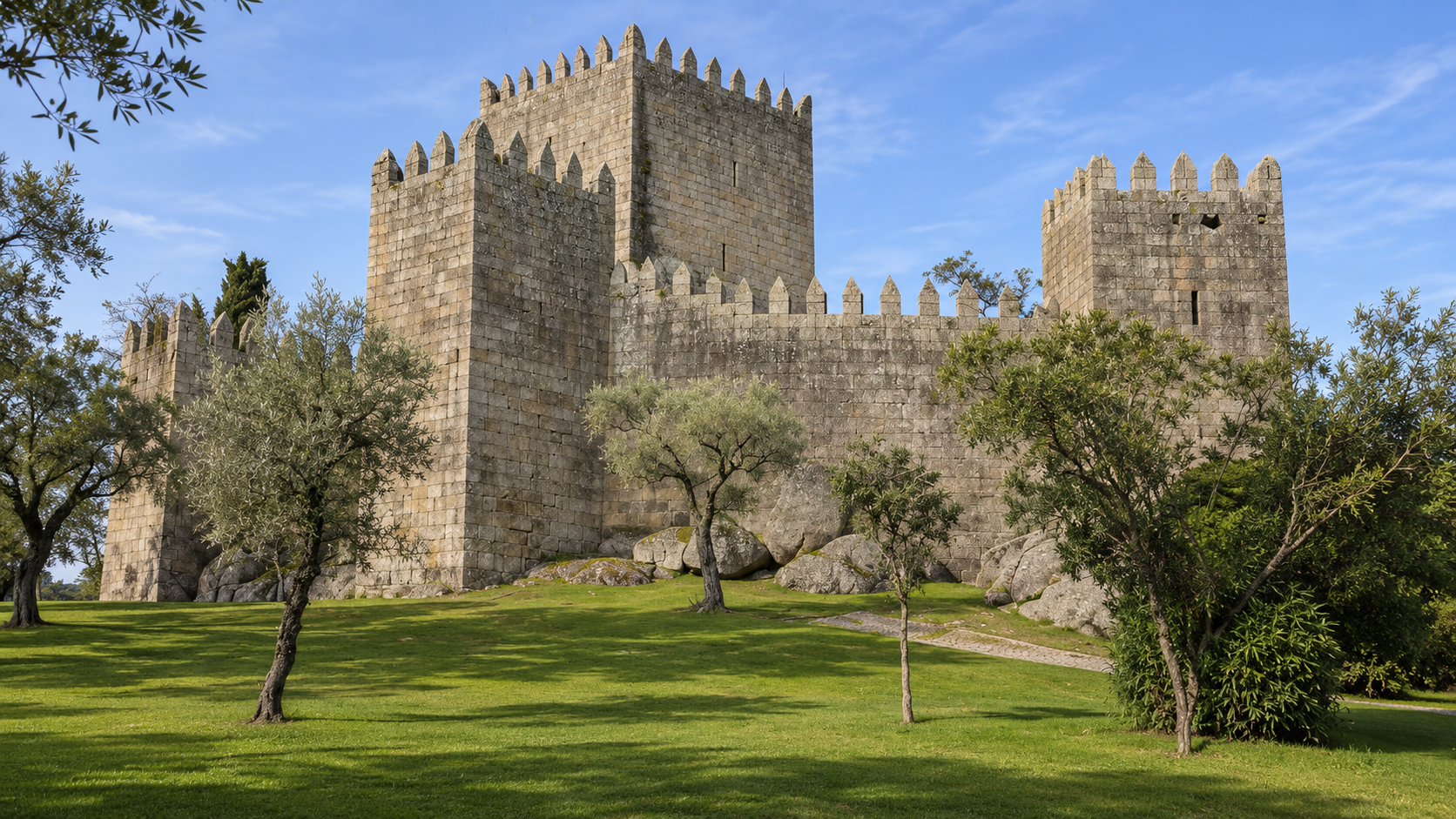
Guimarães Castle / Castelo de Guimarães (Guimarães, Portugal)
Cultural Heritage Destination COUNTRIES AND TERRITORIES Portugal Visitor Attractions, Culture and Heritage
Guimarães, Portugal
-
2026

Guimarães Castle stands on Monte Latito, overlooking the historic city of Guimarães in the district of Braga. Its origins date to the tenth century, when Countess Mumadona Dias established a fortification to protect the nearby Monastery of Santa Maria and the surrounding population. The threat of raids, particularly by Scandinavian forces, provided an important defensive justification, while the castle also asserted the countess’s territorial authority. A document dated 4 December 968 records its transfer to the monastery, demonstrating that the fortification already existed by that date. The surviving structure largely reflects subsequent medieval rebuilding and modern restoration.
During the late eleventh and early twelfth centuries, Count Henry of Burgundy and Countess Teresa established their court at Guimarães and substantially strengthened the castle. Further alterations during the time of their son, Afonso Henriques, extended the fortified enclosure. The castle’s association with Portugal’s first king underlies its enduring national symbolism. Tradition identifies Guimarães as his birthplace, although his birth within the castle cannot be established with certainty. The nearby Battle of São Mamede, fought on 24 June 1128, enabled Afonso Henriques to assume control of the county after defeating forces supporting his mother. This event became central to the city’s identification with the emergence of Portuguese sovereignty.
The castle acquired much of its recognizable defensive form through Gothic building campaigns during the later thirteenth century, associated with the reigns of Afonso III and Denis. These interventions introduced the central keep and the eight towers reinforcing the curtain walls. Further changes occurred under John I, including residential accommodation for the castle’s governor. The monument therefore incorporates successive phases of construction rather than representing a single tenth-century building.
Constructed predominantly from granite, the castle consists of a compact fortified enclosure surrounding an open courtyard and a substantial square keep, or Torre de Menagem. Eight towers strengthen the perimeter, with paired towers protecting the principal entrances. Battlements, narrow openings, and elevated wall walks illustrate its defensive organization. The keep has a raised entrance connected to the surrounding circulation route by a bridge. Remains of the governor’s residence provide evidence of the domestic and administrative activities once accommodated within the enclosure.
Although the castle retained military importance during medieval conflicts, its strategic role diminished as Portugal’s borders moved farther away and artillery changed the requirements of warfare. From the sixteenth century, it served other purposes, including imprisonment and storage. Neglect and the removal of building stone contributed to its deterioration. Renewed nineteenth-century interest in medieval monuments gradually transformed the castle into an object of preservation and national commemoration.
Official recognition of its historical importance dates to 1881, while its National Monument protection is recorded in decrees of 1908 and 1910. A major restoration campaign undertaken by the Direcção-Geral dos Edifícios e Monumentos Nacionais during the late 1930s substantially shaped its present appearance. Directed by architect Rogério de Azevedo, the restored castle was inaugurated on 4 June 1940 during the commemorations of Portugal’s foundation. These interventions reflected the Estado Novo regime’s use of medieval heritage in constructing a narrative of national identity.
The castle belongs to the historic urban ensemble recognized through the UNESCO inscription of the Historic Centre of Guimarães in 2001. Following the extension approved in 2023, the property is officially named the Historic Centre of Guimarães and Couros Zone. This designation concerns the wider urban ensemble; the castle does not hold a separate World Heritage inscription.
Today, the castle functions as a protected monument and educational visitor attraction, closely connected with the nearby Church of São Miguel do Castelo and the Palace of the Dukes of Braganza. Admission and access depend on the areas available during conservation work. As of November 2026, the keep remains closed to visitors, while the courtyard and reopened wall walk form part of the visitor route. Its tourism significance rests on both its medieval architecture and its role in interpreting the formation, commemoration, and public understanding of Portuguese national identity.
References
Barroca, M. J. (2000). O Castelo de Guimarães: Do mito à história. Câmara Municipal de Guimarães; Fontes, L. (2012). Guimarães medieval: O castelo e o território. Edições Afrontamento; Real, M. L. (1996). O Castelo de Guimarães e a arquitectura militar românica. IPPAR; UNESCO World Heritage Centre. (n.d.). Historic Centre of Guimarães and Couros Zone. https://whc.unesco.org/en/list/1031
See Also
Map