Historic City of Braga / Cidade Histórica de Braga (Braga District, Minho, Portugal)
Cultural Heritage Destination COUNTRIES AND TERRITORIES Portugal Visitor Attractions, Culture and Heritage
Braga District, Minho, Portugal
-
2026

Braga is a regional centre in the historical province of Minho whose urban heritage reflects more than two millennia of development. The Roman settlement of Bracara Augusta was founded around 16–15 BCE during the reign of Augustus. Initially an administrative centre serving the surrounding territory, it developed an organized street network, public buildings, residential quarters, and connections to major Roman roads. Its elevation to the capital of Gallaecia occurred considerably later, during the administrative reforms associated with Diocletian in the late third and early fourth centuries CE. In the fifth century, Braga became the capital of the Suebic kingdom.
An episcopal presence is documented by the participation of Bishop Paternus in the Council of Toledo in 400. Political upheavals subsequently affected the city and its ecclesiastical institutions, including a period when its bishops resided in Lugo. The restoration of the episcopal seat in the eleventh century accompanied the development of a medieval urban centre around the cathedral. Consecrated in 1089, before the establishment of the Portuguese kingdom, Braga Cathedral preserves Romanesque elements alongside later architectural and decorative interventions. Its Baroque upper choir and monumental organs are particularly significant. The cathedral has been classified as a National Monument since 1910.
Roman heritage remains visible through archaeological sites and museum collections. The public baths at Alto da Cividade were constructed in the early second century CE and subsequently underwent several alterations. Excavated from 1977 onward, the remains were conserved and opened to visitors in 2004 through cooperation between the municipality, the University of Minho, and the D. Diogo de Sousa Archaeological Museum. The museum, established in 1918 and housed in a purpose-built building opened in 2007, displays material ranging from prehistory to the Middle Ages. Roman milestones, ceramics, glass, funerary objects, and architectural remains illustrate the city’s connections with its wider territory.
Archiepiscopal patronage strongly influenced Braga’s later urban form. Diogo de Sousa, archbishop from 1505 to 1532, promoted improvements to religious buildings, civic facilities, and urban circulation. During the eighteenth century, further rebuilding gave the city a substantial Baroque and Rococo architectural legacy. André Soares contributed to this transformation through works including the Palácio do Raio and the Congregados church. The former, also known as Casa do Raio, combines elaborate granite carving with a richly articulated façade. Restored in 2015, it now accommodates the interpretation centre of the Santa Casa da Misericórdia de Braga. Carlos Amarante’s work at the Church and former Hospital of São Marcos represents another important contribution to the city’s architectural development.
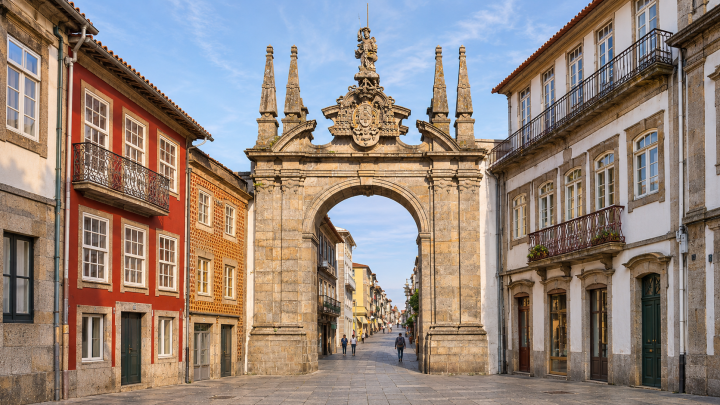
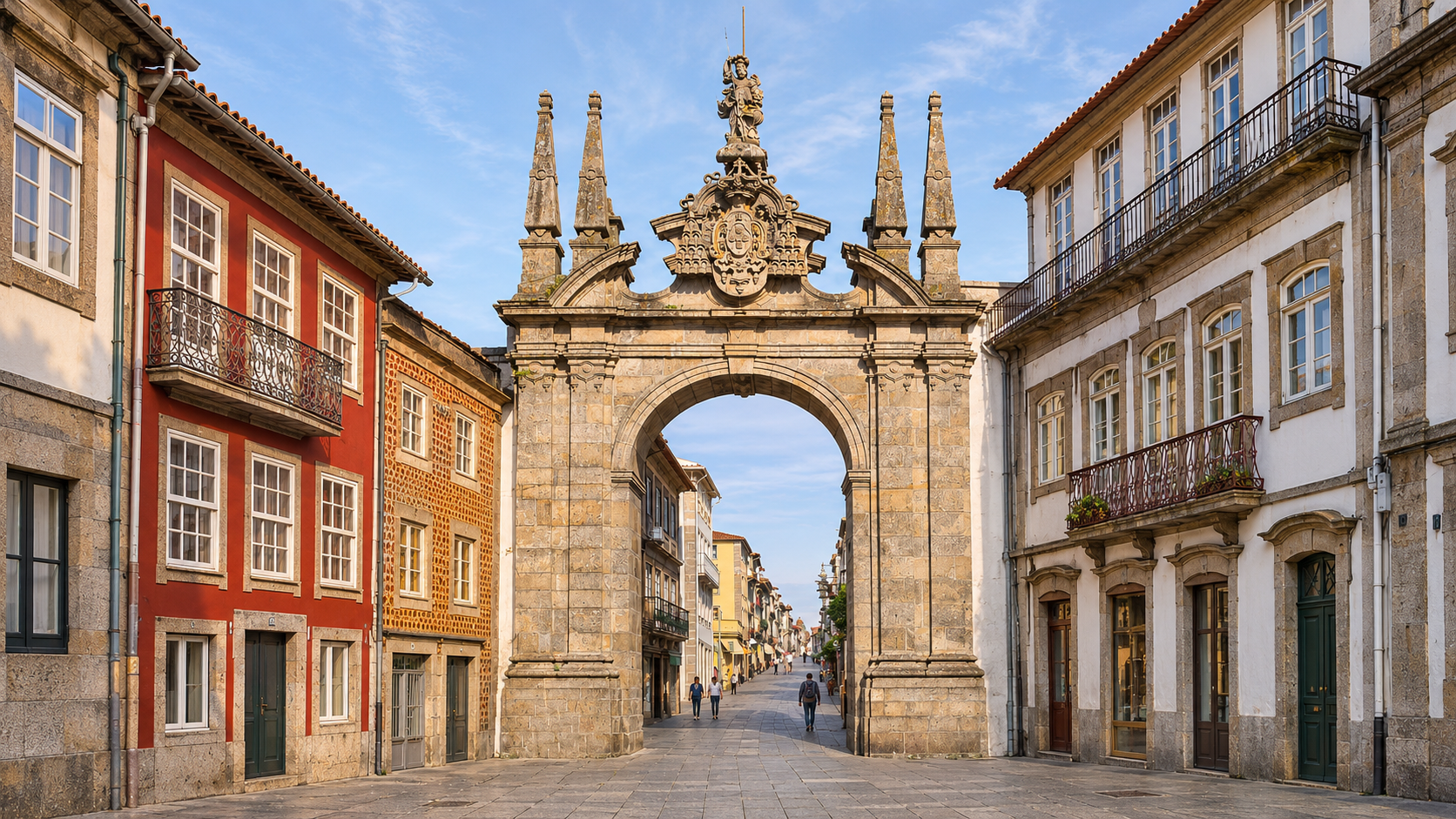
The former Archbishop’s Palace records successive phases of ecclesiastical residence and administration. Its medieval wing forms a backdrop to the Jardim de Santa Bárbara, a formal public garden created between 1951 and 1953. Geometric flowerbeds, architectural fragments, and a fountain transferred from the former Convent of Remédios contribute to its historical setting. Nearby, the Arco da Porta Nova marks an entrance to the historic centre. Its present form dates to 1772 and combines late Baroque ornament with emerging Neoclassical characteristics. Although frequently attributed to André Soares, its authorship has also been associated with Carlos Amarante. The arch became a National Monument in 1910.
The surrounding hills extend Braga’s religious landscape beyond the central streets. Bom Jesus do Monte integrates devotional chapels, monumental stairways, fountains, woodland, and a Neoclassical church within a sacred landscape. UNESCO inscribed this sanctuary on the World Heritage List in 2019; the designation applies to the sanctuary and its enclosure, rather than to Braga’s entire historic centre. The nearby Sanctuary of Our Lady of Sameiro developed from a Marian monument initiated in 1863 and constitutes another important pilgrimage destination within the municipality.
Religious observances remain an active component of urban life and tourism. Holy Week brings processions through the historic streets, including the Ecce Homo procession, distinguished by its hooded farricocos, and the solemn procession commemorating Christ’s burial. These events connect churches, confraternities, residents, and visitors through shared ceremonial spaces. The Braga Romana festival offers a different form of heritage interpretation through performances, historical recreation, and activities inspired by Bracara Augusta.
Contemporary Braga combines these historical functions with university education, commerce, and cultural activity. The University of Minho, founded in 1973, maintains its Gualtar campus in the city. Visitors can explore public streets, squares, and gardens independently, while museums and monuments operate separate admission arrangements. Cathedral visits include routes through the treasury, chapels, upper choir, and main church, with tourist access restricted during worship. This coexistence of religious practice, archaeological interpretation, architectural heritage, and everyday urban activity shapes Braga’s role in tourism in northern Portugal.
References
Bandeira, J. M. (2000). Braga: História, arte e património. Câmara Municipal de Braga; Capela, J. V. (2003). Braga nos séculos XVII e XVIII: A cidade e o território. Universidade do Minho; Marques, J. (1998). A Arquidiocese de Braga na Idade Média. Edições do Arquivo Distrital de Braga; Real, M. L. (1990). Bracara Augusta: A cidade romana e o seu território. IPPAR.
See Also
Map