Historic Centre and Canals of Aveiro / Centro Histórico e Canais de Aveiro (Aveiro, Portugal)
COUNTRIES AND TERRITORIES Portugal Visitor Attractions, Culture and Heritage
Aveiro, Portugal
-
2026

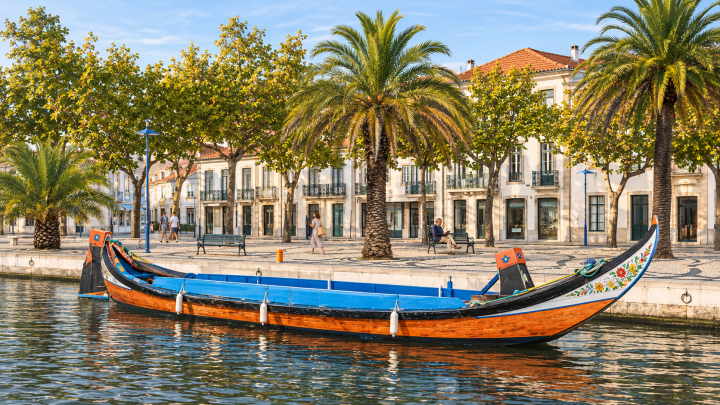
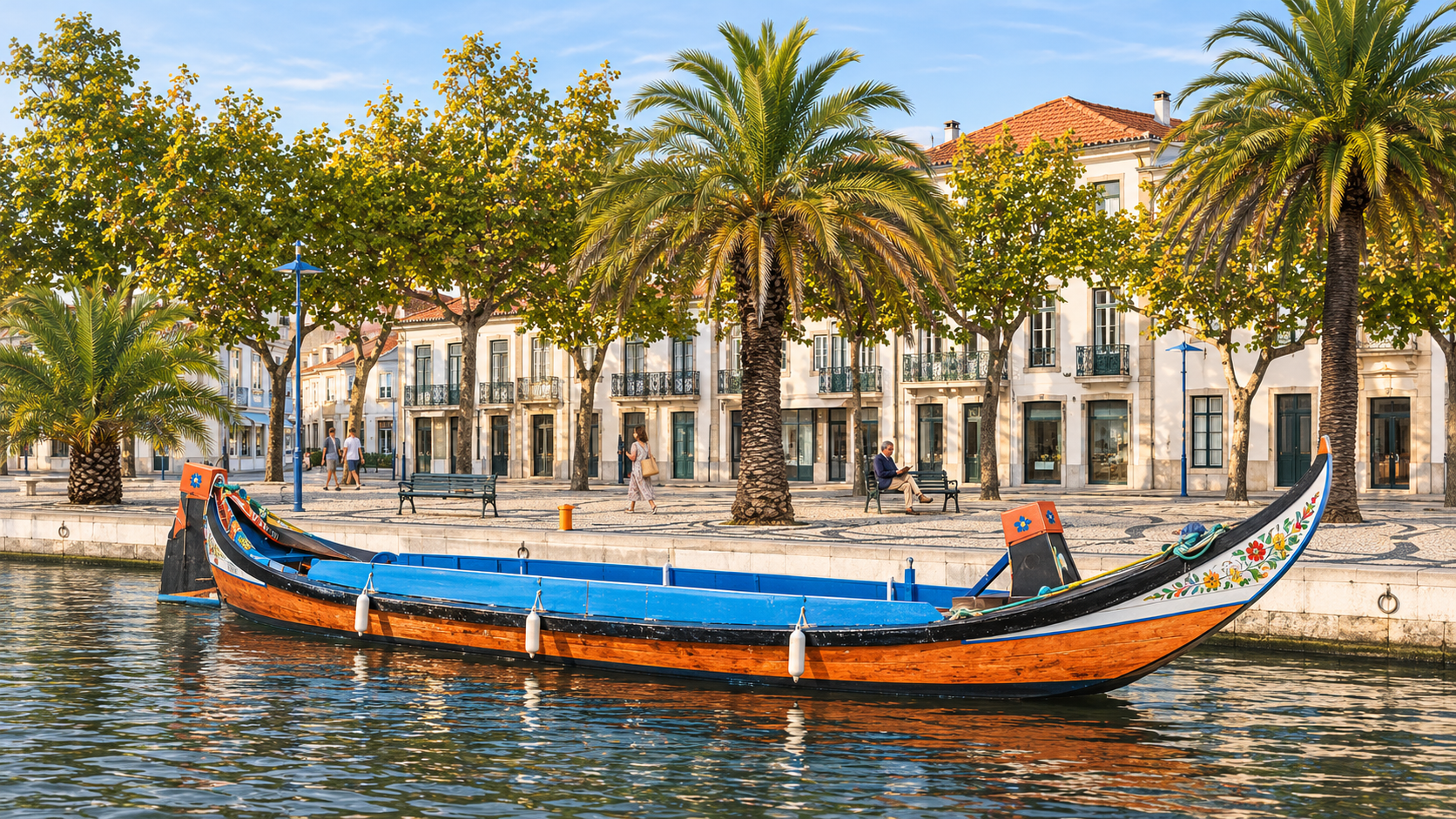
Aveiro’s historic centre developed beside the Ria de Aveiro, a coastal lagoon whose waterways supported fishing, salt production, transport, and commerce. Its urban landscape combines residential neighborhoods, religious monuments, commercial buildings, and canals connected to the wider lagoon. The principal waterways include the Canal Central, Canal do Cojo, Canal de São Roque, and Canal das Pirâmides. Along São Roque, the Beira-Mar neighborhood preserves traces of the communities and storage facilities associated with fishing and the salt trade.
The earliest documented reference to Aveiro appears in the testament of Countess Mumadona Dias, dated 26 January 959, which mentions land and salt pans at Alauario. This establishes a documentary reference rather than a foundation date. The settlement acquired town status during the thirteenth century, and King John I supported its reconstruction and fortification following a fire in 1418. King Manuel I granted a municipal charter in 1515, while King José I elevated Aveiro to city status in 1759.
Aveiro’s prosperity depended heavily on access to the Atlantic. Progressive silting of the lagoon entrance contributed to economic difficulties during the seventeenth and eighteenth centuries. The artificial opening of a new inlet on 3 April 1808, associated with engineers Reinaldo Oudinot and Luís Gomes de Carvalho, restored maritime access and supported gradual economic recovery. Improved transport connections, including the railway station inaugurated in 1864, subsequently strengthened the city’s commercial development.
Art Nouveau became particularly prominent between approximately 1904 and 1920. Merchants, industrial interests, and prosperous emigrants returning from Brazil helped introduce decorative façades expressing wealth and modernity. Francisco Augusto da Silva Rocha was a central figure in this development. Local buildings combine floral and animal motifs, curved stonework, wrought iron, and decorative ceramic tiles, frequently applied to otherwise conventional architectural layouts. The former Casa Major Pessoa, constructed between 1907 and 1909, now houses the Museu Arte Nova. Its design is attributed to Silva Rocha, with possible participation by Ernesto Korrodi. Classified as a Property of Public Interest, the building provides an introduction to the city’s architectural itinerary. The museum participates in the Réseau Art Nouveau Network and its Council of Europe Cultural Route.
The religious heritage includes the former Convent of Jesus, founded in 1458 and now occupied by the Museu de Aveiro / Santa Joana. Princess Joana, daughter of King Afonso V, entered the convent in 1472 and remained there until her death in 1490. Its surviving spaces include a cloister, a church richly decorated with gilded woodcarving and tiles, and the princess’s multicolored marble tomb, designed by João Antunes. The monastery, including the tomb, was classified as a National Monument in 1910. The late eighteenth-century town hall provides another architectural landmark, with a symmetrical façade and central clock tower characteristic of late Pombaline design.
The moliceiro boat connects the canals with the lagoon’s working traditions. These wooden vessels originally collected aquatic vegetation known as moliço and are now used primarily for sightseeing. Their distinctive decoration includes four painted panels, often combining images with humorous or socially meaningful captions. Construction relies on inherited carpentry knowledge, pine timber, and traditional measuring techniques. In 2025, “Moliceiro boat: naval carpentry art of the Aveiro region” was inscribed on UNESCO’s List of Intangible Cultural Heritage in Need of Urgent Safeguarding. This recognition concerns the boatbuilding tradition rather than a World Heritage designation for the historic centre.
Salt production remains represented by the Ecomuseu da Marinha da Troncalhada, an operational salt pan incorporated into the municipal museum network. It preserves traditional production methods and interprets the knowledge of the marnotos, or salt workers. The site also supports lagoon vegetation and birdlife, linking industrial heritage with environmental interpretation. Its outdoor setting permits independent visits supported by explanatory panels, while guided activities provide further information about salt production and local history.
Today, walking routes, museum visits, canal excursions, and lagoon activities connect Aveiro’s architectural and maritime heritage. Public streets and waterfronts remain part of everyday urban life, while museums and commercial boat excursions have separate admission arrangements. Gastronomic tourism centres particularly on Ovos Moles de Aveiro, an egg-yolk-and-sugar confection with Protected Geographical Indication status. Regional itineraries also extend to Costa Nova, whose striped palheiros are located in the neighboring municipality of Ílhavo.
References
Gaspar, J. (1998). Aveiro: A cidade e a laguna. Centro de Estudos Geográficos; Neves, A. (2008). Arte nova em Aveiro. Câmara Municipal de Aveiro; Réseau Art Nouveau Network. (2015). Art Nouveau European Route: Aveiro city guide; Silva, R. H. (2002). O Convento de Jesus de Aveiro: História e arte. IPPAR.
See Also
Map