Sanctuary of Bom Jesus do Monte / Santuário do Bom Jesus do Monte (Braga, Portugal)
Cultural Heritage Destination COUNTRIES AND TERRITORIES Portugal Visitor Attractions, Culture and Heritage
Braga, Portugal
-
2026

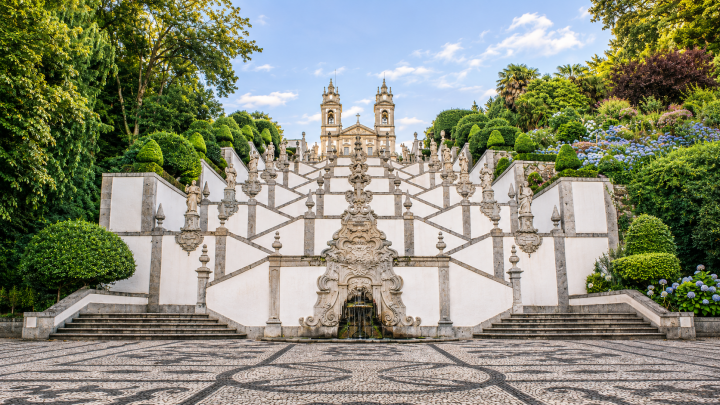
The Sanctuary of Bom Jesus do Monte occupies the western slopes of Mount Espinho, east of Braga in northern Portugal. Its approximately 26-hectare enclosure combines religious buildings, stairways, fountains, gardens, and woodland. The ensemble belongs to the European tradition of sacri monti, or sacred mountains, which developed particularly during the Counter-Reformation. Through architecture, sculpture, and the physical experience of ascent, the sanctuary evokes Christian Jerusalem and invites pilgrims to contemplate the Passion of Christ.
Religious activity on the hillside predates the monumental complex. A document of 1373 mentions a chapel dedicated to the Holy Cross and refers to an earlier pilgrimage tradition. Successive chapels were rebuilt or enlarged, and the Confraternity of Bom Jesus do Monte was established in 1629. Archbishop Rodrigo de Moura Teles initiated an extensive redevelopment in the early 1720s, commissioning a church, chapels, and stairways. The entrance portico bears an inscription dated 1723 that presents the undertaking as the restoration and rebuilding of Jerusalem.
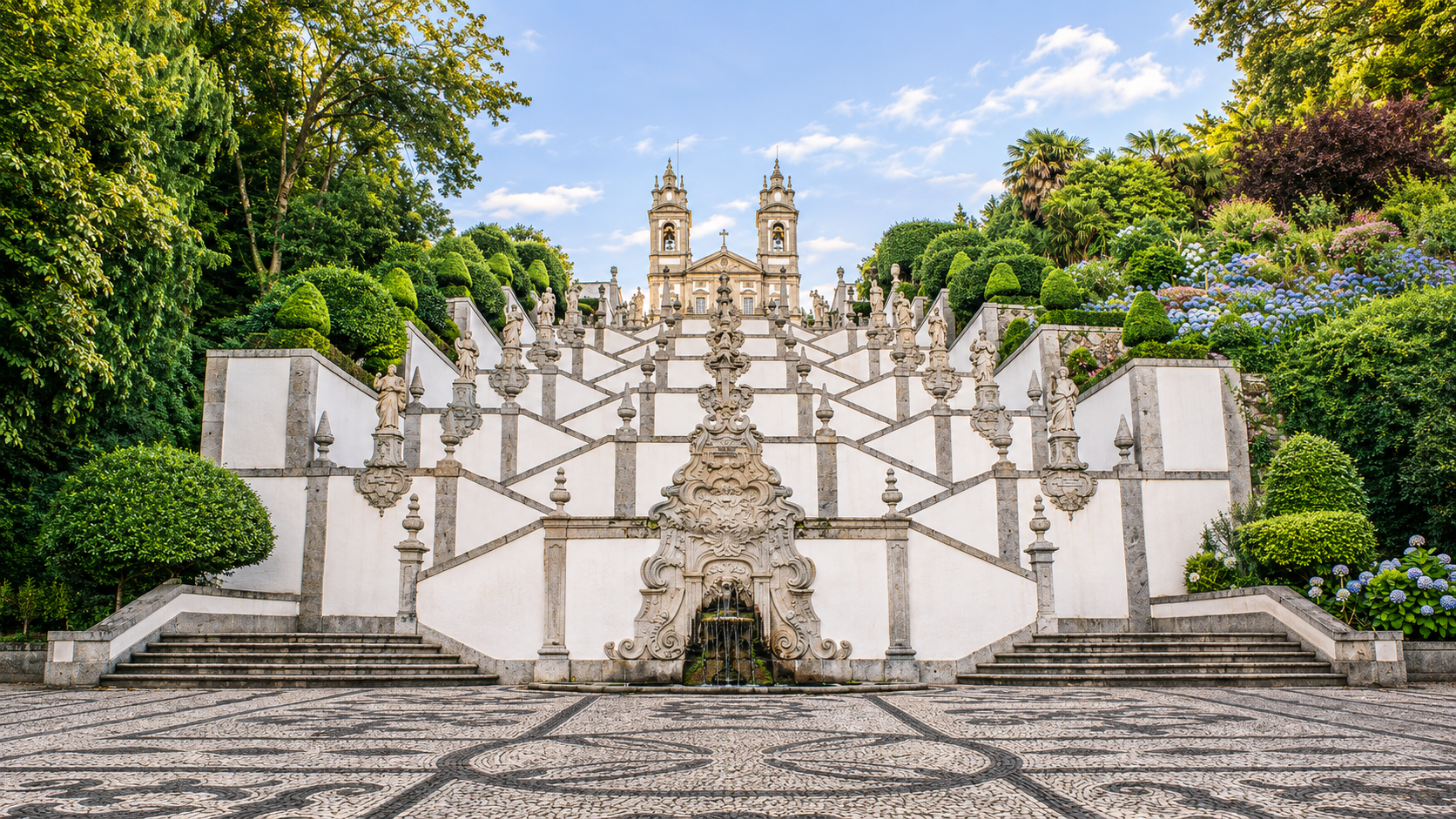
The ascent is organized into three principal sections: the Stairway of the Portico, the Stairway of the Five Senses, and the Stairway of the Three Virtues. From the portico to the Pelican landing, below the church forecourt, the route rises approximately 116 metres through more than 500 granite steps. The lower section incorporates chapels depicting episodes of Christ’s Passion. Above it, symmetrical flights converge at landings ornamented with fountains representing sight, hearing, smell, taste, and touch. White rendered walls contrast with exposed granite steps, balustrades, and sculpture. The upper Stairway of the Virtues, dated 1837, continues the devotional programme through representations of Faith, Hope, and Charity.
The present church was designed by Carlos Amarante under the patronage of Archbishop Gaspar de Bragança. Its foundation stone was laid on 1 June 1784, and construction continued until 1811. The building replaced an earlier eighteenth-century church that had become inadequate for the growing number of pilgrims. Its Latin-cross plan, twin towers, and façade articulated with classical columns distinguish it from the predominantly Baroque stairways. The interior contains paintings by Pedro Alexandrino and a sculptural representation of Calvary at the high altar. The church received the title of minor basilica in 2015.
The religious narrative extends beyond the church to scenes associated with the risen Christ, culminating in the Courtyard of the Evangelists. The surrounding landscape also developed as a place of recreation. A plan for the park and lake was initiated in 1877, incorporating paths, planted trees, ornamental vegetation, and places for rest. The lake was enlarged in 1908. Woodland, grottoes, rustic bridges, viewpoints, and formal gardens integrate the devotional route with a Romantic landscape.
The funicular opened on 25 March 1882 following an initiative by the Braga businessman Manuel Joaquim Gomes. Designed by the Swiss engineer Nikolaus Riggenbach, with construction supervised locally by Raul Mesnier du Ponsard, it was the first funicular in the Iberian Peninsula. Its two cable-linked cars operate through a water-counterbalance system. The Confraternity identifies it as the world’s oldest operating funicular retaining this method of propulsion. Running beside the stairways, it provides an alternative ascent and constitutes an attraction associated with nineteenth-century transport engineering.
The sanctuary’s church, stairways, chapels, and portico were classified as a Property of Public Interest in 1970. In 2019, the ensemble was inscribed on the UNESCO World Heritage List as the “Sanctuary of Bom Jesus do Monte in Braga,” under criterion (iv). Portuguese legislation accords the inscribed property protection equivalent to that of a National Monument. Conservation programmes undertaken by the Confraternity have addressed chapel sculptures, masonry, rendered surfaces, stairways, and the basilica’s interior, including campaigns in 2014–2015 and 2017–2019.
The Confraternity remains responsible for the property and its religious activities. The sanctuary accommodates worship, pilgrimage, architectural sightseeing, and recreation within the same landscape. Visitors can approach by the stairways, road, or funicular. The basilica maintains daily opening hours and regular services, while separate charges apply to the funicular and access to the upper choir and bell tower. These combined religious, artistic, landscape, and engineering attractions contribute to Braga’s cultural and religious tourism.
References
Bandeira, J. M. (2014). O Bom Jesus do Monte em Braga: História, arquitetura e paisagem. Confraria do Bom Jesus do Monte; Ferreira, J. A. (2007). O Santuário do Bom Jesus do Monte: Guia histórico e artístico. Edições Almedina; Smith, R. C. (1973). The art and architecture of the Sacro Monte of Bom Jesus do Monte. Fundação Calouste Gulbenkian; UNESCO World Heritage Centre. (n.d.). Sanctuary of Bom Jesus do Monte in Braga. https://whc.unesco.org/en/list/1590
See Also
Map