Fado de Coimbra (Coimbra, Portugal)
Heritage Tourism COUNTRIES AND TERRITORIES Portugal Culture and Heritage Visitor Attractions, Culture and Heritage
Coimbra, Portugal
-
2026

Fado de Coimbra, also known as Canção de Coimbra, developed through interaction between the university community and the city’s musical traditions. Documented from the mid-nineteenth century, its repertoire became increasingly distinct from Lisbon fado around the transition to the twentieth century. Its origins encompass several influences, including local popular music, student serenading, literary poetry, and circulating urban songs. The tradition has developed through successive generations of performers rather than through a single founding event or formal act of codification.
Augusto Hilário helped popularize the tradition during the late nineteenth century, becoming closely associated with Coimbra’s serenades and the composition known as “Fado Hilário.” António Menano and Edmundo de Bettencourt subsequently contributed to its vocal repertoire and wider recognition. Artur Paredes transformed the sound and expressive possibilities of the Coimbra guitar through innovations in performance and collaboration with instrument makers. His son Carlos Paredes further developed the instrument’s concert repertoire, achieving recognition beyond the setting of student song.
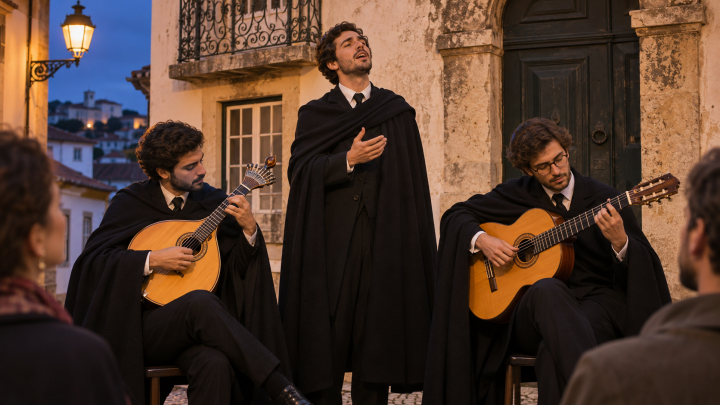
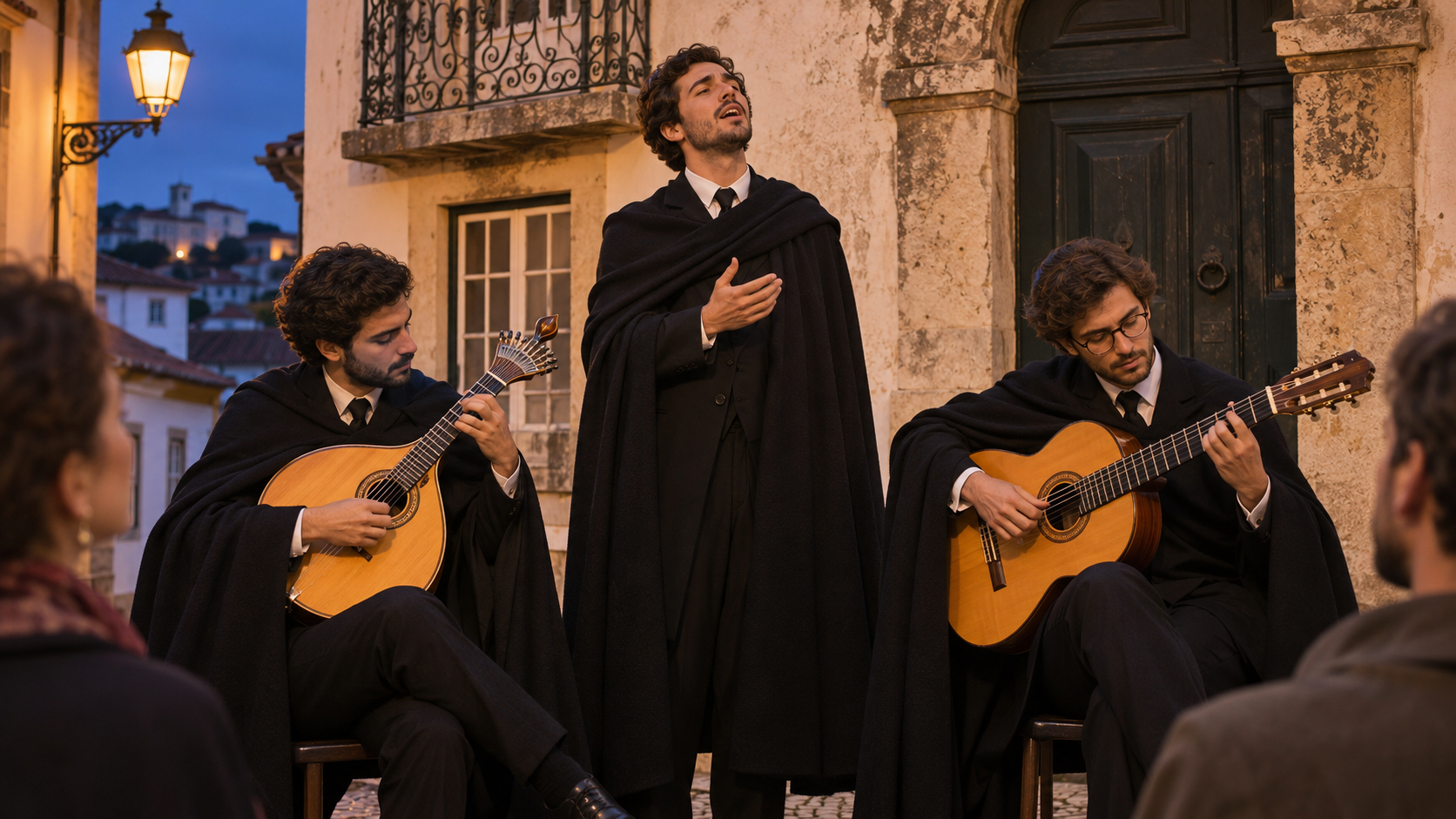
The characteristic ensemble combines a singing voice with the Coimbra model of the Portuguese guitar and a classical guitar, commonly called the viola in this context. The Portuguese guitar has twelve metal strings arranged in six pairs. Its Coimbra tuning is conventionally one whole tone below the Lisbon tuning, producing a lower register. Instrumental introductions, interludes, and independent guitar compositions are important elements of the repertoire. Vocal performance generally places greater emphasis on melodic phrasing and less on ornamentation than is customary in Lisbon fado.
Performance is closely associated with black academic dress, particularly the capa e batina, and with students and former students. Men have historically predominated in the academic serenade tradition, but contemporary practice also includes women singers. Municipal and university cultural programs have explicitly presented female interpretations and encouraged discussion of participation and tradition. The Serenata Monumental, performed at the Old Cathedral during the Queima das Fitas celebrations, remains a prominent academic setting. Audience conventions vary: traditional serenades emphasize silence and generally exclude applause, while public concerts may welcome it. A
During the mid-twentieth century, musicians associated with Coimbra helped develop Portuguese political song. José Afonso and Adriano Correia de Oliveira expanded their work into ballads and songs addressing social conditions and resistance to the Estado Novo dictatorship. “Trova do Vento que Passa,” recorded by Adriano in 1963, with words by Manuel Alegre and music by António Portugal, became closely associated with student opposition. These developments connected Coimbra’s musical culture with the broader canção de intervenção, or politically engaged song movement, while traditional serenade repertoires continued to be performed.
Transmission depends on personal contact between generations, rehearsal, recordings, and organized teaching. The Secção de Fado of the Associação Académica de Coimbra traces its origins to an initiative begun in 1979 and maintains performing groups and a music school open to the wider community. Documentation also supports continuity: the municipality’s Arquivo Sonoro do Fado e da Canção de Coimbra, presented in 2024, records contemporary performers, new compositions, and discussions about the tradition’s changing boundaries.
Its heritage recognition requires a distinction between different UNESCO designations. The University of Coimbra–Alta and Sofia entered the World Heritage List in 2013 as an urban and architectural ensemble with associated academic traditions. This is not a separate intangible-heritage inscription for Coimbra song. UNESCO’s 2011 inscription, Fado, urban popular song of Portugal, and its corresponding Portuguese national inventory record describe a tradition centered on Lisbon’s communities.
Visitors encounter Coimbra’s music through academic ceremonies, cultural festivals, and regular concerts at venues such as Fado ao Centro. The Núcleo da Guitarra e do Fado de Coimbra, opened in the Torre de Anto on 4 July 2015, presents instruments, documents, recordings, and material associated with important performers. These settings connect musical performance with the city’s literary, academic, and urban history, giving the tradition an active role in Coimbra’s cultural tourism.
References
Castelo-Branco, S. E. (Ed.). (2010). Enciclopédia da música em Portugal no século XX. Círculo de Leitores; Côrte-Real, M. J. (2001). Sons de Abril: Música, política e identidade no Portugal contemporâneo. Instituto de Etnomusicologia – Centro de Estudos em Música e Dança; Nery, R. V. (2012). A history of fado. Imprensa Nacional-Casa da Moeda; Nunes, A. M. (2003). A canção de Coimbra: Temas e protagonistas. Gráfica de Coimbra; Osório, A. (1993). O fado de Coimbra. Edições Século XXI; UNESCO World Heritage Centre. (n.d.). University of Coimbra – Alta and Sofia. https://whc.unesco.org/en/list/1387; Universidade de Coimbra. (2018). Academic traditions and intangible heritage of Coimbra. Imprensa da Universidade de Coimbra.
See Also
Map