Historic City of Viseu / Cidade Histórica de Viseu (Viseu District, Portugal)
Cultural Heritage Destination COUNTRIES AND TERRITORIES Portugal Visitor Attractions, Culture and Heritage
Viseu District, Portugal
-
2026

Viseu, the capital of Viseu District in the historic province of Beira Alta, grew around a hill already occupied during the Iron Age. Under Emperor Augustus, a Roman town developed on the site as the administrative center of a civitas, or territory, in the province of Lusitania. An altar inscription discovered near the cathedral in 2009 provides evidence for the town’s ancient name, Vissaium. Several roads converged here, including the route from Mérida to Braga. The Roman forum occupied the hilltop where the cathedral and the Grão Vasco National Museum now stand. Excavated sections of a later defensive wall, including one on Rua Formosa, date from the second half of the fourth century CE.
By the late sixth century, Viseu was a bishopric in the Suebi kingdom. The region came under Visigothic rule in 585 and later changed hands between Muslim and Christian rulers before Ferdinand I of León took the city in 1058. In May 1123, Teresa, Countess of Portugal and mother of Afonso Henriques, granted Viseu its first municipal charter (foral), setting out the rights and obligations of its inhabitants. King Manuel I renewed the charter in 1513.
North of the historic center, the Cava de Viriato is an octagonal enclosure formed by earthen banks and an outer ditch. Its perimeter extends for approximately two kilometers. The name refers to Viriathus, the Lusitanian leader who resisted Roman expansion, but the association arose in the seventeenth century and does not establish who built the earthworks. An older interpretation identified the site as a Roman military camp. Archaeologists have also proposed an Islamic fortified settlement or a tenth-century project associated with Ramiro II of León. The date and original purpose remain uncertain.
The streets of the old town preserve traces of both Roman planning and medieval trade. Rua Direita follows much of the Roman town’s principal north–south axis. In the Middle Ages it was known as Rua das Tendas, or Street of Shops, and it remains a commercial street today. Sixteenth-century houses on Rua Direita and nearby Rua Escura retain carved gargoyles and Gothic windows. After Castilian attacks in the late fourteenth century, work on a new defensive circuit began under João I and continued under Afonso V. An inscription dated 1472 commemorates Afonso V’s role at the Porta do Soar, one of two surviving gates from the original seven. The other is the Porta dos Cavaleiros.
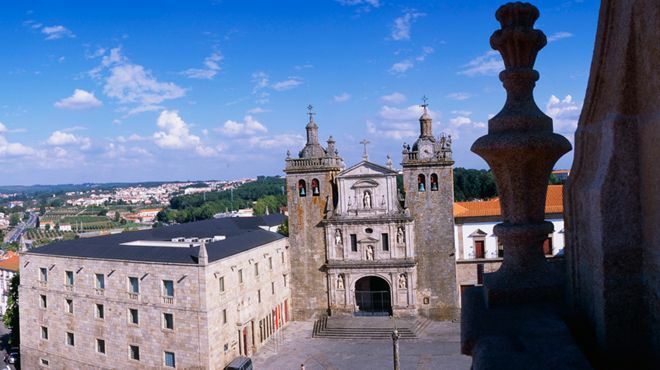
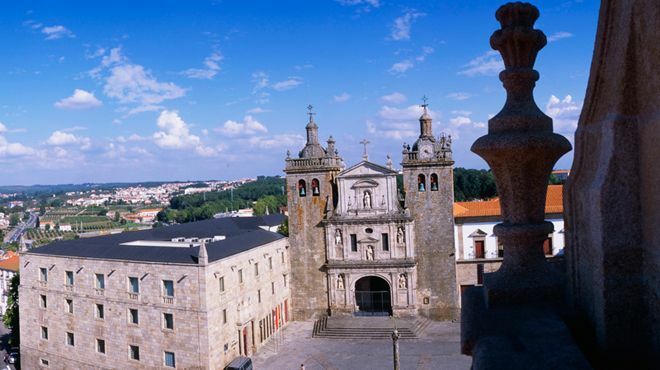
At the top of the hill, the Adro da Sé brings together the cathedral, the Paço dos Três Escalões, and the Church of the Misericórdia. The cathedral’s medieval fabric took shape in successive campaigns beginning in the twelfth century. Gothic rebuilding began in the second half of the thirteenth century, and the new east end was consecrated in 1314. Inside, the stone ribs of the Manueline vaults cross in the form of knotted ropes. The vaults were completed in 1513 under Bishop Diogo Ortiz de Vilhegas. His successor in the patronage of Renaissance art and architecture, Bishop Miguel da Silva, commissioned the cloister built between 1528 and 1534 to a design by the Italian architect Francesco da Cremona. After a storm brought down the cathedral’s Manueline façade in 1635, João Moreno of Salamanca designed its Mannerist replacement. Across the square, the eighteenth-century Misericórdia church has a Rococo façade with twin bell towers and a balcony above the entrance.
The Grão Vasco National Museum preserves the connection between the cathedral and the painters who worked for it. Its namesake, Vasco Fernandes, known as Grão Vasco, painted the Saint Peter altarpiece for a chapel in the cathedral. Commissioned by Bishop Miguel da Silva, the painting depicts the apostle enthroned as pope and is now displayed in the museum. Founded by decree on 16 March 1916, the museum initially occupied rooms in the cathedral. In 1938 its collections moved into the adjoining Paço dos Três Escalões. An inscription records that construction of this granite building began in 1593 as a seminary on the site of an earlier episcopal residence. Between 2001 and 2003, architect Eduardo Souto de Moura adapted its interior for museum use.
Heritage protection in Viseu covers both individual monuments and the surrounding neighborhoods. The cathedral, the Cava de Viriato, and the surviving city walls and gates are classified as National Monuments. The Church of the Misericórdia, including its churchyard and steps, received the distinct designation of Monument of Public Interest in 2015. The municipality’s urban rehabilitation area includes the historic center, the riverside quarter, and the area around the Cava. At the cathedral, conservation work completed in 2026 included the restoration of the carved stalls in the upper choir. The cathedral remains a place of worship; its Treasury Museum interprets the building’s liturgical life through vestments, reliquaries, silverwork, and the choir and chapter house themselves.
Two regional traditions continue to draw visitors beyond the cathedral square. The annual Feira de São Mateus traces its origin to a fair charter issued by João I on 10 January 1392. The fair occupied several sites before settling at the Campo de São Mateus in the sixteenth century. Viseu is also a starting point for the Dão Wine Route. At the former episcopal estate of Fontelo, the Solar do Vinho do Dão houses the regional wine commission and a visitor center where travelers can taste local wines and arrange visits to producers.
References
Alves, A. (2001). Viseu: História, arte e património. Câmara Municipal de Viseu; Correia, A. (1989). O monumento da Cava de Viriato: Estudo arqueológico. Instituto de Beira Alta; Rodrigues, D. (2004). Grão Vasco e a pintura do Renascimento em Viseu. Museu Nacional de Arte Antiga / IPPAR; Vaz, J. L. (1997). A cidade de Viseu na época medieval. Edições Almedina.
See Also
Map